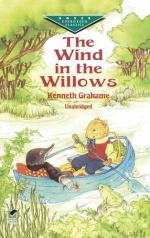
For more than eighty years, Kenneth Grahame's works have been among the most widely read of English children's writers. In his 1959 biography of Grahame, Peter Green reports that The Wind in the Willows (1908) had gone into more than one hundred editions...
By the late 1890s Kenneth Grahame had established his reputation in England and in the United States as an essayist. In 1898, at the age of thirty-nine, he further distinguished himself by becoming the youngest person to be commissioned secretary of the...
Although it has often been pointed out that The Wind in the Willows (1908), Kenneth Grahame's most enduring work, presents an idealized portrait of rural nineteenth-century England, Edmund Little in The Fantasts: Studies in J. R. R. Tolkien, Lewis Carrol...
The Wind in the Willows is a classic of children's literature written in 1908 by Kenneth Grahame. The story is alternately slow moving and fast paced, focusing on four heavily anthropomorphised animal characters in a pastoral version of England. The...
The traditional art of pueblo basket weaver Carol Naranjo ties the past to the present In warm shades of reds, rusts and browns, the slender willow branches fan across Carol Naranjo's kitchen table at her Santa Clara Pueblo home. "Just a couple...
Willow Wind Organic Farms Inc., of Spokane, has filed for Chapter I I bankruptcy protection The company listed assets in the range of $1 million to $10 million, and debts in that same range on its filing in U.S. Bankruptcy Court here. ...
SOURCE: "Kenneth Grahame and the Search for Arcadia" and "The Wind in the Willows," in Secret Gardens: A Study of the Golden Age of Children's Literature, Houghton Mifflin Company, 1985, pp. 115-25, 151-69.
In the following essay, Kuznets provides a thematic and stylistic analysis of The Wind in the Willows, focusing on mythological aspects of the children's book.
A comparative analysis of the dustjacket of Ivory Trail, by Victor Kelleher; an extract from The Wind in the Willows, by Kenneth Graham; and the film "Contact," directed by Robert Zemeckis. All three of these works present contrasting features of the imaginative journey, but all three shape our ideas through effective use of cinematic, language, and visual devices.
Get the complete The Wind in the Willows Study Pack, which includes everything on this page. Approximately 515 pages (at 300 words per page) in 26 products. (Download a sample literature guide)