BookRags.com Literature Guides Literature Guides Criticism/Essays Criticism/Essays Biographies Biographies My Bibliography Periodic Table U.S. Presidents Shakespeare Sonnet Shake-Up
Research Anything:        
History | Encyclopedias | Films | News | Create a Bibliography | More... Login | Register | Help

Search "The Waste Land"


Not What You Meant?  There are 16 definitions for Wasteland.

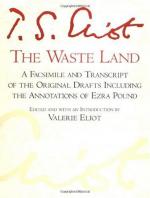
The Waste Land by T. S. Eliot

About 488 pages (146,460 words) in 17 products

"The Waste Land" Search Results
Contents:
Summaries and Analysis


Author Biography

Name: Thomas Stearns Eliot
Birth Date: September 26, 1888
Death Date: January 4, 1965
Place of Birth: St. Louis, Missouri, United States
Place of Death: London, England
Nationality: American, English
Gender: Male
Occupations: author, poet, critic, playwright, editor, publisher

summary from source:
Biography of Thomas Stearns Eliot
19947 words, approx. 66.5 pages
T. S. Eliot is one of the giants of modern literature, highly distinguished as poet, literary critic, dramatist, and editor/publisher. In 1910-1911, while still a student, he wrote "The Love Song of J. Alfred Prufrock" and other poems which are landmarks...
summary from source:
Biography of T(homas) S(tearns) Eliot
16377 words, approx. 54.6 pages
T. S. Eliot is one of the giants of modern literature, highly distinguished as poet, literary critic, dramatist, and editor/publisher. In 1910-1911, while still a student, he wrote "The Love Song of J. Alfred Prufrock" and other poems which are landmarks...
summary from source:
Biography of T(homas) S(tearns) Eliot
16364 words, approx. 54.5 pages
T.S. Eliot 's contributions to twentieth-century literature are complex, far reaching, and of perhaps greater import than those of any other major literary figure of the period. His poems created a revolution in and revaluation of the world of poetry, an...


Encyclopedia and Summary Information
summary from source:
The Waste Land Summary
7,071 words, approx. 24 pages
The Waste Land by T. S. Eliot Born in St. Louis, Missouri, on September 26, 1888, Thomas Stearns Eliot spent his youth in St. Louis and New England. Eliot earned his A.B. and an M.A. degrees in philosophy at Harvard University in 1906. He spent the next...
summary from source:
The Waste Land Summary
3,715 words, approx. 12 pages
The Waste Land by T. S. Eliot Thomas Stearns Eliot was born in 1888 in St. Louis, Missouri, and died in 1965 in England. Between these two dates, he transformed himself from an American philosophy student to a powerful British man of letters, and in the...
summary from source:
The Waste Land Information
4,366 words, approx. 15 pages
The Waste Land (1922)[1] is a highly influential 434-line modernist poem by T. S. Eliot. It is perhaps[weasel word sentence] the most famous and most written-about long poem of the 20th century. Despite the alleged obscurity of the poem – its...


News and Journals
summary from source:

The Boston Globe
Waste Land
07/03/2005: 995 words, approx. 3 pages
Garbage has become a metaphor of modernity. It's the main character in Don DeLillo's novel "Underworld," where the sinister and shadowy waste trader, Jesse Detwiler, claims that the throwaway culture forced postindustrial countries to "come up with a resourceful means of disposal" and "build...
summary from source:

The Hudson Review
A Night in the Waste Land
04/01/2003: 473 words, approx. 2 pages
That nothing was mine, along with the closed car at four, and the Cockney woman in the pub. One or two other places, I don't recall. I wasn't exactly keeping a count, you know. The bit about nothing? Oh that was something I...
summary from source:

AP News
Obituaries in the news
10/25/2007: 601 words, approx. 2 pages
Ernst Ludwig EhrlichGENEVA (AP) — Ernst Ludwig Ehrlich, a Jewish religious philosopher who escaped the Nazis and later helped bridge the gap between Christians and Jews, has died. He was 86.Ehrlich died Sunday at his home in Riehen, according to the family notice in Swiss...
summary from source:

The New York Observer
William Tucker Work Alludes to Degas, But It Won't Dance
5/15/2005: 744 words, approx. 3 pages
Few professionals in the art world, whether they're artists, critics, historians or museum curators, can be said to command as comprehensive an understanding of the art of sculpture as William Tucker, the British-born artist who's been working in this country since 1978 and is now...


Criticism and Essays
Literary Criticism
summary from source:
Critical Essay by Charles Moorman
7,914 words, approx. 26 pages
In the following essay, Moorman analyses T. S. Eliot's literary and philosophical development, specifically his ideas on the creation of literary myths and use of the Grail legend in his poetry. Moorman contends that Eliot's spiritual viewpoint was central to his writing, and in The Waste Land the legend of the grail assumes a position of vital importance because of its connections with images of religious fertility.
summary from source:
Critical Essay by Scott R. Christianson
6,993 words, approx. 23 pages
In the following essay, Christianson examines hard-boiled fiction in the context of modern literature. He argues that, like, for example, T. S. Eliot's The Wasteland, hard-boiled fiction presents an “oppositional” stance toward the world, while at the same time upholding many of its values.
summary from source:
Critical Essay by Linda Ray Pratt
6,331 words, approx. 21 pages
In the following essay, Pratt compares the use of the Grail myth in Alfred Tennyson's Idylls of the King and T. S. Eliot's The Waste Land, contending that both authors have significant differences in the way they view the legend—for Eliot, the Grail is representative of individual salvation, while for Tennyson, the quest for the Grail is an act that deflects man from the responsibilities he must assume in the real world.
Featured Essays
summary from source:


Essay Grade: 90%
summary from source:


Essay Grade: 78%
Modernism in T.s. Eliots's the Wasteland
1,113 words, approx. 4 pages
Modernism has been defined as a rejection of traditional 19th-century norms, whereby artists, architects, poets and thinkers either altered or abandoned earlier conventions in an attempt to re-envision a society in flux. In literature this included a progression from objectivist optimism to cynical relativism expressed through fragmented free verse containing complex, and often contradictory, allusions, multiple points of view and other poetic devices that broke from the forms in Victorian and Romantic writ


The Waste Land Study Pack

Get the complete The Waste Land Study Pack, which includes everything on this page. Approximately 488 pages (at 300 words per page) in 17 products. (Download a sample literature guide)

 Please Note: Study Pack does not include any HighBeam content.

This Study Pack Contains:
Complete Literature Study Guide
8 Biographies
3 Encyclopedia Articles
3 Literature Criticism Essays
2 Student Essays
Multiple Formats Available:

· online web format
· "print-friendly" format
· downloadable PDF format
· downloadable Word/RTF format
Available Immediately Online
 

The Waste Land by T. S. Eliot

About 488 pages (146,460 words) in 17 products


Join BookRagslearn moreJoin BookRags


About BookRags | Customer Service | Report an Error | Terms of Use | Privacy Policy