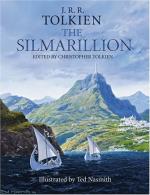
The Silmarillion (1977) is a collection of J. R. R. Tolkien 's works, edited and published posthumously by his son Christopher Tolkien, with assistance from Guy Gavriel Kay by J. R. R. Tolkien Published post-humously in 1977 this work collects many of...
The Silmarillion is a collection of J. R. R. Tolkien's mythopoeic works, edited and published posthumously by his son Christopher Tolkien in 1977, with assistance from Guy Gavriel Kay,[1] who would later become a noted fantasy fiction writer. It tells...
"The Children of Hurin" (Houghton Mifflin, 313 pages, $26, or $75 for a deluxe slipcased edition) _ J.R.R. Tolkien: Six thousand years before the Fellowship of the Ring, long before anyone had even seen a Hobbit, the elves and men of Middle-earth quaked at the...
If "The Hobbit" is a lesser work than the Ring trilogy because it lacks the trilogy's high seriousness, the collection that makes up "The Silmarillion" stands below the trilogy because much of it contains only high seriousness; that is, here Tolkien cares more about the meaning and coherence of his myth than he does about these glories of the trilogy: rich characterization, imagistic brillance, powerfully imagined and detailed sense of place, and thrilling adventure. Not t...
The Silmarillion, despite the cuts that have evidently been made in the original materials, the selection and arrangement that have been imposed on them, remains an empty and pompous bore. There are epic elements in it, but they have been smothered by an overgrowth of genealogy. The narrative is not in itself very sturdy. Oaths, feuds, sword fights, lost cities, doomed lovers, and ill-starred friendships abound; but there is a dearth of characters and an oversupply of stereotypes. The familiar Tolkien divis...
I feel that Tolkien did not revise and add to [The Silmarillion] over the years as an escape, though it does seem in one way to belong to a deep, almost childlike need to fix and possess for ever a part of the English countryside (and in this sense it could be said to bear the same relation to his practical life as "The Wind in the Willows" bore to Kenneth Grahame's.) The clue to reading it can be found, perhaps, in Leaf by Niggle. The Silmarillion is the creation of what Tolkien called...