Republic
by Plato
Plato (428-347 B.c.) was the son of wealthy and powerful Athenian parents. He rejected the political life that had corrupted members of his family and became a student under the f...
Read more
The Greek philosopher Plato (428-347 BC) founded the Academy, one of the great philosophical schools of antiquity. His thought had enormous impact on the development of Western philosophy.Plato was bo...
Read more
Plato stands at the center of philosophical thought in the ancient world. He was the first person to approach philosophical issues systematically, but it was the genius with which he treated those iss...
Read more
Biography EssayPlato stands at the center of philosophical thought in the ancient world. He was the first person to approach philosophical issues systematically, but it was the genius with which he tr...
Read more
One of the best known and most influential philosophers of all time, Plato has been admired for thousands of years as a teacher, writer, and student. His interests and knowledge were wide and varied, ...
Read more
Plato, known as perhaps the greatest of all the ancient Greek philosophers and educators, was more interested in moral rather than natural (or scientific) philosophy. Nevertheless, he made many import...
Read more
Throughout history, mankind has struggled to lead better lives and improve their society for future generations. What do we continuously attempt to improve? What kind of changes are we trying to insti...
Read more
At the beginning of the chapter, Cephalus invites Socrates to his home for philosophic discussion. Although it is the first scene, Cephalus appears only in this scene and does not reappear in th...
Read more
Thrasymachus has just stated, "Justice is nothing other than the advantage of the stronger", and is now, at the request of Socrates, clarifying his statement.
"'Don't you know that some cities are rul...
Read more
Plato creates a seemingly invincible philosopher in The Republic. Socrates is able to refute all arguments presented before him with ease. The discussion on justice in Book I of The Republic is one s...
Read more
Many societal ills in a given culture can be attributed to the pride that develops in leaders and the aggressive effect this nature has on the need for personal gain. In his work The Republic, Plato ...
Read more
The Republic by Plato examines many aspects of the human condition. In this piece of writing Plato reveals the sentiments of Socrates as they define how humans function and interact with one another....
Read more
Philosophy is a Greek word meaning "love of wisdom." Throughout Plato's Republic, wisdom plays an important role. According to Plato, education is wisdom and all of our knowledge is not acquiring ...
Read more
I believe Plato's Republic was a necessary catalyst for the advancement of human knowledge through the idea of using inductive reasoning. I feel it was important for scientific studies of the past to ...
Read more
Socrates was a renowned philosopher in the ancient Grecian times. His peak was around the Peloponnesian War, when the Spartans defeated the Athenians and ended the Golden Age. The reason Socrates...
Read more
Philosophy is a Greek word meaning "love of wisdom." Throughout Plato's Republic, wisdom plays an important role. According to Plato, education is wisdom. In the passage, 518d, Plato discusses the t...
Read more
Book one of Plato's Republic examines the concept of democracy and justice. Thrasymachus, the Sophist declares that justice is the advantage of the stronger, whereas Socrates argues that justice is wi...
Read more
In The Republic by Plato, Plato constructed an ideal city where Philosophers would rule. Governed by an aristocratic form of government, it took away some of the most basic rights a normal citizen sh...
Read more
Philosophy is a Greek word meaning "love of wisdom." Throughout Plato's Republic, wisdom plays an important role. According to Plato, education is wisdom. In the passage, 518d, Plato discusses th...
Read more
Agamemnon Close Readings
--Line numbers are in parentheses
"No one takes me in with visions- senseless dreams (275)."
Clytaemnestra says this quote before Agamemnon returns home, and she currentl...
Read more
By studying a variety of events and people involved in the Peloponnesian War and the Theban play Antigone, it becomes noticeable that many of these events and people can be explained through Platonic ...
Read more
When he wrote The Republic, Plato recognized the need for the rulers or `guardians' of his kallipolis to be good and righteous. He also realized that "imitations practiced from youth become part of na...
Read more
The Republic Book Notes is a free study guide on The Republic by Plato. Browse the summary below:
Author Biography / Context of the Work
One-Page Plot Summary
Character Desc...
Read more



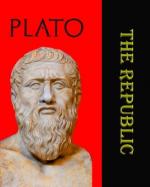
 Republic
 Plato
Plato
 Plato
Plato
 Plato
Plato
 Plato
Plato


 The Republic