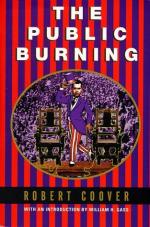
The Public Burning Summary
Because of its mass and its scope, the novel has a predictably large cast of characters. These can be broken down into three classes: historical victims; historical oppressors, by far the largest group; and personifications of public attributes.
Because one purpose of The Public Burning is to treat that moment in history at which the attitudes of America solidified into an unquestioning monism, Coover treats many historical figures as having mythic proportions.
President Eisenhower's famous obscurantist rhetoric is effectively parodied and the General's insensitivity to the human issues the Rosenberg case raises is satirized. Senator Joseph McCarthy's notorious belligerence toward anything red is effectively evoked, as is Senator Robert Taft's statesmanship; the novel significantly treats Taft's terminal cancer as symbolic of a dying political order.
Most spectacularly, however, half of the novel is narrated by then-Vice President Richard Milhous Nixon.
Although this... View more of the The Public Burning Summary
Study Pack
The The Public Burning Study Pack contains about 237 pages of study material in 14 products, including:
The Public Burning Short Guide
Robert Coover Biography (2)
11,215 words, approx. 38 pages
Even before the publication of The Public Burning (1977) made him famous, Robert Coover had already achieved a solid reputation, mostly among academics and college audiences, as one of the most origi...
Read more
8,483 words, approx. 29 pages
Robert Coover is one of America's most distinguished writers. His eminence is to be measured not by the size of his current readership, which remains select, but in terms of the technical resourcefuln...
Read more
Essays & Analysis (11)
195 words, approx. 1 pages
Critical Essay by Benjamin Demott
Richard Nixon's inward ruminations in [The Public Burning] offer a view of the then Vice President's adolescence, college experience, early years, and s...
Read more
364 words, approx. 2 pages
Critical Essay by Michael Mason
One thing [the sodomy episode in The Public Burning] brings out is how boringly enthralled and confused [Coover] is by sex, like many contemporary American novelists. T...
Read more
159 words, approx. 1 pages
Critical Essay by Tom Paulin
Coover is an ambitious and gifted writer who has made the mistake of treating a distressing and important subject in a kind of surrealistic razzamatazz which rapidly becom...
Read more
10,044 words, approx. 34 pages
McCaffery is an American educator and critic. In the following excerpt, originally published in slightly different form in 1979, he examines Coover's portrayal of the human tendency to manufact...
Read more
7,563 words, approx. 26 pages
In the following essay, Estes examines Robert Coover's use of folk styles, particularly an unsentimental type of humor, in The Public Burning.
Robert Coover has shown a continuing interest in t...
Read more
1,617 words, approx. 6 pages
In the following review, Quinn praises the reissued edition of The Public Burning and offers a positive assessment of Ghost Town.
Imagine a re-worked Mount Rushmore, sculpted in dynamite. Looming larg...
Read more
6,767 words, approx. 23 pages
In the following essay, Cioffi explores the problematic representation of real and fictive worlds in The Public Burning, particularly as evident in the character of Richard Nixon, whose fictional pers...
Read more
5,218 words, approx. 18 pages
In the following essay, Cornis-Pope discusses Coover's evocation of “otherness” and marginality in The Public Burning, especially as portrayed through the novel's composite...
Read more
5,472 words, approx. 19 pages
In the following interview, Coover discusses the cultural impact of the Rosenberg trial and the creative process behind his writing of The Public Burning, as well as the potential of hypertext literat...
Read more
7,170 words, approx. 24 pages
In the following essay, Walsh examines Coover's reinterpretation of the Rosenberg trial and McCarthy-era hysteria in The Public Burning, arguing that the novel's carnivalesque satire...
Read more
5,020 words, approx. 17 pages
In the following essay, Frick explores Coover's preoccupation with Richard Nixon, as evidenced in The Public Burning. Frick contends that Nixon represents an authorial alter-ego through whom Co...
Read more