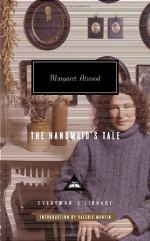
The Handmaid's Tale
by Margaret Atwood
Born in 1939 in Ottawa, Ontario, Canada, Margaret Atwood worked as a cashier, waitress, market research writer and film script writer before publishing her ow...
Read more
One of Canada's most distinguished literary figures, Margaret Eleanor Atwood (born 1939) is an internationally famous novelist, poet, critic, and politically committed cultural activist.Margaret Elean...
Read more
The author of over sixty books, Margaret Atwood holds a unique position in contemporary Canadian literature. "Atwood is arguably the most recognizable writer in the country," noted John Bemrose in Mac...
Read more
One of Canada's most public literary personalities, Margaret Atwood has made her reputation as much as by being versatile as by being controversial. As a poet she has to date produced ten volumes of v...
Read more
Margaret Atwood is arguably the most prominent contemporary Canadian writer. Best known for her novels, Atwood is also admired for her accomplishments as a poet, critic, essayist, and short-story writ...
Read more
In the following essay, Mahoney examines how women challenge male authority and inherited gender stereotypes in Margaret Atwood's The Handmaid's Tale and Vlady Kociancich's The La...
Read more
In the following essay, Stein suggests that Margaret Atwood's The Handmaid's Tale can be interpreted as a cautionary but hopeful dystopian vision of women's struggle to reclaim la...
Read more
In the following essay, Feuer discusses ways in which Margaret Atwood's The Handmaid's Tale both partakes of and extends the dystopian genre, focusing on Atwood's questioning of c...
Read more
In the following essay, Harris examines parallels between Margaret Atwood's The Handmaid's Tale and George Orwell's Nineteen Eighty-Four, asserting that Atwood's novel is a...
Read more
In the following review, Davidson offers a favorable analysis of The Handmaid's Tale.
I once watched Margaret Atwood try to pass unnoticed through a crowded conference center where she was t...
Read more
In the following essay, Finnell examines Atwood's subversion of traditional quest themes and narrative structures in The Handmaid's Tale. “Atwood's strategy,” writes...
Read more
In the following essay, Templin examines the significance of symbolic, generic, and biblical names in The Handmaid's Tale.
One element in the highly wrought art of Margaret Atwood, and one t...
Read more
In the following essay, Filipczak examines the significance of the Bible as a tool of institutionalized oppression and the biblical parallels and interpretation as seen in The Handmaid's Tale.
...
Read more
In the following essay, Staels examines modes of resistance and creative self-expression in the language and poetic imagery of Offred's narrative in The Handmaid's Tale. According to Sta...
Read more
In the following essay, Raschke examines the function of language as a tool of oppression and the objectification of opposing strategies of deconstruction and multiple interpretation in The Handmaid...
Read more
In the following essay, Howells discusses the presentation of female self-identity, memory, sensual experience, and Offred's resistance to patriarchal authority in The Handmaid's Tale.
...
Read more
In the following essay, Feuer discusses gender, essentialism, and ambiguity in The Handmaid's Tale, noting parallels with George Orwell's 1984. According to Feuer, Atwood's ironic...
Read more
In the following review, Gray offers qualified praise for The Handmaid's Tale.
Canadian Author Margaret Atwood's sixth novel will remind most readers of Nineteen Eighty-Four. That can...
Read more
In the following review, O'Brien cites flaws in the plausibility of Atwood's dystopia as depicted in The Handmaid's Tale.
I like Margaret Atwood very much, but her new novel, T...
Read more
In the following review, Stimpson offers a positive analysis of The Handmaid's Tale.
Politics, Margaret Atwood once said, means “who is entitled to do what to whom, with impunity; who...
Read more
In the following essay, Davidson examines the significance of the “Historical Notes” epilogue in The Handmaid's Tale, stating, “what Atwood has written is not just a histor...
Read more
In the following essay, Freibert provides an analysis of satire, Western patriarchal stereotypes, and the application of French feminist theory in The Handmaid's Tale. According to Freibert, ...
Read more
In the following essay, Rubenstein examines the use of nature imagery and symbolism to portray female sexuality, reproduction, and maternity in The Handmaid's Tale.
I
One might say that Marg...
Read more
In the following essay, Ketterer examines the cyclical structure and historical perspective of The Handmaid's Tale. According to Ketterer, Atwood breaks from traditional dystopia conventions by...
Read more
In the following essay, Hammer discusses Atwood's use of satire and ironic appropriation of male literary convention to portray female domination and the dynamics of social control in The Handm...
Read more
An oppressive world, a world without freedom, without choice and without opinion. In the totalitarian regime that governs the society of Gilead, women are not worthy of anything - they don't even hav...
Read more
"The Handmaids Tale" is a dystopian, futuristic novel in which Atwood presents a totalitarian theocracy that has forced a certain class of fertile women to produce babies for elite barren couples. The...
Read more
Authors often write novels based on a dystopian society in order to forewarn the reader about the dangers of a chaotic, oppressive society. Certain political and social elements create an anti-Utopian...
Read more
What Is The Importance Of Aunt Lydia To The Novel And How Does Atwood Present Her"
Aunt Lydia is one of the ruling females in the Gilead regime. She is a woman employed to rule women, Gilead are usi...
Read more
AP English Literature and Composition
25 November 2003
Escape and Variety
Margaret Atwood's novel The Handmaid's Tale tells of a futuristic, dystopian society named Gilead in which women are no lo...
Read more
Margaret Atwood's novel The Handmaid's Tale is a dystopic vision on the implications of the use and abuse of power. There are many types of power illustrated in the novel, each gained and maintained i...
Read more
In many books, there is a warning against the main character. Do not trust this person, or do not go that route. But in dystopian novels, the warning is towards the society as a whole. They are wri...
Read more
The story starts with a woman reflecting on her past (Offred), she has been living in an army-based camp with other girls. She starts with describing the history of the room where she is now based, ...
Read more
Religion and the state are far from separate in Gilead. Religion has become an event for all Patriots to enjoy. Freedom of religion is of course not allowed and those who are found guilty of blasphe...
Read more
The Handmaid's Tale is set in the early twentieth century in the futuristic Republic of Gilead, formerly the United States of America. The Republic has been founded by a Christian response to decli...
Read more
Have you ever stopped to think, "How would my life change if someone was in total control of it"" How do you think it would change? Do you think it would be difficult living this way? Would people ad...
Read more
The character of Moira is introduced to the novel during a flashback which is related by the main protagonist and narrator, Offred. From Offred's point of view, Moira is the epitome of feminism and co...
Read more
Margaret Atwood's Novel "The Handmaid's Tale" is all about a change in society. The narrator Offred describes her experience in the years before Gilead and the early years of Gilead. Gilead evolves fr...
Read more
"I would like to be without shame. I would like to be shameless. I would like to be ignorant. Then I would not know how ignorant I was."
Webster's dictionary defines shames as "a painful emotion ca...
Read more
Throughout the novel, we are presented with two different handmaids that accompany Offred on her shopping expeditions. One of these is Ofglen, who works for the Resistance movement and eventually kill...
Read more
Throughout the novel, characters are presented to the reader by Atwood through the eyes of Offred. Although the Commander is firstly seen to be simply another part of Gilead's society that Offred has...
Read more
The Handmaid's Tale is a dystopian novel in which a small part of America is subject to a religious coup. The life of the main character, Offred is greatly altered by this new society. Before the take...
Read more
The Handmaid's Tale, a science-fiction novel written by Margaret Atwood, focuses on women's rights and what could happen to them in the future. This novel was later made into a movie in 1990. As wit...
Read more
What are the effects of the first person narrative on the reader in chapters 1-12"
The Handmaid's Tale is written in the first person narrative by the main character Offred. It is written in an autob...
Read more
"There is more than one kind of freedom, said Aunt Lydia.
Freedom to and freedom from. In the days of anarchy, it was freedom to.
Now you are being given freedom from.
Don't underrate it" (...
Read more
A Handmaid's Tale, by Margaret Atwood is novel told from the view of Offred, a Handmaid in Gilead. She tells the story in the immediate present tense but frequently shifts to past tense for flashback...
Read more
Gilead is a highly stratified and ritualised society, where the individual is tightly controlled by the totalitarian regime. Through Gilead Atwood presents us with a system that makes clever use of th...
Read more
Moira is presented through Offred as the novel is written in first person narrative. The readers get a very biased view of Moira because we only got Offreds view of Moira.
This is important becaus...
Read more
Women in today's society are considered and viewed as less important than men; this is mostly due to the expectations men have set for these women and how women cannot escape from this subtle oppressi...
Read more
The Handmaid's Tale by Margaret Atwood is a dystopia about a world where unrealistic things take place, it is set in the futuristic Republic of Gilead. Sometime in the future, conservative Christians ...
Read more
The words control and Gilead, the setting for the novel "The Handmaid's Tale" by Margaret Atwood, are interchangeable. Not only is control a pivotal feature of the novel and its plot, it cons...
Read more
Both worlds of The Handmaid's Tale and 1984 are governed by a party or group which strictly monitor most aspects of the lives of its civilians. This imposing form of government is generally described ...
Read more
The Handmaids Tale illustrates that dictatorship can be established by creating a state of fear once language controls are instituted. As a tradition to dystopian novels, Atwood has drawn much attenti...
Read more
What is the purpose and function of the `Historical Notes' and how do they assist your interpretation of the novel"
The historical notes are not part of Offred's narrative, they are a transcript of a...
Read more
Anyone who knows anything about social utopia will say that it is impossible. The attempt by an external authority to eliminate a problem by using force always creates a bigger dilemma then the prob...
Read more
Introduction
The main character of the novel The Handmaid’s Tale, written by Margaret Atwood is the mid-aged woman Offred. Offred lives in the Republic of Gilead, a future dystopian society in ...
Read more
Lauren Bedard
Ignorance is Misery
In the novel, The Handmaid's Tale, and the play, Tartuffe, written by Margaret Atwood and Moliére respectively, the theme of irony is used to und...
Read more
The Handmaid's Tale Book Notes is a free study guide on The Handmaid's Tale by Margaret Atwood. Browse the summary below:
Author Biography / Context of the Work
One-Page Plot Summary...
Read more