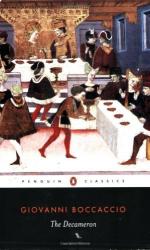
The Italian author Giovanni Boccaccio (1313-1375) is best known for the Decameron. For his Latin works and his role in reviving Hellenistic learning in Florence, he may be considered one of the early humanists. The culture of Giovanni Boccaccio is rooted...
The Decameron by Giovanni Boccaccio Giovanni Boccaccio was probably born in 1313 in Florence. The illegitimate son of a partner in one of the citys most important banking companies, the Bardi, he began his life when Florence was well on its way...

The Decameron (subtitle: Prencipe Galeotto) is a collection of 100 novellas by Italian author Giovanni Boccaccio, probably begun in 1350 and finished in 1353. It is a medieval allegorical work best known for its bawdy tales of love, appearing in all its...
The Decameron. By GIOVANNI BOCCACCIO. Trans. by G. H. MCWILLIAM. 2nd edn. Harmondsworth: Penguin. 1995. Cli + 909 pp. 8.99 [pounds sterling]. The Penguin Classics Decameron first appeared in 1972; the greatly expanded second edition offers a new introduction, bibliography, and notes by...
Ten stories a night, for 10 nights: it doesn't take a great mental effort to work out that staging the Decameron in one evening means either stooping to a kind of Reduced Boccaccio Company absurdity, or cutting the numbers drastically. The most obvious thing...
Question 1 of 10: England was struck by famine in 1316 after farms were devastated by...?Crop diseaseA drought Torrential rain Civil warQuestion 2 of 10:The infamously incompetent King Edward II of England was in 1327 imprisoned and put to death by whom?The King of ScotlandA...
Elena, a writer of self-help books at work on Here’s How: To Do EVERYTHING Correctly!, and Max, a Hollywood filmmaker whose single Oscar is decades behind him, are together in bed. They should be having sex, but under the shadow of the recent invasion of...
In the following essay, originally delivered as a lecture in 1975, Bergin reviews Boccaccio's career and reflects on the historical and environmental foundations of the Decameron, characterizing it as a work that conveys the solace that can be provided by art in the face of intolerable reality.
In the following excerpt, Almansi presents a psychological interpretation of Boccacio's first novella of the fourth day in the Decameron, theorizing that Tancredi's murder of his daughter's lover is rooted in his own incestuous feelings for her.