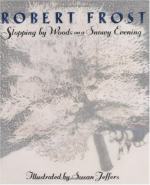
Biography EssayWhen Robert Frost died on 29 January 1963, the public mourned the loss of what it thought was the grandfatherly old bard of the nation, the most beloved poet of the century, the gentle ...
Read more
Robert Lee Frost (1874-1963) was an intentionally American and traditionalist poet in an age of internationalized and experimental art. He used New England idioms, characters, and settings, recalling ...
Read more
Robert Frost is considered one of the foremost American poets of the twentieth century. Through his imagery of nature and life in rural New England, Frost explored fundamental questions about man's ex...
Read more
When Robert Frost died on 29 January 1963, the public mourned the loss of what it thought was the grandfatherly old bard of the nation, the most beloved poet of the century, the gentle writer of simpl...
Read more
In the following essay, Ogilvie discusses the recurring image of the dark woods in Frost's poetry.
Leaves are all my darker mood
I
Together with “Birches,” “Mending ...
Read more
In the following essay, Garcia reflects upon “Stopping by Woods on a Snowy Evening” in terms of the philosophical perspective of Marcelian phenomenology.
In this short reflection pape...
Read more
In the following excerpted essay, Gray discusses the seeming lack of resolution in the closing lines of “Stopping by Woods on a Snowy Evening.”
The duality of the narrator's re...
Read more
In the following excerpt, Rotella discusses the balancing of opposites and “indeterminacy” in “Stopping by Woods on a Snowy Evening.”
“Stopping by Woods on a Snow...
Read more
In the following excerpt, Meyers discusses literary references in “Stopping by Woods on a Snowy Evening.”
The masterpiece in New Hampshire is the justly famous “Stopping by Woo...
Read more
In the following essay, Hochman discusses multiple interpretations of “Stopping by Woods on a Snowy Evening,” a poem that seems to evade any one definite interpretation.
Perhaps no po...
Read more
In the following excerpt, Kilcup asserts that “Stopping by Woods on a Snowy Evening” is a “feminine” poem and compares it to Helen Hunt Jackson's “Down to Sle...
Read more
In the following excerpt, Thompson describes the process by which Frost wrote “Stopping by Woods on a Snowy Evening.”
Fatigued and yet elated, after finishing the rough draft of ...
Read more
In the following excerpt, Coale discusses the theme of man's encounter with the allure of nature in “Stopping by Woods on a Snowy Evening.”
Frost admitted that “my best ...
Read more
In the following excerpt, Greiner discusses Frost's use of the image of the woods as a metaphor in his poetry.
We should begin with a discussion of the spellbinding power of the woods becaus...
Read more
In the following essay, Frank provides a psychological interpretation of the speaker in “Stopping by Woods on a Snowy Evening.”
Like the snake, a poem may slough off some of its more ...
Read more
In the following excerpt, Greiner argues that it is the element of “ambiguity” which makes “Stopping by Woods on a Snowy Evening” a great poem.
“Stopping by Woods...
Read more
In the following excerpt, Gerber analyses “Stopping by Woods on a Snowy Evening” in terms of its formal, metrical elements.
“Stopping by Woods on a Snowy Evening” is wid...
Read more
In the following essay, Hepburn discusses a variety of critical responses to “Stopping by Woods on a Snowy Evening.”
Many years ago, William Rose Benét called Robert Frost a ...
Read more
In the following excerpt, Mack and Rome offer a semiotic analysis of the title and opening passage of “Stopping by Woods on a Snowy Evening.”
What comes to us as the title, the prefat...
Read more
Two seemingly unrelated poems can have many surprising similarities despite their obvious contrasting elements. In Robert Frost's "Stopping by Woods on a Snowy Evening" and Edward R. Sill's "Morning,...
Read more
The poem "Stopping by the woods on a Snowy Evening" has many poetic devices. The author, Robert Frost, used alliteration. He also used rhyme. Last, he used was repetition. All of these poetic devices ...
Read more
Both poems are about travelling and choosing the path to take, and both poems are about travelling through a wood. In `Stopping by Woods on a Snowy Evening', the poet is obviously sleepy and he is tal...
Read more
Frost's poem, "Stopping by Woods on a Snowy Evening", seems to be a simple story of a man and his horse. It portrays beautiful imagery with an enjoyable rhythm and rhyming scheme. Taking a second loo...
Read more
The poet seems to be on a journey when he comes across the woods. The persona here seems to be fascinated by what he sees. With words like "lovely", "dark", and "deep."
Also we can tell that th...
Read more
"Stopping by the Woods on a Snowy Evening" by Robert Frost demonstrates the struggle between a world of serenity and one of social obligations. The speaker, on horse back in the countryside, has sto...
Read more
`Stopping by Woods on a Snowy Evening' by Robert Frost
`Stopping by Woods on a Snowy Evening', like many of Frost's poems can be read on many different levels. The surface meaning is often a wonder...
Read more
The poem "Stopping by Woods on a Snowy Evening" by Robert Frost is a nature poem; specifically it's a poem about a man who is passing through a forest in winter. It seems simple, just like the way nat...
Read more
Stopping by the Woods on a Snowy Evening Essay
In Robert Frost's poem, "Stopping by the Woods on a Snowy Evening", the elderly protagonist has stopped his horse in the woods of a man from town to pa...
Read more
Q: In some poems what is described is given a meaning beyond the immediately obvious. Explore any one of the poems where this feature is most memorable.
"Stopping by Woods on a Snowy Evening" by Robe...
Read more
In a way, it goes back to the spirit of the early Edgy Enthusiast columns, which were numbered riffs on cultural obsessions. Playlists, even—dare I say it? —pre-blog blogging. Not real...
Read more
Think of this week's column as a play list for the overeducated, the media-saturated, the culturally jaded: things you may have missed, things you ought not miss, things you still can see and hear....
Read more