Steven Millhauser, one of the most original novelists to emerge in the 1970s, was born on 3 August 1943 in New York and grew up in Connecticut where his father, Milton Millhauser, was an English profe...
Read more
Critical Essay by The New Republic
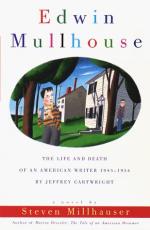
Edwin Mullhouse was a Connecticut boy who wrote the novel Cartoons and who died under strange circumstances at age 11; Jeffrey Cartwright, his neighbor, classmate an...
Read more
Critical Essay by William Kennedy
William Faulkner argued that the problems of children were not worth writing about. He wrote frequently about children himself, but he treated their lives as windows ...
Read more
Critical Essay by John Calvin Batchelor
In Millhauser's Portrait Of A Romantic, 29-year-old Arthur Grumm sits down to reminisce about his youth. The story thus has a limitation placed upon it t...
Read more
Critical Essay by William Boyd
Portrait of a Romantic is about 30,000 words too long, and most of them are adjectives; massed battalions of them, lovingly marshalled in pages of relentlessly detailed ...
Read more
Critical Essay by William Hjortsberg
["Edwin Mullhouse: The Life and Death of an American Writer (1943–1954). By Jeffrey Cartwright"], Steven Millhauser's deft first novel,...
Read more
Critical Essay by J. D. O'hara
Let me make one thing perfectly clear: [Edwin Mullhouse] is a novel….
Let me add one more thing. Steven Millhauser, who is the only begetter of Cartwright,...
Read more
Critical Essay by Joseph Kanon
Like great actors in mediocre plays, there are some writers whose talent seems larger than the vehicles they have chosen to contain it. A case in point is [Edwin Mullhou...
Read more
Critical Essay by J. Justin Gustainis
Steven Millhauser, it seems to me, is attempting to do several things with his novel ["Edwin Mullhouse"]. First, and perhaps basically, he is writin...
Read more
Critical Essay by Pearl K. Bell
Little could James Joyce have foreseen the avalanche of cliché he was setting in motion when he began A Portrait of the Artist as a Young Man with [a] now legend...
Read more
Critical Essay by J. D. O'hara
Millhauser's first novel received wide critical attention and excellent reviews but few readers. (Although those readers tend to grapple him to their soul ...
Read more
Critical Essay by Sheldon Frank
There is something very disconcerting and peculiar about Steven Millhauser's fiction. It is written with the discipline of a man far beyond his thirty-four years...
Read more
Critical Essay by George Stade
Steven Millhauser's first novel, "Edwin Mullhouse: The Life and Death of an American Writer, 1943–1954, by Jeffrey Cartwright," is probably t...
Read more
In the following essay, Eder asserts that the stories of In the Penny Arcade “all suffer to varying degrees from overarrangement and an evident striving for effect.”
[In In The Penny Arc...
Read more
In the following essay, Fowler praises Millhauser as a miniaturist, claiming that this role sets the author apart from other contemporary writers and allows him to create “exquisite, apolitical...
Read more
In the following essay, Saltzman analyzes the role of lists in Millhauser's fiction.
The classification of the constituents of a chaos, nothing less is here essayed.
—Herman Melville, M...
Read more
In the following review, LaHood elucidates the disparity between Millhauser's short stories and realistic fiction.
Pulitzer Prize-winning novelist Steven Millhauser (in 1996 for Martin Dressler...
Read more
In the following review, Evenson offers a mixed assessment of Enchanted Night.
Millhauser's latest offering [Enchanted Night] is a lean novella consisting of seventy-four short, titled prose se...
Read more
In the following review, Dirda maintains that “like many readers, I find Steven Millhauser irresistible, even while recognizing, grudgingly, that for others the stories in The Barnum Museum may...
Read more
In the following review, Malin offers a positive assessment of The Barnum Museum.
Although Millhauser has written four remarkable books, he has not received sustained, profound criticism. His latest c...
Read more
In the following mixed review of The Barnum Museum, Saroyan praises the wit and imagination of the stories in the collection, but contends that Millhauser tries too hard to emulate the style of such p...
Read more
In the following essay, Howe offers a close reading of Millhauser's Catalogue of the Exhibition.
Since Steven Millhauser's novella is experimental in form—I'm not aware of ...
Read more
In the following essay, Kinzie explores the defining characteristics of Millhauser's short fiction and finds parallels between his work and that of Jorge Luis Borges and Franz Kafka.
“Si...
Read more
In the following review of Little Kingdoms, Dirda addresses Millhauser's reputation as a writer of meticulous tales.
“Reviews,” finally concludes Steven Millhauser, “did no...
Read more
In the following excerpt, Davis provides a favorable review of Millhauser's novella The Little Kingdom of J. Franklin Payne.
[The Little Kingdom of J. Franklin Payne is] the best (and by far th...
Read more
In the following excerpt, Green finds parallels between Steve Stern's A Plague of Dreamers and Millhauser's Little Kingdoms.
Throughout the recent period in American fiction dominated by...
Read more