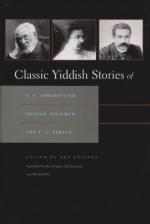
Probably the foremost writer of Yiddish literature, Sholom Aleichem (1859-1916) was a catalyst for its revival at the turn of the century. He is also "The Jewish Mark Twain," a folk artist who faithfu...
Read more

The Jewish author Sholem Aleichem (1859-1916) wrote with great humor of Jewish life in eastern Europe and America.Sholem Aleichem was born Sholem Rabinowitz on March 3, 1859, in Freislav, Poltava dist...
Read more
In the following essay, which was originally published in 1908, the critic examines prominent character types in Sholom Aleichem's stories and how they reflect Jewish reaction to life in exile....
Read more
In the following essay, Goldsmith contends that Aleichem's "humor is a unique phenomenon in the history of Jewish culture and a surprising mutation in the evolution of the Jewish spirit....
Read more
In the following essay, Boyarín discusses Aleichem's narrative technique as evinced in his short story "Stantsye Baranovitsh."
Sholem-Aleykhem's works bridge the gul...
Read more
In the following essay, Roskies examines Aleichem's use of mythology in his short fiction and places his work within the context of Yiddish literature.
What could be more obvious for a writer w...
Read more
In the following excerpt, Halberstam-Rubin asserts that Aleichem's short stories demonstrate how ignorance, prejudice, and violent physical attacks affected the day-today lives of the Jewish pe...
Read more
In the following essay, Pritchett favorably assesses Aleichem's humor and storytelling ability.
Sholom Aleichem is one of the prolific masters of Yiddish comic storytelling, an art springing fr...
Read more
In the following excerpt, which was originally published in 1941, Wiener discusses Aleichem's unique brand of humor.
The Victory Over Human Fear
Brave children, when fearful upon entering a dar...
Read more
In the following excerpt, which was originally published in 1956 as an introduction to Selected Stories of Sholom Aleichem, Kazin assesses Aleichem's treatment of Jewish people and the Yiddish ...
Read more
In the following excerpt, Howe discusses Aleichem's significance within the Jewish literary tradition, asserting 'He is, I think, the only modern writer who may truly be said to be a cul...
Read more
In the following essay, Gittleman examines Aleichem's portrayals of Jewish mothers and sons in his short fiction and finds similarities in Philip Roth's novel Portnoy's Complaint....
Read more
Frances Butwin is a Polish-born American translator and critic. With Julius Butwin, she selected and translated a collection of stories by Sholom Aleichem, which was published in 1946 as The Old Count...
Read more
In the following essay, Wirth-Nesher discusses the paradoxical nature of the monologue form in Aleichem's short fiction.
It is generally recognized that Sholem Aleichem's success as a wr...
Read more
In the following essay, Miller considers the problematic endings of Aleichem's short fiction.
The nonspecialist (I shall use a none-too-hypothetical undergraduate student as example) comes to t...
Read more
In the following excerpt, Aarons examines the defining characteristics of Aleichem' s shtetl stories.
At the heart of Sholom Aleichem's short stories, monologues and feuilletons lies Kas...
Read more