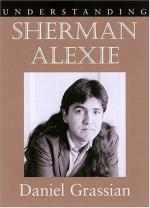
Winner of Washington State Arts Commission poetry and National Endowment for the Arts poetry fellowships, Sherman Alexie (born 1966) has published poems, stories, translations, and several books.Sherm...
Read more
Sherman Alexie admits he was once a "good" Indian, his term for a person of Native American heritage who does his best to assimilate into mainstream North American society. It drove him to drink, and ...
Read more
Sherman Alexie is the "Indian du jour" of the mainstream publishing industry, as he notes in his 1995 Tonic interview with Kelly Myers. Alexie has published seven books and three chapbooks in less tha...
Read more
Sherman Alexie's meteoric rise to national prominence among Native American writers occurred in a period of less than five years, beginning not with a blockbuster novel published by a major commercial...
Read more
Sherman Alexie's writing has attracted a broad spectrum of readers in a relatively brief span. During his first eight years in publishing, Alexie was awarded the Washington State Arts Commission Poetr...
Read more
In the essay below, Kuo describes the wide range of cultural references in Alexie's prose and verse.
Sherman Alexie's territory, as he describes in these forty poems and five stories ...
Read more
In the following review, Allen discusses cultural and personal influences on Alexie's verse in First Indian on the Moon.
Outraged pride, broken promises, and the scourge of alcoholism are th...
Read more
In the following review of First Indian on the Moon, Bruchac explores Alexie's evolution as a writer.
Few young writers have burst onto the scene with as much praise as Sherman Alexie. His f...
Read more
In the review below, Velie describes The Lone Ranger and Tonto Fistfight in Heaven as "powerful and lyrical."
Although it is highly uncommon for American writers to be successful at b...
Read more
Below, Beschta surveys Native American themes in First Indian on the Moon.
[First Indian on the Moon] opens with "Influences," a poem of the survival of young Indian children in the f...
Read more
In the following review of First Indian on the Moon, Bankston notes that while Alexie's recent verse resembles his previous efforts, his work has not become "hackneyed."
We kno...
Read more
In the review below, Baxter discusses elements of realism and imagination in Alexie's Old Shirts & New Skins, First Indian on the Moon, and The Lone Ranger and Tonto Fistfight in Heaven.
...
Read more
In the following review, Silko studies characterization in Reservation Blues.
When N. Scott Momaday won the Pulitzer Prize for his novel House Made of Dawn in 1969, book reviewers fretted that the ...
Read more
In the following review of Reservation Blues, Busch comments on narrative structures in the work.
To read about Native American reservation life is usually to read about illness and despair. Fictio...
Read more
Below, Davis praises the universality of Alexie's literary works.
This first novel by Sherman Alexie [Reservation Blues] comes as close to helping a non-Native American understand the modern...
Read more
In the following review of Old Shirts & New Skins, the critic praises Alexie's verse for "capturing the full range of modern Native [American experience."]
[In Old Shirts a...
Read more
In the following essay, the critic explores the impact of Alexie's life experiences on his literary works.
Why the nondescript Northwestern city of Spokane was chosen as the site of the 1974...
Read more
In the following review of The Lone Ranger and Tonto Fistfight in Heaven, the critic lauds Alexie's short stories as exemplary products of the author's potent imagination.
Known prima...
Read more
Below, Baxter comments on the themes of isolation and alienation in The Business of Fancydancing.
Sherman Alexie's remarkable debut, The Business of Fancydancing, is an outstanding collectio...
Read more
In the following review of The Lone Ranger and Tonto Fistfight in Heaven, Schneider briefly examines Alexie's narrative voice.
Each of the twenty-two stories in Sherman Alexie's colle...
Read more
Below, Price commends Alexie's ability to portray the sufferings of Native Americans but suggests that the author's rapid publication of his work may be affecting its quality.
Sherman...
Read more
In the following review of The Lone Ranger and Tonto Fistfight in Heaven, Sides examines how Alexie uses storytelling to help rescue his tribe and his culture from oblivion.
Reading Sherman Alexie&...
Read more
In the following review, the critic praises Alexie's use of the metaphor of fire in First Indian on the Moon.
Reading [First Indian on the Moon, the] latest offering of poetry and short pros...
Read more
In the following excerpt, Ullman offers a positive assessment of the equivocal and metaphysical nature of The Business of Fancydancing.
Sherman Alexie's collection of poems and stories [in T...
Read more
In the following review, Bolton-Fasman praises Indian Killer for Alexie's skillful character development and his blunt treatment of racism in America.
Sherman Alexie is a native American who...
Read more
In the following review, Berner offers a positive assessment of The Summer of Black Widows, commenting favorably on Alexie's portrayal of the true Native-American cultural experience and his us...
Read more
In the following excerpt, Donahue discusses the significance of basketball in Native-American culture as evidenced in The Lone Ranger and Tonto Fistfight in Heaven and Reservation Blues.
In basketb...
Read more
In the following excerpt, McFarland examines the polemic nature of Alexie's writing and his unique poetic form.
When a new poet [Sherman Alexie] comes on the scene, it is “both fittin...
Read more
In the following interview, conducted on October 4, 1997, Alexie discusses his role in the film Smoke Signals, his desire to be universally accessible, his views on publication, and his opinion of mod...
Read more
In the following review, Gorra offers a negative assessment of Reservation Blues, focusing on Alexie's failure to blend humor with drama and his overly didactic tone.
In Indian Killer, Sherm...
Read more
In the following interview, Alexie discusses his screenplay for the film Smoke Signals and comments on a variety of topics including stereotypical film portrayals of American Indians, the autobiograph...
Read more
In the following review, Georgakas offers a positive assessment of Smoke Signals, asserting that Alexie displays a unique ability to break from the traditional portrayal of modern American-Indian cult...
Read more
In the following review, Levi explores the diversity of Alexie's American-Indian characters in The Toughest Indian in the World.
“What is an Indian?” Sherman Alexie asks in his...
Read more
In the following review, Penner comments on Alexie's exploration of the struggle for American-Indian cultural identity as experienced by the characters in The Toughest Indian in the World.
T...
Read more
In the following favorable review of Reservation Blues, Klinkenborg praises Alexie's illustration of Native American life, his use of dark humor, and his consciousness of audience.
The Spoka...
Read more
In the following review, Oates explores the search for ethnicity undertaken by the characters in The Toughest Indian in the World.
What is an Indian? runs through Sherman Alexie's second col...
Read more
In the following review, Low examines Alexie's short story collection The Lone Ranger and Tonto Fistfight in Heaven in relation to postmodernist theory.
Peter Burger, in Theory of the Avant-...
Read more
In the following essay, Gillan examines Alexie's work and comments on its focus on an anglicized version of American-Indian history and tradition.
When David Bell, the protagonist in Don DeL...
Read more
In the following excerpt, Lemon offers a positive assessment of Reservation Blues.
This is in part a catch-up review because some books that are too good to ignore were, for one reason or another, ...
Read more
In the following review, Meredith examines the incorporeal motifs and the spiritual importance of the reservation in Reservation Blues.
The art of Sherman Alexie surprises and delights the reader a...
Read more
In the following interview, Alexie discusses his initiation into literature and his adherence to realism in writing about the American-Indian experience.
Six years ago, as a 24-year-old student at ...
Read more
In the following review, Bell explores the rage experienced by the Native-American characters due to the loss of their cultural identity in Indian Killer.
Over the course of writing several novels,...
Read more
In the following interview, Alexie discusses his hesitancy to serve as a representative of the Native-American community at large, his tribe's often bitter attitude toward him, and the film ind...
Read more
In the following review, Stocking offers a brief review of I Would Steal Horses and Old Shirts & New Skins.
Sherman Alexie has two new volumes: I Would Steal Horses (Slipstream) Old Shirts &...
Read more
In the following review, Tvedten evaluates Alexie's Old Shirts & New Skins.
First of all, this book of poems is another entry in the Native American Literature Series published by the...
Read more
In the following essay, Gillan traces the influences of popular video culture on the content and structure of Sherman's storytelling in poetry and prose.
When David Bell, the protagonist in ...
Read more
In the following essay, Lincoln examines Alexie's place among Native American writers of his generation.
Alexie is not writing the intellectualized masturbation that passes for so much of to...
Read more
In the following interview, Alexie discusses his literary and film projects and talks about Native American literature and popular culture.
On a rare sunny Seattle day, Sherman Alexie's mana...
Read more
In the following essay, McFarland offers a review of One Stick Song.
Nine years have passed since the warm reception of Sherman Alexie's first collection of mingled very short stories and po...
Read more
In the following essay, Evans discusses Alexie's depiction of contemporary reservation life in his poetry and fiction.
Ironic and satiric impulses consistently suffuse the tone, structure, r...
Read more
In the following essay, Etter discusses Alexie's modification of the traditional English sonnet, asserting that this particular structure supports the author's literary treatment of tens...
Read more
Sherman Alexie illustrates a subtle sarcasm that is very consistent among his stories. He conveys many of the current social issues that seem to be constant among those of Indian heritage. His main c...
Read more

Should Christopher Hitchens win a National Book Award, you can be sure he won't thank any higher powers.The author, columnist and commentator was nominated for "God Is Not Great," a polemic with a ...
Read more
Oprah Winfrey has pulled a discredited children's book, Forrest Carter's "The Education of Little Tree," from a list of recommended titles on her Web site, blaming an archival "error" for including...
Read more
NEW YORK (Reuters) - A history of the U.S. Central
Intelligence Agency and a fictional tale of a CIA agent during
the Vietnam War were among the winners at America's 58th annual
National Book Awar...
Read more
With the United States fighting an increasingly unpopular war in Iraq, stories of espionage and critiques of foreign policy were winners at the 58th annual National Book Awards.Denis Johnson's "Tre...
Read more
The National Book Awards were held last night at the Marriot Marquee, bringing hordes of agents and editors--along with authors like Toni Morrison, Jonathan Franzen, and Joan Didion, who received ...
Read more