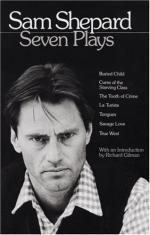
Shepard, Sam (1943—)
Playwright, actor, and director Sam Shepard is a serious and distinguished playwright whose work is performed by his peers and admired by critics and theatergoers in many c...
Read more
Sam Shepard (Samuel Shepard Rogers VII; born 1943) began his career as a playwright in the lively off-off-Broadway scene of the 1960s and became one of the United States' most prolific and acclaimed d...
Read more
"Sam Shepard's perennial theme isn't nostalgia for the Old West or depicting the tortured artist in society," wrote Michael Green of Backstage West, "not even dysfunctional families (though they're pa...
Read more
November 5, 1943. Samuel "Steve" Shepard Rogers "...plunged into the world head first and, although covered with blood, my attitude was very friendly...."My name came down through seven generations of...
Read more

Sam Shepard is considered by many critics to be the most important playwright in the Off-Broadway theatre movement. His unique blend of styles--using mythical American heroes, rock and roll music, poe...
Read more
Although Sam Shepard has written more than forty plays and five screenplays, including collaborating on Michelangelo Antonioni's Zabriskie Point (1970) and Wim Wenders's Paris, Texas (1984); has direc...
Read more
In the following interview, Shepard discusses his background, his early experiences as a dramatist, and a number of specific plays.
[Theatre Quarterly]: Born 5 November 1943 at Fort Sheridan, Illinois...
Read more
Mustazza is an educator and critic. In the following essay, he outlines the similarities between The Tooth of Crime and traditional tragedies such as Shakespeare's Richard IL
Most commentators ...
Read more
In the following essay, Shepard details the processes and principles that figure in the creation of his plays.
I feel a lot of reluctance in attempting to describe any part of a process which, by its ...
Read more
Smith is a critic, stage director, and theater director, whose books include Eight Plays from Off-Off Broadway (1966) and More Plays from Off-Off Broadway (1972). A drama critic for the Village Voice ...
Read more
A director and critic, Bloom addresses Shepard's initial work, arguing that the early plays are a form of ";gestalt theatre"; that conveys the consciousness of America in the 1960...
Read more
Gilman is an American critic, editor, and educator whose books include The Confusion of Realms (1969) and The Making of Modern Drama (1974). In the following essay, he outlines biographical and cultur...
Read more
In the following essay, Rabillard notes the marked difference between Shepard's abstract early plays and his more realistic later work The critic finds, however, that both styles are exploratio...
Read more
The Tooth of Crime was first produced at London's Open Space Theatre in 1972. In the following review of that performance, Cushman criticizes the play as being a simplistic story of dueling mus...
Read more
Oliver began her career as an actor, writer, and producer and joined the New Yorker in 1948, becoming one of the magazine's theater critics in 1961. Here she praises Shepard's writing in...
Read more
In the following excerpt, Powe discusses Shepard's use of music in The Tooth of Crime and the influence of rock music on some of the playwright's other works.
The Tooth of Crime is, at p...
Read more
In the following review, Brustein offers a mixed assessment of A Lie of the Mind, noting that the “plotting is a little too undisciplined.”
A Lie of the Mind is Sam Shepard's most...
Read more
In the following review, Weales criticizes A Lie of the Mind, objecting to the “cartoon atmosphere” of the play.
Sam Shepard's new play, A Lie of the Mind, runs for more than four...
Read more
In the following essay, Wyatt explores the ambivalence of the characters and the world view in Shepard's body of work.
Sam Shepard does not write dramas of recognition. His characters renounce ...
Read more
In the following essay, Carveth explores Shepard's examination of the human “self” in Paris, Texas.
As early as the 1950s, psychoanalysts began to report significant changes in th...
Read more
In the following essay, Heilman provides a thematic overview of Shepard's plays, highlighting his literary style in each play.
Any playwright with such a highly individualized manner as flashes...
Read more
In the following interview—which is excerpted from Rosen's book Sam Shepard: A Poetic Rodeo—Shepard discusses his theatrical style and stage imagery as well as his concepts of rhy...
Read more
In the following essay, Willadt analyzes the structure of States of Shock, emphasizing Shepard's sense of machismo and his portrayal of relationships between men.
I
After a six-year silence, Sa...
Read more
In the following excerpt, Brustein offers a mixed assessment of Simpatico, faulting the play for its “manipulated suspense.”
Sam Shepard's new play, Simpatico, which he also direc...
Read more
In the following essay, Brustein offers a mixed assessment of Shepard's works, particularly Buried Child and Cruising Paradise, within the context of Shepard's attitudes towards being a ...
Read more
In the following interview, Shepard discusses Buried Child and his likes and dislikes among his various other works.
[Coen]: In a 1983 interview, you called Buried Child “verbose and overblown&...
Read more
In the following review, King compares Shepard's fiction in Cruising Paradise with his dramas, faulting the stories as the “literary equivalent of doodles.”
A few writers—C...
Read more
In the following essay, Shewey debates Shepard's mid-life quandaries, discussing the all-Shepard season at the Signature Theatre in New York, Shepard's collaborations with Joseph Chaikin...
Read more
In the following essay, Smith assesses Shepard's current problematic critical reception, accounting for his early acclaim and his subsequently diminished reputation.
When Eric Bentley tackled t...
Read more
In the following interview, Shepard discusses his casting decisions for and the inspirations behind The Late Henry Moss.
Halloween Day 2000. Outside Theatre on the Square on Post Street, a woman sport...
Read more
In the following review, Phillips offers a mixed assessment of The Late Henry Moss, noting that the play has “nuggets of gold.”
In 1986, Robert De Niro returned to the New York stage for...
Read more
In the following review, Duncan-Jones praises a London production of A Lie of the Mind, calling the play a “triumph.”
To label Sam Shepard's modern family melodrama A Lie of the M...
Read more
In the following essay, Wilson examines the issue of linguistic “presence” in Shepard's plays, exploring the theological dimension of Shepard's dramatic language.
Walt Whit...
Read more
Critical Essay by Adrian Rendle
Madness in drama has reached a … universal point of contact in the world of knife-edge dreams and hopes as realized by Sam Shepard….
The marvellous thing ...
Read more
Critical Essay by John Simon
Shepard is one of the most stimulating figures in the off-and-off-off-Broadway theater; in Red Cross, he conjures up a day in the estival life of a young couple in a fores...
Read more
Critical Essay by Gerald Weales
[Except for Melodrama Play], which has something approximating a conventional plot, [the plays collected in Shepard's Five Plays] are all constructed in the same...
Read more
Critical Essay by Clive Barnes
Despite my worst instincts I cannot prevent myself from mildly loving the plays of [Sam Shepard]…. He is so sweetly unserious about his plays, and so desperately ...
Read more
Critical Essay by Catharine Hughes
[There] are occasions when I have no idea what to say about Sam Shepard….
Shepard is very much the avant garde man of the moment….
The Unseen Hand ...
Read more
Critical Essay by Mel Gussow
Sam Shepard is fascinated by America's folk heroes, which for him means not merely historical and legendary figures, but also movie and pop stars. These larger-than...
Read more
Critical Essay by Clive Barnes
Sam Shepard is one of those natural dramatists who is almost obsessed with dramatic form. In "Melodrama Play" …, Mr. Shepard is as much concerned wi...
Read more
Critical Essay by Richard F. Shepard
["Up to Thursday"] centered on (1) a young man lying in bed under an American flag and (2) four handsome, very young people sitting on straight-back ...
Read more
Critical Essay by Richard A. Davis
[Sam Shepard] has a tremendous ability to make words bring the imagination of an audience to life. (p. 12)
Distances, levels, and points of view are important to She...
Read more
Critical Essay by Clive Barnes
Mr. Shepard writes mythic plays in American jazz-poetry. He writes about today but obliquely, which is possibly the only way today can be written about. He is trying to ...
Read more
Critical Essay by Edith Oliver
Sam Shepard, at around thirty, is one of the three or four most gifted playwrights alive. His "The Tooth of Crime" is … strong and vivid and funny...
Read more
Critical Essay by Harold Clurman
Sam Shepard is a voice from the "underground," a poet's voice. His plays are mythic. They speak of the contemporary world and subliminally convey ...
Read more
Critical Essay by Robert Brustein
The Unseen Hand is a hallucination based on fact—a compound of nostalgia and celebration in the face of the more tawdry elements of American life—which ...
Read more
Critical Essay by Charles R. Bachman
For several years Sam Shepard has been acknowledged as the most talented and promising playwright to emerge from the Off-off Broadway movement. Now, more than a de...
Read more
Critical Essay by Michael Feingold
Sam Shepard fills the role of professional playwright as a good ballet dancer or acrobat fulfills his role in performance: That is, he always delivers; he executes f...
Read more
Critical Essay by Chet Flippo
[Rolling Thunder Logbook] is more remarkable for what was left out than for what was put in. In his introduction, Shepard cannily seeks to defuse such criticism by saying...
Read more
Critical Essay by Michael Feingold
[Shepard's plays] have no extrinsics. Not only their meaning lies in themselves, but also their mode and their tradition. Shepard's theatre, as much as...
Read more
Critical Essay by Robert Pasolli
Red Cross is an enigmatic play on many counts, the playwright having left out a great deal of information ordinarily thought pertinent. He avoids elements of expositio...
Read more
Critical Essay by Robert Palmer
Sam Shepard's "Rolling Thunder Logbook" is a particularly interesting literary genre, the rock-tour-as-mythic-quest narrative. It is interesting pr...
Read more
Critical Essay by John Lahr
Of all contemporary American playwrights, Sam Shepard alone still has romantic feeling for the landscape. He is not a city playwright; but a Midwestern wanderer who has dri...
Read more
Critical Essay by Michael Feingold
In one of the more revealing images of Sam Shepard's Seduced, the mind in pursuit of an idea is compared to a bird of prey swooping down on a rabbit. The imag...
Read more
Critical Essay by Carol Rosen
Sam Shepard is a playwright of zap-pop-pow action, and he is a playwright of comic-book verbs: his plays flash, zoom, and screech across the stage. Primary colors ooze th...
Read more
Critical Essay by William A. Raidy
Sam Shepard's vast canvas of the disintegrating American landscape, both physical and spiritual, continues in a rather fragmented way in his new drama, Seduce...
Read more
Critical Essay by Robert Pasolli
Chicago is a play of vivid stage imagery, slippery symbols and an unbridled indulgence of imagination. It possesses the barest outline of recognizable reality…....
Read more
Critical Essay by Stanley Kauffmann
["Chicago"] is a fantasy-comedy about a young man in a bathtub….
What gives the play its delights is Mr. Shepard's ability to follow fas...
Read more
Critical Essay by Sydney Schubert Walter
If the initial production of Fourteen Hundred Thousand was in any way a success, it was only in demonstrating to both myself and Sam Shepard some pitfalls that...
Read more
Critical Essay by Jacques Levy
Red Cross is a cool play—in the sense that it is dense, not brought to the point of intellectual clarity, embedded in a series of metaphors which are all intercon...
Read more
Critical Essay by Edith Oliver
["Red Cross"] is a disagreeable, and hateful, play. It is also as mysterious and haunting as [Mr. Shepard's] "Chicago" of a few season...
Read more