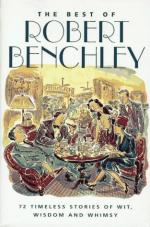
Robert Charles Benchley ( 1889-09-15 - 1945-11-21 ) was an American humorist, critic and actor. Sourced The way to go to the circus, however, is with someone who has seen perhaps one theatrical performance before in his life and that in the High School...
Robert Benchley (1889-1945) was one of the most popular and influential humorists of 20th century America. He took his gentle, self-deprecating wit to celebrity in literature, the theater, and the movies. The offspring of a prominent local family and...
Robert Benchley combined in his life and work many of the traditional qualities of the American humorist. First, and most important, like Washington Irving and Oliver Wendell Holmes, Benchley was a superb comic essayist, catching in carefully cadenced...
In his relatively short life Benchley managed to enjoy careers as a humorist, theater critic, newspaper columnist, screenwriter, radio performer and movie actor. His writing appeared in such magazines as the old Life and The New Yorker and his pieces...
Robert Charles Benchley (September 15, 1889 – November 21, 1945) was an American humorist best known for his work as a newspaper columnist and film actor. From his beginnings at the Harvard Lampoon while attending Harvard University, through his many...
Robert Benchley and the Knights of the Algonquin Kino It's a lost art-the short comedy talkie, produced by the hundreds during Hollywood's so-called golden age as nothing more than bonus gifts for audiences still schooled on the packed, bang-for-your-buck vaudeville experience. The...
HOW refreshing to read a biography of a humorist who was not, in real life, a son of a bitch. The worst that could be said of Robert Benchley (1889-1945) was that he was a bit of a bounder to his wife, an absentee...
A federal judge has ruled that compiling Dorothy Parker's poems was a far less original act than writing them.The editor of a book of uncollected work by the late author did not show enough "creativity" to claim copyright infringement from a near-identical set contained in...
Question 1 of 10:She was to become one America 's best-known critics, but how did Dorothy first make a living?A fashion model A pianist A nannyA secretaryQuestion 2 of 10:The first of many tragedies to befall Dorothy was the premature death of her brother, who...
He wasn't lazy. He liked to put things off as long as he could. He was a procrastinator. He got his copy done just in the nick of time for the New Yorker. They often had to send runners out to get it. Benchley's law is "Any man can do any amount of work, provided it's not the work he's supposed to be doing." So he would find all manner of things to do rather than start a piece. During the Depression decade, Robert Benchley wrote nearly seventy-five casual essays for...
There came a time early in the 1940s when Benchley, after years of resisting identification as an actor, had to concede that he no longer considered himself a writer. Nathaniel Benchley tells of his father's announcement, in November 1943, "that he was through with writing and was resigned to being a radio and movie comedian," but he had already issued much the same statement two years earlier in a Columbia Studios press release. According to this source, he had wearied of trying to mai...
It is impossible to say just when the bemused householder and white-collar man became really prominent in American humor, but by 1910 Stephen Leacock, Simeon Strunsky, and Clarence Day, Jr. were writing pieces in which the disguise of each author was just that. As noted before, one of Benchley's direct models was Leacock, whose Literary Lapses appeared in that year. "Leacock to quote Ralph L. Curry found much of his fun in the little man beset by advertising, fads, convention, sex, science, c...