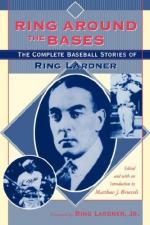
Lardner, Ring (1885-1933)
Ring Lardner's cynical humor made him one of the most popular writers of the 1920s. Throughout his career, first as a sports writer and columnist and then as the autho...
Read more
Biography EssayRing Lardner began his writing career as a newspaperman, first covering routine assignments for a local paper in South Bend, Indiana, then moving to Chicago where he was a sports report...
Read more

Ringgold Wilmer Lardner (1885-1933), American writer, was an important literary humorist and the author of sports fiction. His stories are distinguished by a bitterly sardonic view of humanity. He has...
Read more
Ring Lardner began his writing career as a newspaperman, first covering routine assignments for a local paper in South Bend, Indiana, then moving to Chicago where he was a sports reporter specializing...
Read more
Rats drove Ring Lardner into journalism.As he told the story, he was working as a meter reader for a gas company in his hometown of Niles, Michigan, but too often he found "a rat reading the meter a...
Read more
Ring Lardner was one of the most admired American writers of the 1920s--praised by Virginia Woolf in 1925 as the author of "the best prose that has come our way" from America; compared favorably to Ma...
Read more
Ring Lardner 's place in literature as one of America's most important and influential short-story writers and humorists is secure. He was also a successful playwright, although his ambition was to be...
Read more
In the following review of How to Write Short Stories, Mencken claims that no contemporary American writes better, though he doubts Lardner's work will stand the test of time.
Some time ago a y...
Read more
In the following essay, Patrick surveys Lardner's stories from 1925 to 1929, noting his switch in narrative technique from first to third person.
After slackening his production of short storie...
Read more
In the following excerpt, Friedrich discusses Lardner's sports stories and notes how Lardner's prose changed the style and candor of sports journalism.
Nevins Surveys Lardner's St...
Read more
In the excerpt below, Voss provides a brief assessment of Lardner's short fiction, noting in particular those qualities that distinguish Lardner's best stories.
A journalist turned short...
Read more
In the following essay, Spatz surveys Lardner's short fiction, placing the major stories in the literary tradition of despair that had begun in the early 1920s with T. S. Eliot's "...
Read more
In the essay below, Holmes evaluates Lardner's career and short fiction against earlier criticism, concluding that Lardner was "a realist, an ironist, and a satirist" who created ...
Read more
In the following excerpt, Yardley claims that although Lardner's prose style had a major affect on American journalism and fiction, critics have neglected—not rejected—the bulk of...
Read more
In the following essay, Evans details Lardner's misogynist depiction of female characters.
Jonathan Yardley has suggested that Lardner "tended to divide women into two separate and absol...
Read more
In the following essay, Bordewyk traces four types of communication failures in Lardner's fiction, each of which leads to a sense of alienation among his characters.
Mark Twain once said that &...
Read more
In the following essay, Hart argues that in You Know Me Al Lardner lampoons the "twentieth-century American," who is both egotistical and conformist.
When You Know Me Al appeared in book...
Read more
In the following essay, Gilead investigates abusive language in Lardner's stories, noting its effects on both the narrator and reader.
Influenced by Michel Foucault's investigations of t...
Read more
Virginia Woolf's Laudatory Review of You Know Me Al:
When a crack player is in the middle of an exciting game of baseball he does not stop to wonder whether the audience likes the color of his...
Read more
In the following essay, Blythe and Sweet revise the standard interpretation of the barber-narrator as senseless in "Haircut," perhaps Lardner's most famous story, suggesting he is...
Read more
In the following essay, Pellow describes how Lardner's "baseball dialect" in You Know Me Al serves to create a universe devoid of communication or logic.
In writing that is about ...
Read more
In the following essay, Payne describes how the protagonist of "The Love Nest" violently manipulates language to impose his will
Ring Lardner criticism has come a long way since Clifton ...
Read more
In the following essay, Robinson traces the scholarship on Lardner and analyzes it in terms of "shifting class polarities."
[Lardner's vernacular humor] appeals to two types of m...
Read more
In the following excerpt, Cowlishaw counters the argument that readers are helpless to battle the effects of Lardner's "authorial manipulation."
Readers' responses to Ring ...
Read more
In the essay below, Fadiman accuses Lardner of viciousness, arguing that "the hates himself; more certainly he hates his characters; and most clearly of all, his characters hate each other....
Read more
In the following review of Lose with A Smile, Mencken argues that critics ignore Lardner because of his attack on idealism and sentimentality.
Writing in this place in July, 1924, I permitted myself t...
Read more
In the following essay, which was originally published in 1933, Fitzgerald eulogizes Lardner, lamenting the fact that Lardner expressed so little of what he felt so deeply.
For a year and a half, the ...
Read more
In the essay that follows, Farrell evaluates Lardner's characters in Round Up, finding that "they are among the most banal characters in all of modern American fiction. " Yet thes...
Read more
In the following essay, Pritchett argues that Lardner's principal contribution to American prose is his welding together of the "stream of consciousness " and the "stream o...
Read more
In the essay below, Webb asserts that the "dominant theme in Ring Lardner's writing was not the pettiness and meanness of modern life; it was the problem of communication."
Our ju...
Read more
In the following essay, Hardwick observes that Lardner's characters are unexpectedly mean and desperate during a time when the country is booming and other authors are writing about the "...
Read more