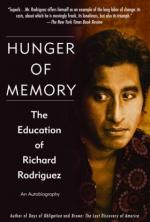
In 1981 Richard Rodriguez burst onto the publishing scene with his autobiography, Hunger of Memory: The Education of Richard Rodriguez . Its success can be attributed to the author's antagonism to bil...
Read more
Richard Rodriguez's life and writing are about balance and paradox--the joining together of seemingly irreconcilable differences. In his life as a writer he balances between journalism, particularly b...
Read more
In the following essay, Fine examines the development of Rodriguez's cultural perceptions throughout his two autobiographies.
Hunger of Memory: The Education of Richard Rodriguez garnered both ...
Read more
In the following essay, Márquez debates the problems of classifying Rodriguez's memoirs as “ethnic-autobiographies.”
A. Analysis of Themes and Form
Hunger of Memory is comp...
Read more
In the following essay, McNamara discusses the various forms of cultural identity that Rodriguez describes in Days of Obligation, particularly the concept of double consciousness within San Francisco&...
Read more
In the following essay, Schilt studies the pastoral qualities of several of the essays in Days of Obligation.
The tender soul has fixed his love on one spot in the world; the strong man has extended h...
Read more
In the following essay, Tilden discusses Rodriguez's views on homosexuality and the role of the Catholic Church as both a censor and a solicitor in his essay “Late Victorians.”
In...
Read more
In the following essay, Fachinger discusses the differences in autobiographies written by authors from distinct ethnic and racial backgrounds, using the memoirs of Eva Hoffman and Richard Rodriguez as...
Read more
In the following review of Days of Obligation, Henderson comments on Rodriguez's continuing quest for self-identification.
Richard Rodriguez's first book, Hunger of Memory, established h...
Read more
In the following review, Stavans offers a negative assessment of Days of Obligation: An Argument with My Mexican Father.
It is a complex fate to be an American. James Baldwin liked to quote Henry Jam...
Read more
In the following interview, Rodriguez discusses American culture, cultural assimilation, and his growing pessimism towards multiculturalism.
Essayist Richard Rodriguez, best known for his 1982 book Hu...
Read more
In the following review, Read offers a positive assessment of Days of Obligation and comments on Rodriguez's exploration of the differences between Anglo-Saxon and Latino-American culture.
At ...
Read more
Richard Rodriguez, the author, describes his experience of growing up as an immigrant from Mexico, who's family has adopted English as their main language. Rodriguez expresses his support for encourag...
Read more
In a passage written by Richard Rodriguez, the author recaps spending the Christmas season at home with the family. While recalling the event, Rodriguez provides details on Mother Rodriguez's predict...
Read more
Torn between the two lands of his heritage, Richard Rodriguez struggles with a seemingly impossible decision: he had once harbored a belief that the two opposing cultures could reconcile their differ...
Read more
In his introduction to Days of Obligation, Richard Rodriguez describes the emotional paradox he encounters as he compares the comedy of California to the tragedy of Mexico. Even before Monroe declare...
Read more