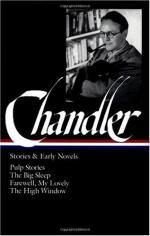
Chandler, Raymond (1888-1959)
Raymond Thornton Chandler started writing fiction in middle-age, out of economic necessity, after being fired from his job. Despite his late start and relatively brief ca...
Read more
In the late 1940s well-known British author and critic Evelyn Waugh hailed Raymond Chandler as America's "greatest living writer." Poet W. H. Auden stated that Chandler's mystery novels "should be rea...
Read more
Upon the publication of his first novel, The Big Sleep (1939), Raymond Chandler was hailed as one of the leading practitioners of the American hard-boiled detective novel, but he received virtually no...
Read more

In the following essay, Chandler describes what he believes is good mystery fiction.
The detective story, even in its most conventional form, is difficult to write well. Good specimens of the art are ...
Read more
In the following essay, Meador discusses Chandler's early writing career, tracing the development of his use of language and his social attitudes, while also describing the creation of his chie...
Read more
In the following essay, Margolies presents an overview of Chandler's career, commenting on his themes, style, and characters, as well as placing his works in their cultural and historical conte...
Read more
In the following essay, Marling surveys Chandler's short stories, addressing issues of plot, character, and style in each.
Before he invented Philip Marlowe in The Big Sleep, Chandler created ...
Read more
In the following essay, Wolcott discusses Chandler's works in light of current literary tastes.
Lined up on the shelves in their glossy black jackets, the books constituting the Library of Ame...
Read more
In the following review, Lyons favorably critiques the Library of America's two-volume edition of Chandler's collected writing.
The Library of America has just issued a two-volume editio...
Read more
In the following review of Raymond Chandler Speaking, Priestley assesses Chandler's story-telling skills and his efforts to turn murder mysteries into literature.
Raymond Chandler Speaking off...
Read more
In the following review of Raymond Chandler Speaking, Pollock describes Chandler's writings in light of significant events in his life.
Following in Dashiell Hammett's footsteps, Raymon...
Read more
In the following essay, Durham examines Chandler's published short stories, praising his evocative descriptions of character and the city of Los Angeles.
Thousands of ghost-like flimsy wooden ...
Read more
In the following essay, Durham analyzes Chandler's narrative technique, noting his lively prose, elegant expression, and belief that style was more important than plot
In England early in 1954 ...
Read more
In the following essay, Durham discusses Chandler's efforts to develop his short detective stories into serious novels concerned with themes of social injustice.
During his lifetime Raymond Ch...
Read more
In the following essay, Beekman maintains that Chandler's writings transcend the ordinary limitations of mystery-detective fiction through the author's acute consciousness of style and e...
Read more
In the following essay, Symons traces stylistic developments in Chandler's works and characterizes the author as a romantic aesthete primarily concerned with the literary quality of his writing...
Read more
In the following essay, Speir discusses how Chandler's short stories evolved into novels and argues that the pulp stories were an essential stage in Chandler's development as a novelist....
Read more
In the following essay, Mayer discusses film adaptations of Raymond Chandler's works, commenting on ways in which Chandler's style becomes altered in the screen realizations of his novel...
Read more
In the following essay, Grimes explores three modern novels as “revisions” of Raymond Chandler's hard-boiled detective formula that increasingly focus on the role of the imaginati...
Read more