RĀMĀYAṆA. Along with the Mahābhārata, the Rāmāyaṇa is the most influential epic of India. Attributed to the sage Vālmīki, it is a poem of about fifty thousand lines narrating in...
The great Sanskrit epic poem, the Ramayana, attributed to the legendary poet-sage Valmiki, appears to have been largely composed during the first half of the first millennium BCE. Since that time, it has firmly established itself as one of the most...
For the television series by Ramanand Sagar, see Ramayan (TV series). The Ramayana (Devanāgarī: Rāmāyaṇa, रामायण) is an ancient Sanskrit epic attributed to the poet Valmiki and an important part of the Hindu canon (smṛti). The name...
Scholarly activity in the Indological world in recent years has given evidence of a renewed interest in the study of the Ramayana in many of its numerous versions. Publication of works such as the ongoing translation of the critical edition of the Valmiki Ramayana,...
Byline: MICHAEL COVENEY The Ramayana by Pete Oswald: Royal National Theatre WELL, here's a rare and beautiful thing for Easter week at the National. An ancient Hindu epic has been done up by Pete Oswald - a new voice in verse...
Thailand's new military-appointed government has threatened to shut down an operatic version of the Hindu epic Ramayana, ostensibly over fears one of its scenes may bring bad luck. "Ayodhya" premiered Thursday night and is scheduled for repeat performances on Saturday...
Dec 5 (Reuters) - Following are some of the major events to have occurred on December 12 in history: 1913 - Leonardo Da Vinci's painting "Mona Lisa" was recovered in Florence two years after it had been stolen from the Louvre in Paris. 1936...
In the following essay, Alles compares the social and mythological contexts of the Ramayana and The Iliad, arguing that both poems reflect the problem social communities face when persuasion breaks down.
In the following entry, Hess discusses the sexual politics of male domination and female subjugation as expressed in the Ramayana, exploring responses to those doctrines.
The main traditional texts that support the traditional roles of men and women are the Rg Veda, the Kalpa Sutras, the epics (the Ramayana and Mahabharata), Tryambaka, and Manu Smrti. They are believed to lay the foundations for order in society, as well as giving people the knowledge of their duty. These separate texts have defined roles within castes and genders and show how their different styles of writings have defined roles in different ways.
The Ramayana is not just a story of virtues and deeds performed by Rama but it is also a book of love, the undying love of Rama and Sita. Their relationship is filled with divine love, faith and total commitment.
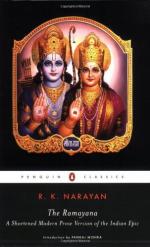
Discusses the Ramayana, by R.K. Narayan. Provides a plot summary, explores the personalities of major characters and examines the story's importance to Hindu culture in India.