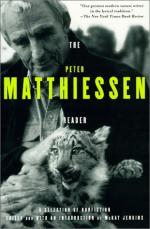
Peter Matthiessen is widely considered one of the most important wilderness writers of the twentieth century. In fiction and nonfiction alike, he explores endangered natural environments and human cul...
Read more
Peter Matthiessen was born on May 22, 1927, in New York City to Elizabeth Carey and Erard Matthiessen. "I am a New Yorker by birth, not inclination; I have never remained there very long."My formative...
Read more

Peter Matthiessen's increasingly substantial reputation as a novelist rests firmly on two remarkable books. Although he wrote three promising early novels, his two best-known works of fiction are sure...
Read more
Peter Matthiessen is among a handful of American authors to be nominated for the National Book Award in both fiction and nonfiction--for the novel At Play in the Fields of the Lord (1965) and the trav...
Read more
While Peter Matthiessen's publications include several well-received novels, his reputation as a writer rests largely on his nonfiction nature books, which passionately yet scientifically document the...
Read more
Critical Essay by Paul Zweig
Peter Matthiessen is one of the important wilderness writers of our time. His The Tree Where Man Was Born … is a masterpiece of understated prose and exacting desc...
Read more
Critical Essay by Edward Hoagland
Peter Matthiessen has made [in "The Snow Leopard"] another of his epic trips for us—epic in the sense that he writes about them so much better t...
Read more
Critical Essay by Terrence Des Pres
The best places are not on any map, or so Melville once remarked, and Peter Matthiessen would surely agree…. Most of his work has grown from first-hand expe...
Read more
Critical Essay by Jim Harrison
The Snow Leopard is an heraldic book, full of ghosts, demons and unfamiliar mythologies; a well-veiled, lower-case buddhist text set in the virtual top of the world, th...
Read more
Critical Essay by Leonard Michaels
Most impressively dramatic [in The Snow Leopard] is Matthiessen's account of [his] passage through the Himalayas. In images that are intensely kinesthetic as...
Read more
Critical Essay by Robert M. Adams
[The Snow Leopard is a kind of book] with which we are becoming familiar lately; it is part travelogue, part autobiography, part historical discourse, and predominan...
Read more
Critical Essay by Donald Hall
For a long time, [Matthiessen's] writing has been vigorous, metaphoric, exact, luminous, coherent, and resolved. If one sensed that something was lacking, one did...
Read more
Critical Essay by Sylvia Berkman
[With] his first novel "Race Rock," [Peter Matthiessen] assumes immediate place as a writer of disciplined craft, perception, imaginative vigor and seri...
Read more
Critical Essay by John Thompson
Far back upstream, so very far back in the jungles of the Amazon headwaters that not even an anthropologist has visited them, live the Indians of Peter Matthiessen...
Read more
Critical Essay by Robert M. Mengel
Highly original in its approach and a beautiful object in its own right, [The Shorebirds of North America] devotes itself to its subject, not only with unstinting e...
Read more
Critical Essay by John Hay
[The Shorebirds of North America] is one of the finest books of natural history that I have ever seen, regardless of its qualities as an ornithological text, which are cons...
Read more
Critical Essay by John Rechy
Peter Matthiessen's Sal Si Puedes ("Escape If You Can") documents … [a] list of horrors surrounding the migrant workers: abysmal living condit...
Read more
Critical Essay by James Forest
[In Sal Si Puedes Peter Matthiessen] prefers the typewriter equivalent of the cinema verité, shoulder-held camera approach over the rehearsed, Mennen-deodorized,...
Read more
Critical Essay by John Womack, Jr.
Of all the recent books on farm-workers, the truest is Peter Matthiessen's Sal Si Puedes. It was born in a deathly time, in the wretched summer of 1968, afte...
Read more
Critical Essay by William Styron
[The essay from which this excerpt is taken originally appeared in 1979 as an introduction to Peter Matthiessen, A Bibliography: 1951–1979, compiled by D. Nich...
Read more
Critical Essay by Samuel Pickering, Jr.
In comparison to The Snow Leopard, which is marred by botanizing amid Eastern philosophy, Sand Rivers is straightforward. Although the elephant becomes a symbo...
Read more
Critical Essay by Jim Harrison
"Sand Rivers" is a strange, bittersweet, autumnal book based on a safari into the Selous Game Reserve in southern Tanzania, one of the last great wilderne...
Read more
Critical Essay by Vernon Young
Matthiessen was invited, in 1979, to join what the sponsor called "the last safari into the last wilderness," namely the Selous Game Preserve, largest rem...
Read more
Critical Essay by Edward Weeks
[Peter Matthiessen] is by intention a tight writer: he begins with a situation of tension and screws it to a higher pitch. This is his device in his first novel, Race R...
Read more
Critical Essay by Robert Sherrill
[Matthiessen] has had considerable experience observing others hunt all sorts of beasts and fish. This is the first time he has observed manhunts, and there are mome...
Read more
Critical Essay by Christopher Lehmann-haupt
In a letter of his own that he quotes in his latest nonfiction work, "In the Spirit of Crazy Horse," Peter Matthiessen describes the case he ...
Read more
Critical Essay by Alan M. Dershowitz
"In the Spirit of Crazy Horse," is really about contemporary America and the way American law is seen through the eyes of American Indians. It is no...
Read more
Critical Essay by Roderick Nordell
Even when Peter Matthiessen writes the text in a book full of photographs ("The Tree Where Man Was Born," with Eliot Porter's pictures of Afric...
Read more
Critical Essay by Page Stegner
On a sultry morning in June 1975 two FBI agents assigned to the Pine Ridge Reservation near Rapid City, South Dakota, followed a station wagon onto Indian land somewher...
Read more
Critical Essay by Wilcomb E. Washburn
Mix together the following ingredients: a threatened natural environment, endangered plants and animals, and Indians resisting change, and you have the formula f...
Read more
Critical Essay by Paul Zweig
For almost twenty years, Peter Matthiessen has pursued a vanishing world of wilderness and uninhabited spaces in which man is no more than a sparse, gentle guest. In a do...
Read more
Critical Essay by Peter Nabokov
During the past eight years Peter Matthiessen has returned from his travels in Africa or Nepal to discover a hidden network of native American states of mind and place...
Read more
Critical Essay by William Goyen
["Partisans" is] the quest of a young American for his identity in terms of a search for a political hero and guide. It is the hope of this young man, so...
Read more
Critical Essay by James Finn
In Partisans many of the situations … seem contrived….
[Too] often [the] characters do not merely express or even embody the ideas they discuss; they are...
Read more
Critical Essay by Archie Carr
Packed with carefully gathered information, ["Wildlife in America"] is a delight to read. Appendices offer factual material on rare, declining and extinct ...
Read more
Critical Essay by Terry Southern
[In Raditzer we find] a character distinct from those in literature, yet one who has somehow figured, if but hauntingly, in the lives of us all. It is, in certain way...
Read more
Critical Essay by Marston Bates
Peter Matthiessen, novelist and naturalist, started on his way to South America. Five months later he came back—and wrote a book ["The Cloud Forest...
Read more
Critical Essay by Loren Eiseley
["Under the Mountain Wall," a] sensitively written book by Peter Matthiessen, is an engrossing human document that sheds light on the story of man, stone...
Read more
When the board of directors of The Paris Review named New Yorker staff writer Philip Gourevitch as the new editor of the literary quarterly last week, a flicker of surprise rippled among the writer...
Read more