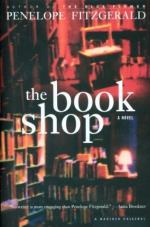
From virtually the outset of her career as a novelist, Penelope Fitzgerald's work has attracted serious critical attention. Her second novel, The Bookshop (1978), was shortlisted for the Booker Prize,...
Read more
Penelope Fitzgerald's novels are described by Frank Kermode in the London Review of Books as "the kind of fiction in which perfection is almost to be hoped for." Louis B. Jones, in The New York Times ...
Read more

Critical Essay by Susannah Clapp
Penelope Fitzgerald's first novel [The Golden Child] is a small, benign thriller set in a London museum. It has an amiable, mostly baffled hero, who worries abo...
Read more
Critical Essay by P. H. Newby
[Penelope Fitzgerald's] Human Voices is about the BBC in the summer and autumn of 1940, when French troops camped in London parks, the Concert Hall in Broadcasting...
Read more
Critical Essay by Penelope Lively
Penelope Fitzgerald's latest book, Human Voices, makes use of her experiences in the BBC during the war to give us another exercise in the fiction of economy a...
Read more
Critical Essay by Valentine Cunningham
Penelope Fitzgerald's The Bookshop is on any reckoning a marvellously piercing fiction. It is (of course) about a woman's resilience under stress. ...
Read more
Critical Essay by John Mellors
[In The Bookshop] Penelope Fitzgerald paints the bleak East Anglian coast in a verbal equivalent of the watercolours which a local artist tries to persuade Florence to e...
Read more
Critical Essay by A. S. Byatt
[Penelope] Fitzgerald's new book, Human Voices, is about the BBC in the early days of the war…. She attempts to be exact; she offers authorial summings-up a...
Read more
In the following review, Eder praises Fitzgerald’s deft use of details to evoke a sense of possibilities in her Gate of Angels.
High wind and drenching rain lash the flat fenlands [in Penelope ...
Read more
In the following review, Holmes traces the course of Fitzgerald’s career that eventually led her to write The Blue Flower.
The sensibility of early German Romanticism seems infinitely distant t...
Read more
In the following essay, Gitzen studies Fitzgerald’s use of compression in her novels, tracing common features including a short time span, a restriction of plot, and a minimum number of promine...
Read more
In the following review, Herzog asserts that the spareness of Fitzgerald’s style and her ability to capture setting in The Blue Flower create a powerful effect on the reader.
The late eighteent...
Read more
In the following excerpt, Flower states that The Bookshop is “clearly one of [Fitzgerald’s best.”]
Another backward glance must be made at the amazing career of Penelope Fitzgeral...
Read more
In the following review, Knapp delineates the positive and negative features of Fitzgerald’s The Blue Flower.
Penelope Fitzgerald’s ninth novel The Blue Flower, sets out to retell the ta...
Read more
In the following review, Hensher argues that Fitzgerald’s The Blue Flower finally solidifies the author’s reputation.
A little national pride has been restored, in the aftermath of the m...
Read more
In the following review, Charters provides a brief overview of Fitzgerald’s life and career and how the author’s experience working at the BBC during World War II provided the basis for ...
Read more
In the following review, Raban lauds Fitzgerald’s ability to write as if from first-hand memory instead of historical research, especially in her Human Voices.
If Penelope Fitzgerald has ever f...
Read more
In the following review, Wheeler states that the central paradox of Fitzgerald’s Human Voices is between human truth and the lies of war.
The trouble with memory “is that it develops its...
Read more
In the following essay, Bawer traces the distinctive characteristics of Fitzgerald’s fiction and asserts that these features are most prominent in The Gate of Angels.
Among the many symptoms of...
Read more
In the following excerpt, Pritchard lauds Fitzgerald’s Gate of Angels as a “delightful entertainment.”
For some reason I’ve failed to read Penelope Fitzgerald, thus know he...
Read more
In the following review, Annan discusses the amount of detail Fitzgerald manages to put into The Blue Flower.
The German Romantics were drunk with ideas, and Novalis was the drunkest. He is the hero o...
Read more
In the following review, Ratcliffe complains that while Fitzgerald has provided a well-drawn setting and several memorable characters, she has not given all of her heart to The Blue Flower.
Penelope F...
Read more
In the following review, Gardam praises Fitzgerald’s ability to draw a convincing setting and set of characters in The Blue Flower.
‘Novels arise out of the shortcomings of historyȁ...
Read more
In the following review, Kermode asserts that Fitzgerald’s skillful use of detail in The Blue Flower convincingly renders the historical moment.
Penelope Fitzgerald’s The Blue Flower is ...
Read more
In the following review, Eder describes the mosaic quality of Fitzgerald’s writing in The Blue Flower.
It is not certain that God makes a distinction between Beethoven’s writing the Wald...
Read more
In the following review, Dirda recounts the virtues of Fitzgerald’s Blue Flower.
Penelope Fitzgerald brought out her first novel in 1977, when she was past 60; in the two decades since then her...
Read more