Biography EssayPaul Theroux's novels, short stories, essays, and travel books, in which he often explores the expatriate experience and the postcolonial world of developing countries, have established...
Read more

Paul Theroux (born 1941) was an expatriate American writer of numerous works of fiction and of the chronicles of his own travels by train throughout the world. He was a keen observer of the relationsh...
Read more
The author of over three dozen books, Paul Theroux has earned a reputation as travel writer par excellence and as a novelist whose works speak of colonialism and of the expatriate experience. For many...
Read more
Paul Theroux, an American novelist who has lived and written as an expatriate since 1963, was born in Medford, Massachusetts, on 10 April 1941, to Albert Eugene and Anne Dittami Theroux. Following his...
Read more
Paul Theroux has achieved international fame and literary accolades for his travel writings, novels, short stories, poetry, and critical essays. Just as his literary interests shape his travel writing...
Read more
In the following review, Mann praises the detail and honesty of Theroux's description of China in Riding the Iron Rooster.
There will probably be no better portrait of how China looks and fe...
Read more
In the following review of Riding the Iron Rooster, Tung objects to Theroux's negative portrayal of China, which the critic finds only partially justified.
Paul Theroux's China is not...
Read more
In the following review, Wright offers a generally positive assessment of Riding the Iron Rooster.
Paul Theroux is a man who travels unburdened by illusions—a rare gift, and especially so in...
Read more
In the following review, Johnston offers a negative assessment of My Secret History.
Until Salman Rushdie came along, Paul Theroux was the literary establishment's most prosperous Third Worl...
Read more
In the following review, Jaffe praises the evocative descriptions and attention to detail in My Secret History.
Paul Theroux has written a shelf full of books—25 in all—and unlike Hem...
Read more
In the following negative review, Profumo criticizes the lack of emotion in My Secret History.
There is an emphatic disclaimer prefacing this novel [My Secret History], to the effect that it is not...
Read more
In the following review, Krist analyzes the relationship between character and theme in My Secret History.
My Secret History, an enormous book of over 500 pages, belongs to an increasingly familiar...
Read more
In the following negative excerpt, Wilhelmus objects to the protagonist, plot, and tone of My Secret History.
Much of the pleasure in preparing a chronicle like this lies in seeing how the various ...
Read more
In the following review, Brookner argues that Chicago Loop represents “a clinical tour de force” for its relentlessly dispassionate portrayal of the psychopathic mind.
[In Chicago Loo...
Read more
In the following excerpt, Marien compares Theroux's mental state during his Pacific tour to his descriptions of the scenery in The Happy Isles of Oceania.
Paul Theroux's latest excurs...
Read more
In the following positive review, Frater praises the insights, accessibility, and humor of The Happy Isles of Oceania.
Paul Theroux's almost Napoleonic progress across the planet has taken h...
Read more
In the following review, Wright compliments the authentic details and candid tone of The Happy Isles of Oceania, praising it as one of Theroux's best works.
Paul Theroux once said in an inte...
Read more
In the following review, Mortimer offers a negative assessment of The Happy Isles of Oceania.
Paul Theroux can make pleasant reading, when he is not being deliberately disagreeable and his book [Th...
Read more
In the following review, Kennedy offers a positive assessment of Millroy the Magician.
“My name is Millroy and I am a messenger. I was once so fat I was imprisoned in the darkness of my body...
Read more
In the following negative review, Shone argues that Millroy the Magician is inferior to Theroux's earlier novel The Mosquito Coast.
When, at the start of Paul Theroux's new novel [Mil...
Read more
In the following essay, Staggs provides an overview of Theroux's life and career upon the publication of Millroy the Magician, incorporating Theroux's comments on his travel writing and ...
Read more
In the following review, Williams offers a generally positive assessment of Millroy the Magician, but finds the novel's imagery and style overbearing.
“My name is Millroy and I am a m...
Read more
In the following essay, Wheeler provides an overview of Theroux's travel writing and fiction, drawing attention to recurring themes and preoccupations that link his work in both genres, includi...
Read more
In the following excerpt, Flower offers a mixed assessment of Millroy the Magician, citing shortcomings in the passive characterization of Jilly.
[John Gregory] Brown is not the only male writer th...
Read more
In the following negative review, Curran asserts that Jilly's characterization and the narrative of Millroy the Magician are underdeveloped.
Paul Theroux has built his reputation, in part, o...
Read more
In the following review, Hopkins evaluates the strengths of The Pillars of Hercules, after confessing his initial apprehension about reading the work.
The night before beginning a bout of “l...
Read more
In the following review, Urquhart offers a mixed assessment of The Pillars of Hercules, which he concludes is “an uneasy book” despite its “many delights.”
At a time whe...
Read more
In the following review, Coster contrasts the autobiographical aspects of The Pillars of Hercules with those of Theroux's fiction.
‘Are you making a trip here to write a book?’...
Read more
In the following review, Leader examines the imaginary and the real-life incidents in My Other Life, distinguishing the significance of the difference between the two.
When “Paul Theroux,...
Read more
In the following review, Mortimer offers a generally positive assessment of The Pillars of Hercules.
Paul Theroux has mellowed between the Pillars of Hercules, even allowing a wry smile at his own ...
Read more
In the following review of My Other Life, Rubin commends Theroux's skillful prose and lively characterizations, but finds shortcomings in his efforts to probe the psyche of his alter-ego.
Th...
Read more
In the following review, Sexton offers a positive assessment of The Collected Stories and comments on the difficulty of assessing Theroux's overall literary achievement.
Paul Theroux, a grea...
Read more
In the following review of The Collected Stories, Tandon commends Theroux's satires on cross-cultural blunders, but concludes that much of his fiction is marred by a sense of self-indulgence.
...
Read more
In the following positive review, Mirsky praises Theroux's attention to sensual details in Kowloon Tong.
Joseph Conrad said his “task” was “by the power of the written w...
Read more
In the following review, Powers offers a mixed assessment of My Other Life, which she judges to be alternately “funny” and “off-putting.”
My Other Life limns an artistic...
Read more
In the following excerpt, Pritchard praises the culinary aspects of the prose in Kowloon Tong.
It was an extraordinary spring for fiction, as if all the established novelists, especially in this co...
Read more
In the following review of The Collected Short Novels, Crane argues that Theroux's short fiction, while highly competent, is formulaic and unrelentingly morose when viewed cumulatively.
Only...
Read more
In the following review, Knudsen offers a mixed assessment of Kowloon Tong, which he finds excessively “dreary,” but redeemed in part by Theroux's observational skill.
Through ...
Read more
In the following review, Eder describes Sir Vidia's Shadow as fascinating yet deeply flawed by Theroux's recriminations against Naipaul.
Suppose that James Boswell, resenting his own ...
Read more
In the following review, Bowman asserts that Sir Vidia's Shadow is an interesting memoir, but a poor display of Theroux's self-pity and anger.
If only Paul Theroux had consulted Dr. L...
Read more
In the following review, Raphael offers a positive assessment of Sir Vidia's Shadow.
Writers' friendships are often written on water; their enmities are chiselled in stone. Disillusio...
Read more
In the following negative excerpt, Allen expresses contempt for what she sees as the hostility, jealousy, and hypocrisy in Sir Vidia's Shadow.
The appearance in bookstores of the bound, publ...
Read more
In the following review, King focuses on Theroux's descriptions of V. S. Naipaul as a man and as a writer in Sir Vidia's Shadow.
Sir Vidia's Shadow is subtitled A Friendship Ac...
Read more
In the following review, Wilson describes Sir Vidia's Shadow, as an engrossing, if unflattering, portrait of literary jealousy and resentment.
I have been trying to explain to myself how suc...
Read more
In the following review, Sylge offers a positive assessment of Fresh Air Fiend.
Dipping in and out of Fresh Air Fiend, I am struck by what a damn good life Paul Theroux has had: a life on the road ...
Read more
In the following review of Fresh Air Fiend, Cussen examines Theroux's attitudes toward aging, his commentaries on other noted travel writers, and his problematic postcolonial views.
Towards ...
Read more
In the following review, Rose offers a positive assessment of Fresh Air Fiend, but notes the uneven quality of the work's diverse selections.
Paul Theroux is the author of nine travel books....
Read more
In the following review, Stewart offers an unfavorable assessment of Fresh Air Fiend.
Fresh Air Fiend, a collection of pieces written between 1985 and 2000, is an odd, disjointed book, some parts o...
Read more
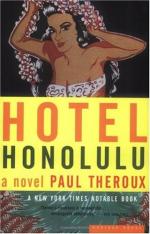
In the following review, McAlpin offers a positive assessment of Hotel Honolulu, calling Theroux a “sharp, unblinking storyteller.”
The ever-prolific Paul Theroux, who demonstrated a ...
Read more
In the following review of Hotel Honolulu, Newton finds Theroux's preoccupation with sexual indulgence tiresome, but appreciates his larger interest in the significance of literary culture.
...
Read more
In the following negative review, Mirsky criticizes the plot, characterization, and dialogue of Hotel Honolulu.
In 1997 Paul Theroux published Kowloon Tong, a novel many readers in the colony disli...
Read more
In the following review, Feehily provides an overview of the narration and themes in Hotel Honolulu.
Mention Hawaii and most people think of the famous TV show: those rolling drums, that zoom shot ...
Read more
Critical Essay by Michael Irwin
The first thing to say about [The Consul's File] is that it makes excellent reading. The stories span a wide range of mood and theme. At one extreme there is co...
Read more
Critical Essay by Anthony Burgess
To Somerset Maugham it was the F.M.S., to Henri Fauconnier Malaisie, to myself Malaya; to the American writer Paul Theroux … it is Malaysia. It is recognizabl...
Read more
Critical Essay by Donald Davie
"The war did not destroy the English—it fixed them in fatal attitudes. The Japanese were destroyed and out of that destruction came different men; only th...
Read more
Critical Essay by Anne Tyler
From the start, Paul Theroux's ["Picture Palace"] takes us by surprise. In the first place, it's less exotic than most of his books, which ten...
Read more
Critical Essay by Nicholas Guild
It is refreshing to find a story that touches on the relationship between art and life and still manages to avoid the narcissism which so often drenches such producti...
Read more
Critical Essay by Vicki Goldberg
It was bold of Theroux to make Maude a photographer [in Picture Palace], and that she is believable as one is a remarkable feat, since artists are notoriously hard to...
Read more
Critical Essay by Karl Miller
Mr. Theroux's Picture Palace examines the relationship between the personal life of an artist and the art it produces (or, as we shall see, doesn't produce...
Read more
Critical Essay by Paul Bailey
Paul Theroux's brilliant new novel ends with a startling scene. Maude Coffin Pratt, a famous American photographer, is attending the private view of a retrospecti...
Read more
Critical Essay by William H. Pritchard
Paul Theroux is simply a wonder, and [Picture Palace is] a remarkable piece of work. In reviewing … The Family Arsenal … I spoke of how it (and it...
Read more
Critical Essay by Maureen Howard
[The Picture Palace] is an entertainment in the best sense…. Theroux knows what he's about, writing lively narrative, controlling the mystery story elem...
Read more
Critical Essay by Rhoda Koenig
Paul Theroux may be the most irascible traveler since Tobias Smollett. Unfortunately, though, his anger never reaches the manic rage of that entertaining author, but de...
Read more
Critical Essay by Roderick Cook
[Waldo is a] good funny novel. It starts, appropriately enough, with the hero's getting a cream pie flung in his face and ends Paul Theroux 1941– Photogr...
Read more
Critical Essay by Benjamin Demott
Travelers, truants and transplants—Paul Theroux's favorite people since the start of his writing career—are the central figures in "World...
Read more
Critical Essay by Alan Hollinghurst
Paul Theroux's short stories [in World's Fair] avoid … problems of commitment by their comedy and brevity; when he expands in the longer form ...
Read more
Critical Essay by Jonathan Raban
One needs energy to keep up with the extraordinary, productive restlessness of Paul Theroux….
He is as busy as a jackdaw in the way he scavenges for forms a...
Read more
Critical Essay by Stanley Reynolds
The title of Paul Theroux's new book [The London Embassy] is rather misleading. The anonymous narrator indeed works at the American Embassy but his work take...
Read more
Critical Essay by Christopher Lehmann-haupt
"There is an English dream of a warm summer evening on a branch-line train," writes the novelist and travel writer Paul Theroux in one of the...
Read more
Critical Essay by The New Yorker
[In Paul Theroux's Waldo the hero] is a shadowy, passive young man, who moves from one intensely symbolic site to another until he has turned into a slightly o...
Read more
Critical Essay by The Times Literary Supplement
Paul Theroux has set his novel [Girls at Play] in East Africa, and the country is every bit as important as the characters. Its effect is pernicious; i...
Read more
Critical Essay by Laurence Lafore
"Girls at Play" is a horror story—not in the usual sense, but in the way that "King Lear" is a horror story. It is, more precisely...
Read more
Critical Essay by Shane Stevens
In Heart of Darkness, Joseph Conrad brilliantly evoked the sense of isolation that white interlopers feel in Africa: the indescribable loneliness and physical languor ...
Read more
Critical Essay by Susan Hill
Jungle Lovers invites comparison with Graham Greene. The setting might certainly have been his, the serio-comic situations in which the characters find themselves frequen...
Read more
Critical Essay by The Times Literary Supplement
Paul Theroux's comic and disturbing fifth novel, Jungle Lovers [is] set in the brilliantly, and sometimes maliciously, realized Malawi of today....
Read more
Critical Essay by L. J. Davis
Paul Theroux has chosen to measure himself against a very tall ghost indeed: Joseph Conrad. Jungle Lovers is an audacious attempt to tell the other half of The Heart of ...
Read more
Critical Essay by Mordecai Richler
I am unfamiliar with Paul Theroux's highly-praised earlier novels, and only wish I could like "Jungle Lovers" more. There is so much that is ad...
Read more
The Famous
Therouxs
The name
Theroux
was already well-known when
Louis
was growing up, as his father is the
writer
Paul
Theroux
. His dad's novels, which include "The Mosquito Coast", tend t...
Read more
Chugging past shaggy yaks and fluffy clouds that look low enough to lasso, the train from Beijing to Lhasa makes its final climb into nosebleed territory pulled by three locomot...
Read more