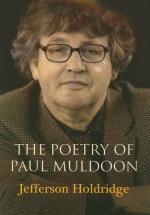
Paul Muldoon is generally associated with Seamus Heaney, Michael Longley, Derek Mahon, and James Simmons. These poets, who emerged in Northern Ireland over a short span of time and achieved, in varyin...
Read more
Critical Essay by Hugo Williams
[Paul Muldoon] represents a painfully accurate rendezvous for the exacting requirements of traditional skill, youthful experiment and popular demand. But the poems [in ...
Read more
Critical Essay by Alan Hollinghurst
Fiction nowadays can scarcely afford to be unselfconscious, and Irish fiction has often been particularly canny about its own business, the artificiality as well as...
Read more
Critical Essay by Rodney Pybus
Paul Muldoon's third collection [Why Brownlee Left] is as humane, ingenious and formally skilful as one would expect after New Weather and Mules, and just a mite ...
Read more
Critical Essay by John Kerrigan
Muldoon's Quoof begins and ends … with an epigraph from Rasmussen's The Netsilik Eskimos—telling how a female shaman made herself a penis of...
Read more
Critical Essay by John Mole
The obscurity in Paul Muldoon's work is … evasive, and often downright teasing. He's a sophisticated high-gloss technician, managing rhyme and stanza f...
Read more
Critical Essay by Geoffrey Stokes
Faber published New Weather in 1973, when Muldoon was barely 21 years old, and his self-assured technical virtuosity was already startling. Yet for all the wit of the...
Read more
Critical Essay by Dillon Johnston
In his first book, New Weather (1973), [Paul Muldoon] distinguishes himself, through his use of metaphor, from Seamus Heaney, whose disciple he is often proclaimed. I...
Read more
Critical Essay by Roger Conover
Two years after publication, Paul Muldoon's New Weather remains the most important first book by an Irish poet since Seamus Heaney's Death of a Naturalist...
Read more
Critical Essay by Colin Falck
In his first book New Weather Paul Muldoon seemed to be controlling a native Irish airiness with a certain determination to be modern and realistic, but he also showed a ...
Read more
Critical Essay by Christopher Hope
[In Mules Paul Muldoon] is evidently aware that however far he reaches, home is where he starts from, and home rules…. Muldoon turns a cold eye on a land fit ...
Read more
Critical Essay by Anne Stevenson
[Paul Muldoon has written] elegantly turned out pastorals in Mules. Here, every cowpat is carefully placed just where you have to notice it for authenticity's s...
Read more
Critical Essay by Craig Wallace Barrow
[Mules] will frustrate those wishing Northern Irish poets to lacerate their souls on the bloody realities of Ulster, for in the collection's first poem, &...
Read more
Critical Essay by Seamus Heaney
[The essay from which this excerpt is taken was originally broadcast over Radio Telefis Eireann in 1978.]
Paul Muldoon's first book was aptly titled New Weather:...
Read more
Critical Essay by Andrew Motion
Why Brownlee Left is Paul Muldoon's third book, and like its predecessors is written in a style which aspires to the condition of clear glass. There are no outbu...
Read more
In the following excerpt, Lucas compliments Muldoon's poetic techinques in Meeting the British, calling the collection “the best of his five full volumes of poetry.”
Like its pred...
Read more
In the following review, Howard evaluates the strengths and weaknesses of Selected Poems: 1968-1987.
For the Irish poet Paul Muldoon no value is more central to the poet's vocation than that of...
Read more
In the following review, McNamara lauds the symbiotic relationship between Muldoon's two collections The Annals of Chile and The Prince of the Quotidian.
In 1794, the English poets Robert South...
Read more
In the following positive review, Ford asserts that The Annals of Chile is “Muldoon's most open and lyrical collection yet.”
‘What are we going to write about now?’ ...
Read more
In the following review, McCarthy discusses Muldoon's decision to write a new poem for every day in 1992 and praises the subsequent collection of the works in The Prince of the Quotidian.
In th...
Read more
In the following review, Quinlan argues that The Prince of the Quotidian will likely satisfy only admirers of Muldoon's previous works and those fond of postmodern verse.
One can look at Paul M...
Read more
In the following interview, originally conducted on April 4, 1996, Muldoon comments on his national identity and influences, his approach to writing, and the composition of “The Briefcase, ...
Read more
In the following essay, Kendall provides an overview of Muldoon's family background, education, publishing career, and critical reception, drawing attention to the formative experiences and per...
Read more
In the following excerpt, Reeve offers a favorable review of The Prince of the Quotidian and The Annals of Chile.
Wake Forest University Press and Farrar, Straus and Giroux teamed up to present Paul M...
Read more
In the following review, Burt lauds Muldoon's skillful verb usage and accomplished verse in Kerry Slides.
Something like a consensus now deems Paul Muldoon the best Irish poet younger than Seam...
Read more
In the following excerpt, Vendler compliments both Selected Poems: 1968-1986 and The Annals of Chile, though she expresses reservations over Muldoon's tendency toward emotional detachment and c...
Read more
In the following essay, Wilson discusses Muldoon's break from the Yeatsian tradition of Irish poetry, particularly as evidenced in Muldoon's patterns of sexual signification and linguist...
Read more
In the following review, Korn asserts that there is “much to praise” in The Faber Book of Beasts, calling the work a “subtle and provoking collection.”
“In poetry, a...
Read more
In the following review of Hay, Kirsch contends that Muldoon's inventive verse is too often a facile display of technical and stylistic virtuosity, whereby complexity and difficulty serve to ...
Read more
In the following essay, Wills provides an overview of Muldoon's poetic style, his personal and intellectual perspective, and critical approaches to his work.
What makes a poem by Paul Muldoon a...
Read more
In the following excerpt, Disch offers a negative assessment of Hay.
I have for a long time been of the opinion that writing poetry, like good manners at dinner, should be a commonplace among any grou...
Read more
In the following excerpt, Kitchen praises Muldoon's verse in Hay, though finds the collection inferior to his previous volume, The Annals of Chile.
It's early morning. I'm sitting...
Read more
In the following essay, Birkerts offers an admiring commentary on Muldoon's challenging and idiosyncratic poetic style.
I first heard of Paul Muldoon through the affectionate enthusing of Seamu...
Read more
In the following review, Wheatley lauds To Ireland, I, Bandanna, and Muldoon's translation of Aristophanes's The Birds.
Marcel Aymé's novel Le Passemuraille, about a man wh...
Read more
In the following review of To Ireland, I, Wills commends Muldoon's idiosyncratic insight into Irish literary and cultural history, but finds shortcomings in his tendency toward overly esoteric ...
Read more
In the following essay, Wheeler presents an overview of Muldoon's poetry, literary career, and personal history, along with Muldoon's own comments on these subjects.
Volumes of the compl...
Read more
In the following review, Quinlan offers a positive assessment of Selected Poems: 1968-1986.
“Kaleidoscopic,” “visionary,” and “charismatic” (the words used on...
Read more
In the following review of Poems 1968-1998, Newey contends that Muldoon's “ludic” poetry often lacks “any substantial core” and risks falling into self-parody.
I wor...
Read more
In the following review, the critic commends Muldoon's “suburban observation and whimsical memory” in Moy Sand and Gravel.
[Moy Sand and Gravel, t]his first full volume since Muld...
Read more
In the following excerpt, Bedient lauds Muldoon's rejection of the traditional motifs of Irish poetry in Meeting the British and Selected Poems: 1968-1986.
1
In the recent work of two Belfast p...
Read more
In the following positive review, Jones argues that Madoc: A Mystery is “the most ambitious and successful long poem that we've seen in a long time.”
Paul Muldoon established a na...
Read more
In the following interview, originally conducted between April 22 and 23, 1993, Muldoon discusses the creative origins and artistic aims of Shining Brow and Madoc: A Mystery, his incorporation of hist...
Read more
In the following review, Driver discusses the modern tradition of libretto collaborations and offers a favorable assessment of Muldoon's verse in Shining Brow.
Architects may come and Architect...
Read more
In the following review, Roberts offers a positive assessment of The Annals of Chile, noting Muldoon's “sharp observation.”
These are poems obsessed with language. The reader stum...
Read more
In the following review, Norfolk compliments The Annals of Chile, drawing attention to the poem “Yarrow” as an example of Muldoon's complex and ambitious verse.
Paul Muldoon is on...
Read more