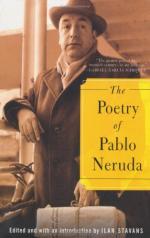
Pablo Neruda ( 1904-07-12 – 1973-09-23 ) was a Chilean poet, born Neftalí Reyes Basoalto (in full, Ricardo Eliecer Neftalí Reyes Basoalto ) Sourced Quién escribe tu nombre con letras de humo entre las estrellas del sur? Ah déjame recordarte cómo...
Pablo Neruda (1904-1973) was perhaps the greatest Spanish poet of the 20th century. The poet known as Pablo Neruda was named Neftalí Ricardo Reyes Basoalto at his birth in 1904. He signed his work "Pablo Neruda" (although he did not legally...
Arguably the most widely read Latin American poet of all time, Pablo Neruda was awarded the Nobel Prize in literature in 1971. This honor came as the culmination of more than fifty years of writing poetry that moved readers the world over, for Neruda's...
Pablo Neruda (July 12 1904 – September 23 1973) was the penname and, later, legal name of the Chilean writer and communist politician Neftalí Ricardo Reyes...
My Life with Pablo Neruda, by Matilde Urrutia. Trans., Alexandria Giardino. Stanford, California: Stanford University Press, 2004. Matilde Urrutia was Pablo Neruda's muse, inspiration for The Captain's Verses and One Hundred Love Sonnets. Both from the south of Chile, they met in a...
Pablo Neruda: A Passion for Life, by Adam Feinstein. New York: Bloomsbury, 2004. Pablo Neruda (1904-73) burst onto the literary scene when he was only twenty with his Veinte poemas de amor y uria canción desesperada [Twenty Love Poems and a Song of...
I once asked the late, esteemed voice teacher Beverley Johnson what distinguished a truly great singer. “An inner light,” she said. “Whether you’re talking about Piaf or Pavarotti, the great voices have a way of illuminating their soul.” On Monday, July 3, the most luminous...
Neruda's career as a poet began with love poetry and ended with love poetry. One of his very last works, written only days before his death, is "The End," a love poem to [his wife] Matilde. There were, of course, changes; there were deviations during the period of Residence on Earth, for example; there were turns and innovations during the period of political and epic poetry that began in the late thirties and culminated in 1950 with Canto General, but there was also a remarkable contin...
[Neruda] will keep on dying with the movement of our century and with us: a vast and profound death of incalculable significance, dying first here, later there, and then beyond; now in me and then in other men and women, without obvious rhythm, but really with the rhythm of the seasons, of the sea, the stars and the trees, through which he keeps growing, stretching, resting from his life, breathing at last all the atmosphere and all the earth, all of time, the components of his death…. I want to writ...
In relation to Neruda's previous public posture as a writer of the people, Estravagario seemed very individualistic, even frivolous in its self-indulgence. What is more, the frivolity was not unintentional. (p. 175) How is one to interpret this about-face, Neruda's sudden lack of solemnity regarding himself and his work? Only eight years before, in 1950, at the end of Canto general, he had piously willed his books to the poets of tomorrow…. Then, speaking as the collective voice of his ...
A short biography of the poet Pablo Neruda and an analysis of "Saddest Poem," one of Neruda's most noteworthy poems. Expressing a depressing, poignant, heartrending, and yet confused mood, the poem describes one's lingering memories for a love that no longer exists.