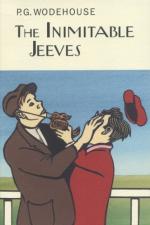
Wodehouse, P. G. (1881-1975)
P. G. Wodehouse's best known creations are upper-class incompetent Bertie Wooster, and his capable servant, Jeeves, who first appeared in the story "Extricat...
Read more
Biography EssayP. G. Wodehouse was born 15 October 1881 in Guildford, the suburb of London to which Charles Dickens retired Mr. Pickwick, and educated at Dulwich College, one of England's best public ...
Read more
P. G. Wodehouse was born in Guildford, the suburb of London to which Dickens retired Mr. Pickwick, and educated at Dulwich College, one of England's best public schools. After graduating, Wodehouse wo...
Read more
P. G. Wodehouse is an anomaly in twentieth-century fiction. In an age of relentless artistic experimentation, he wrote fiction firmly rooted in the Edwardian world of his childhood. In an age of rapid...
Read more

In the following essay, originally written in 1961, Lejeune claims that The Ice in the Bedroom is “an exhibition of easy mastery, of familiar skill, as incomparable in its special way as Fred A...
Read more
In the following review, Marsh contends that Wodehouse's short story collection, Plum Pie,“may not contain top-notch examples of his skill, but it is still very good Wodehouse indeed....
Read more
In the following essay, Hall analyzes Wodehouse's use of the transferred epithet, contending that it lends a comic effect to his fiction.
I balanced a thoughtful lump of sugar on the teaspoon.
...
Read more
In the following essay, Medcalf praises Wodehouse for his innocence and originality, maintaining that his use of language “lies very much in one tradition of English writing, perhaps the most e...
Read more
In the following essay, Smith offers a thematic analysis of Thank You, Jeeves, maintaining that Wodehouse's irreverent approach to plot and characters is his defining characteristic.
What chara...
Read more
In the following essay, Lasky explores the American adventures of another Wodehouse character, Psmith.
Is humour good for anything else but a laugh? Nothing appears to be more pernicious among critics...
Read more
In the following essay, Späth considers the character of Jeeves as a literary “superman,” and links him to the legendary archetype of detective novel hero.
There can hardly be any...
Read more
In the following essay, Galligan applauds the continuing interest in Wodehouse's work and deems him the master of literary farce.
P. G. Wodehouse wrote so much over so many years and made it lo...
Read more
In the following essay, Cohen describes the mild nature of Wodehouse's anti-American humor, asserting that “his bashing of Americans is as unmalicious as befits an Englishman who would e...
Read more
In the following essay, Karla explores the “American connection” in Wodehouse's work.
“It probably comes as a shock to most Wodehouse fans to learn that he has spent by far...
Read more
In the following review, Espey provides a positive review of an audiotape version of Right Ho, Jeeves.
A completely unscientific but conclusive survey has convinced me that the names of the ineffable ...
Read more
In the following laudatory assessment of A Man of Means, Trevor praises the appealing nature of Wodehouse's fiction.
‘I go off the rails,’ P. G. Wodehouse once wrote, ‘unle...
Read more
In the following essay, Lydon recalls her initial pleasure reading Wodehouse's Jeeves stories.
When my friend and colleague Elaine Marks invited me to write about a book, a text, a passage, or ...
Read more
In the following essay, Mooneyham investigates Wodehouse's place in modern comedic literature.
The roof of the Sheridan Apartment House, near Washington Square, New York. Let us examine it. The...
Read more
In the following essay, Watson traces the origins and development of Wodehouse's major character, Jeeves.
I
Jeeves was conceived and born in New York. At least P.G. Wodehouse was living there w...
Read more
Critical Essay by R. C. Churchill
A writer like Wodehouse who published over a hundred books cannot have been a Flaubert or a James Joyce, but in his own style and idiom he was a connoisseur of the mo...
Read more
Critical Essay by Barbara C. Bowen
Clearly Rabelais and Wodehouse are worlds apart, in many ways. For instance, Rabelais is primarily an intellectual and Wodehouse often aggressively anti-intellectual...
Read more
Critical Essay by Dorothy Parker
Well, Wodehouse and Bolton and Ken have done it again. Every time these three are gathered together, the Princess Theatre is sold out for months in advance. This thing...
Read more
Critical Essay by Peter Dickinson
Light verse, for some reason, demands to be written in a rather old-fashioned way. The language can, and should, be as modern as you like, but it should still not mer...
Read more
Critical Essay by Sinclair Lewis
When the meatier conversation at the party is over and you have drearily listened to the latest on Chiang Kaishek,… and the other topics which are regarded as c...
Read more
Critical Essay by Hilaire Belloc
Some two or three years ago I was asked in the United States to broadcast a few words on my own trade of writing—what I thought of it and why I disliked it. (p....
Read more
Critical Essay by George Orwell
[Professor Alfred North Whitehead] once remarked that every philosophy is coloured by a secret imaginative background which does not officially form part of its doctrin...
Read more
Critical Essay by Alexander Cockburn
[The question of tone] is troubling for anyone writing about Wodehouse. High seriousness about him brings to mind poor Professor Scully. This professor's at...
Read more
Critical Essay by Wilfrid Sheed
Somewhere between the Romantic Revolution and the Great Victorian Exhibition of 1851 in England, suet pudding entered the English soul, after which it became almost imp...
Read more
Critical Essay by Malcolm Muggeridge
A substantial cache of uncollected [material] such as David Jasen has got together [in The Uncollected Wodehouse] might seem surprising in view of Wodehouse'...
Read more
Critical Essay by C. David Benson
[Wodehouse's last work, the posthumous] Sunset at Blandings, is actually only the preliminary typescript of the first 16 chapters (out of a planned 22), with t...
Read more