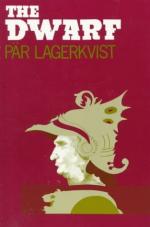
The Swedish author Pär Fabian Lagerkvist (1891-1974) was concerned with the meaning of life in a world without God and the existence of good and evil in such a world. Leif Sjöberg, in Pä...
Read more
The position of Pär Lagerkvist as one of the leading Swedish writers of the twentieth century has long been assured. In a literary career that spanned more than sixty years, Lagerkvist displayed ...
Read more

Critical Essay by Roger Ramsey
Lagerkvist has apparently called himself a "religious sceptic." His novels have a curious unfinality about them, for their characters never come to their p...
Read more
Critical Essay by Irene Scobbie
Throughout most of his creative life Pär Lagerkvist has given artistic form to an inner conflict, a struggle between on the one hand a pessimistic view of life a...
Read more
Critical Essay by Robin Fulton
Although Pär Lagerkvist will no doubt remain best-known for his fable-like fictions, his poetry is an important part of his output and it is a pity so little has ...
Read more
Critical Essay by Gunnel MalmstrÖm
"I constantly conduct a dialogue with myself," Pär Lagerkvist once said in a talk on his works, "one book answers the other"...
Read more
Critical Essay by Everett M. Ellestad
[The story Det eviga leendet is Lagerkvist's] first successful attempt at utilizing the architectonic principles of cubism. Instead of the parallel, static...
Read more
Critical Essay by Kenneth Rexroth
One of Lagerkvist's earlier books was called Angest, (Anguish) and it might be thought from this that he was influenced by Kierkegaard. On the contrary, his do...
Read more
In the following essay, Bloch investigates the role of the mythical female in Lagerkvist's fictional works.
Lagerkvist may be viewed from many angles. Labelled an “existentialist”...
Read more
In the following essay, Algulin offers an overview on Lagerkvist's life and career.
With Pär Lagerkvist (1891-1974), awarded the Nobel Prize in Literature in 1951, Swedish literature got...
Read more
In the following essay, Swanson traces Lagerkvist's literary development and delineates the defining characteristics of his work.
I
Pär Fabian Lagerkvist was born on May 23, 1891, in V...
Read more
In the following essay, Nilsson finds historical, biographical, and religious similarities between Czeslaw Milosz's poem “Father in the Library” and Lagerkvist's untitled p...
Read more
In the following essay, Polet discusses how Lagerkvist's characters mirror his own search for eternal peace and the Kingdom of God, by exploring the connection between social order and freedom ...
Read more
In the following essay, Rovinsky determines Henrik Ibsen's influence on Lagerkvist.
If scholars had accepted without contest Ibsen's words on Kierkegaardian impulses in his plays, this i...
Read more
In the following essay, Linnér notes the religious language and imagery in Lagerkvist's work.
Of all the world's religions, I shall here only be dealing with Christianity; this is...
Read more
In the following essay, Schwab asserts that in his novels Barabbas and Herod and Mariamne Lagerkvist “depicts mankind with reference to one of the most significant events in religious history a...
Read more
In the following essay, Bloch finds similarities between the main influences on and themes found in the work of Lagerkvist, Thomas Mann, Nikos Kazantsakis, and Jacques Roumain.
In the nineteen forties...
Read more
In the following essay, Brantly explores the religious influences on Lagerkvist's poetry.
The question of literary influence is a popular but problematic topic within literary studies. Any give...
Read more
In the following essay, Sondrup considers the influence of Lagerkvist on the poetry of Artur Lundkvist.
Ich weiß nicht, ob Ihnen unter all dem ermüdenden Geschwätz von Individuali...
Read more
In the following essay, Weiss traces Lagerkvist's use of mythology in his work.
Pär Lagerkvist can rightly be called a maker of modern myth. Drawing from ancient and medieval sources, he...
Read more