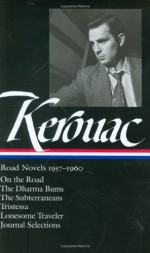
On The Road, written in 1951 and published in 1957, is a novel by Jack Kerouac Contents 1 Part one 2 Part two 3 Part three 4 Part four 5 Part five 6 External links // Part one The only people for me are the mad ones, the ones who are mad to live, mad...
Jean-Louis Lebris de (Jack) Kerouac (1922-1969), American writer, experimented with spontaneous autobiographical fiction chronicling his travels into the American West. He is known as the father of the Beat Generation. Rambling. Wandering. Overflowing. L...
Jack Kerouac, once called "our most misunderstood and underestimated writer," is gradually emerging from that limbo, though much about him remains obscure. The obscurity results from a misreading of his books by critics who, borne along by Cold War preju...
Jack Kerouac died, as he had spent much of his adult life, writing. The morning of October 20, 1969, he was sitting in front of his television at his home in St. Petersburg, Florida, jotting down notes when a vein in his stomach ruptured. A hard-drinking...
Jack Kerouac's 1957 novel was a mostly autobiographical travelogue of cross-country trips that Kerouac took during the late 1940s. On the Road's characters were thinly-disguised Beat luminaries, including Allen Ginsberg, William S....
On the Road by Jack Kerouac The son of French Canadian parents who had immigrated to the United States, Jack (Jean-Louis Lebris de) Kerouac was born in 1922 in Lowell, Massachusetts. He grew up in a French-speaking household, first learning English at...
On the Road - Jack Kerouac - 1957 Introduction On the Road by Jack Kerouac is an autobiographical novel that has come to symbolize the American youth subculture of the 1950s. The book chronicles the cross-country travels of Sal Paradise, the...
On the Road is a novel by American writer Jack Kerouac, written in April 1951, and published by Viking Press in 1957. It is a largely autobiographical work that was written as a stream of consciousness creation—based on the spontaneous road trips of...
News and Journals
summary from source:
Insurance Brokers' Monthly and Insurance Adviser
On the road 12/01/2001: 661 words, approx. 2 pages
BROKER TALK The Road Runner Story: Premium Credit post-Inde: Closer to Close: BIBA West Midlands Dinner: Cottle & Giles get together: Changes in ULR Market: Moving on after 35 years I caught up with Paul Inskip last month. For 20 years or...
summary from source:
The Washington Post
On the Road 05/10/1999: 322 words, approx. 1 pages
In regard to your article "Wolf Urges Extra Lane Westbound on I- 66" {Metro, May 4}: Increased traffic capacity on I-66 lowers the property values of Arlington homes. Although homeowners thought they had a "deal," they of course are getting double-crossed for political...
At traffic lights on Regent Street recently, I realised that the road ahead of me lay empty - a truly rare occurrence in central London. Nothing but tempting, open Tarmac, heading north towards Oxford Street, for, ooh, at least 15 yards. Heart pounding, I reached...
The call of the open road has always been one of America’s greatest freedoms. Probably because I grew up spending about half my time in the back seat of my parents’ car moving from coast to coast (seven crossings by age 13), the thought of...
In spite of its reputation, On the Road is best understood as a skillfully managed traditional novel. Both the manuscript history and the text itself make it clear that Kerouac's most famous book is a good deal more challenging and intricate, if less innovative, than has been generally believed. Even though the particular version that led to On the Road as published was drafted in about three weeks of typing onto a continuous roll of paper, at that point Kerouac had been working on versions of the bo...
More than fifteen years after its publication, On the Road still has a large and growing audience. For many, it was the book that most motivated dissatisfaction with the atmosphere of unquestioning acceptance that stifled the fifties; remarkably, despite the passage of time and its relative unpopularity among older university instructors, its audience grows, and young people especially gravitate to a force in it that seems to be propelled by the material itself, almost as if its author did not exist as an o...
Sal Paradise, the narrator of Jack Kerouac's On the Road (1957), sees the book's central character, Dean Moriarty, as a hero in a variety of American styles—the spirit of the West, the energetic mover and doer, the cowboy, the Whitman-like enthusiast, "that mad Ahab at the wheel" compelling others at hissing, incredible speeds across the country. But the subsuming model for the Cassady legend is of the American hero as a confidence man…. (p. 266) In Sal's usa...
Jack Kerouac's novel On the Road serves as a forceful and complex rejection of the white middle-class American dream. Based on Kerouac's journeys by car across the United States, the book voiced the Beat Generation counterculture's own journey away from mainstream society in search of both freedom and the true meaning of life in post-World War II America.
In "On The Road" by Jack Kerouac, Salvadore Paradise's search for his meaning in life turns him into an outsider. He becomes so obsessed in finding "IT," that he loses his identity and becomes a shell of a man.
The actions we take are a greater representation of who we are as a person than the actions that others take against us. The examples in Sue Monk Kidd's The Secret Life of Bees and Jack Kerouac's On the Road show that what we do for ourselves determines our identity, not what others do to us.
Get the complete On the Road Study Pack, which includes everything on this page. Approximately 368 pages (at 300 words per page) in 19 products. (Download a sample literature guide)