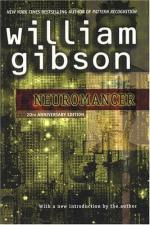
Creator of the concept "Cyberspace," science-fiction author William Gibson developed a new fictional landscape for his edgy work--a hallucinatory three-dimensional region built from computer data gath...
Read more
When science fiction author William Gibson wrote his first two novels, Neuromancer and Count Zero, on a manual typewriter, he knew almost nothing about computers. "When people started talking about th...
Read more
No other Canadian speculative fiction writer, and possibly no other Canadian writer of fiction, has had as great an impact on late-twentieth-century culture as has William Gibson. Beginning with a ser...
Read more
In the following essay, Christie examines the elements of both traditional science fiction and postmodern experimental fiction in Gibson's Neuromancer and John Crowley's Engine Summer.
...
Read more
In the following essay, Stevens presents a thematic analysis of gender, technology, and individual identity in Neuromancer, noting Gibson's complex portrayal of artificial intelligence and sexu...
Read more
In the following essay, de Zwaan comments on the elements of cyberpunk science fiction and postmodern experimentation in Neuromancer, noting the influence of Thomas Pynchon, Kathy Acker, and Jean Baud...
Read more
In the following essay, Concannon discusses the thematic motif of the border and how it relates to self-identity in Neuromancer and Gloria Anzaldúa's Borderlands/La Frontera.
I
When C...
Read more
In the following essay, Freccero contrasts the representations of technology-driven societies in Neuromancer and the Alien film series.
A. Technocultures and Postmodernism
In this chapter I would l...
Read more
In the following essay, Punday explores the relationship between cyberspace and narrative form in Neuromancer, arguing that the novel “offers us a way to negotiate the conventional discursive e...
Read more
In the following essay, Myers examines how Gibson utilizes the concept of cyberspace in Neuromancer to create a postmodern narrative setting.
Much of William Gibson's novel Neuromancer is ce...
Read more
In the following essay, Brouillette presents an analysis of the 1984 publication of Neuromancer in terms of the relationship between the corporate publishing industry and the science fiction subcultur...
Read more
In the following essay, Huntington argues that the alienated characters who populate Neuromancer represent a form of resistance to dominant cultural mores.
I
The dynamic by which science fiction di...
Read more
In the following essay, Grant discusses the theme of transcendence through technology in Neuromancer.
1. People as Systems
Cyberspace. Simstim. Meat puppets. Prosthetic limbs, cranial sockets, and ...
Read more
In the following essay, Mead asserts that characters in Gibson's trilogy of “Sprawl” novels—Neuromancer, Count Zero, and Mona Lisa Overdrive—use technology as a mean...
Read more
In the following essay, Csicsery-Ronay posits that Gibson's narrative in Neuromancer addresses the question of how artists can represent the human condition in a world dominated by cybernetic t...
Read more
In the following essay, Cherniavsky examines the representation of gender and reproductive technology in Neuromancer.
Besides, although the creation of life in vitro would certainly be a scientific...
Read more
In the following essay, Voller explores how Neuromancer portrays cyberspace as a realm of sublime transcendence devoid of spiritual implications.
William Gibson's “matrix” work...
Read more
In the following essay, Schroeder offers a critical assessment of the relationship between cybernetics and postmodernism in Neuromancer.
Back in 1983 Time named the computer “Machine of the ...
Read more
In the following essay, Davidson discusses Neuromancer in terms of postmodern theories of simulation and the visual image, particularly comparing the novel's central themes to the works of Jean...
Read more
In the following interview, Gibson discusses the concept of cyberspace, the cyberpunk movement, and the influence of popular culture on his writing.
In 1984 William Gibson's first novel, Neu...
Read more
In the following review of Fiction 2000: Cyberpunk and the Future of Narrative, edited by George Slusser and Tom Shippy, Latham asserts that Neuromancer is the predominant subject of the essays in thi...
Read more
Considering that there are many different levels of realism, I have chosen to focus on Neuromancer by William Gibson and We so Seldom Look on Love by Barbara Gowdy. The stories explore the boundaries ...
Read more
Teaching Neuromancer
All teaching products sold separately.
Neuromancer Lesson Plans contain 112 pages of teaching material, including:
SPOOK COUNTRYBy William Gibson Putnam, 371 pages, $25.95
By setting his new novel in the recent past—just as he did in Pattern Recognition (2003)—William Gibson once again suggests that...
Read more