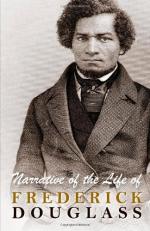
Narrative of the Life of Frederick Douglass, an American Slave, Written by Himself Summary Frederick Douglass
Summaries, notes, essays, guides, lessons, and more - everything you need to understand or teach Narrative of the Life of Frederick Douglass, an American Slave.
Study Narrative of the Life of Frederick Douglass, an American Slave
The Narrative of the Life of Frederick Douglass, an American Slave, Written by Himself Study Pack contains about 994 pages of study material in 44 products, including:
Narrative of the Life of Frederick Douglass, an American Slave Study Guide
Narrative of the Life of Frederick Douglass, An American Slave

by Frederick Douglass
Frederick Douglass was born Frederick Augustus Washington Bailey in the cabin of his grandmother, Betsey Bailey,...
Read more
PREFACE
In the month of August, 1841, I attended an anti-slavery
convention in Nantucket, at which it was my happiness
to become acquainted with Frederick Douglass,
the writer of the following Narrati...
Read more
Biography EssayChampion of the suppressed people of the world, Frederick Douglass was an escaped slave who rose to become the United States Minister to Haiti and counselor to four presidents. A man wi...
Read more
The foremost African American abolitionist in antebellum America, Frederick Douglass (ca. 1817-1895) was the first African American leader of national stature in United States history.Frederick Dougla...
Read more
"I was born in Tuckahoe, near Hillsborough, and about twelve miles from Easton, in Talbot county, Maryland. I have no accurate knowledge of my age, never having seen any authentic record containing it...
Read more
Frederick Douglass (1817"-20 February 1895), reformer and journalist, was born to a black slave in Tuckahoe, Maryland. Upon his escape from slavery in 1838, he adopted the last name of Douglass. He ...
Read more
Frederick Douglass's life encompassed slavery and freedom, absolute poverty and international fame and gentility. Though he made his escape from slavery at the age of twenty-one, he spent his remainin...
Read more
Champion of the suppressed people of the world, Frederick Douglass was an escaped slave who rose to become the United States Minister to Haiti and a counselor to four presidents. A man with no forma...
Read more
As a journalist, Frederick Douglass is mainly remembered for establishing the North Star, one of the most highly acclaimed abolitionist newspapers. He also founded and edited Douglass' Monthly, one of...
Read more
Born Frederick Augustus Washington Bailey, a slave, Frederick Douglass went on to become a leading abolitionist orator, writer, and public figure whose life spanned most of the nineteenth century, tho...
Read more
In the following essay, Baker focuses on The Narrative of the Life of Frederick Douglass as one of the best examples illustrating the African American autobiographer's "quest for being,&...

Read more
Fuller was a prominent American critic and a recognized feminist and transcendentalist. In the following review, originally published in 1845, she praises Douglass's Narrative, commenting on th...
Read more
In the following essay, originally published in 1849, Peabody favorably assesses Douglass's Narrative as among the most remarkable productions of the age, but observes that the author's ...
Read more
In the following excerpt, Baker analyzes the literary techniques of Douglass's Narrative by contrasting it, in terms of style and tone, with David Walker's Appeal.
During the first ha...
Read more
In the following essay, Gibson investigates the intersection of Douglass's public and private personas in the Narrative, commenting on the qualities of balance and restraint that inform both.
...
Read more
In the following essay, Sekora argues that Douglass's Narrative is not simply autobiography, but rather the "first comprehensive, personal history of American slavery."
The au...
Read more
In the following essay, Bennett offers an ecocritical reading of The Narrative of the Life of Frederick Douglass, arguing that the boundaries of the ecological must be expanded and that the dominant c...
Read more
In the following essay, Franklin explores animal imagery in the Narrative and the role of Douglass's story in refuting the commonly held belief, particularly in the South, that slaves were inca...
Read more
In the following essay, Gibson examines Douglass's struggle to reconcile the existence of God with his own condition as a slave.
“O God, save me! God, deliver me, Let me be free! Is t...
Read more
In the following essay, Hubbard, an African-American university professor, describes his experiences reading and teaching Douglass's Narrative.
Reading Frederick Douglass's Narrative ...
Read more
In the following introduction, Blight provides an overview of the composition and reception of Douglass's Narrative.
Memory was given to man for some wise purpose. The past is … the m...
Read more
In the following essay, Morgan compares Incidents in the Life of a Slave Girl with Narrative of the Life of Frederick Douglass, and states that scholars have neglected gender-related distinctions betw...
Read more
In the following essay, Rothenberg examines Douglass's blending of black and white folkloric elements in the Narrative.
Much has been written on Frederick Douglass and his triumphant escape ...
Read more
In the following essay, Wohlpart suggests that Douglass's relationship to Christianity is more complicated than many critics believe, suggesting that in the Narrative the author operates within...
Read more
In the following essay, Sisco discusses Douglass's ambivalent feelings towards literacy, and his struggle to find an acceptable narrative voice in his works. Sisco also examines Douglass'...
Read more
In the following essay, Bergner draws parallels between the identity formation present in Douglass's Narrative and Freud's theory of the Oedipus complex.
No pre-emancipation text by a...
Read more
In the following essay, Ferreira discusses how Douglass developed his position as a visionary and a leader during a six-month stay in Ireland.
The year 1845 was pivotal for Frederick Douglass. With...
Read more
In the following essay, Bennett discusses Douglass's Narrative as an antipastoral text that privileges the freedom associated with urban spaces over the rural areas linked to the worst abuses o...
Read more
In the following essay, originally published in 1978, Stepto examines the Narrative's various appended documents and revisions, noting how these authenticating texts seem to set up a dialogue w...
Read more
In the following essay, originally published in 1978, O'Meally claims that, although the Narrative was meant to be read, it was also meant to be preached, drawing as it does on the tradition of...
Read more
In the following essay, Gates discusses the way in which Douglass's narrative participated in contemporary literary conventions by setting up such binary oppositions as black/white, slave/free,...
Read more
In the following essay, MacKethan explores Douglass's struggle to establish mastery over language and literature as a means of achieving full human and civil rights.
To be an “America...
Read more
In the following essay, Burt characterizes Douglass's Narrative as a declaration of citizenship.
Frederick Douglass claimed that he began to become free when he learned to write. Part of wha...
Read more
In the following essay, Gibson discusses the appendix to Douglass's narrative as an attempt to conform to religious orthodoxy and to disguise the main text's hostility to Christianity.
...
Read more
In the following essay, Rowe discusses Douglass's Narrative as an important text not just in the literary history of America, but also in the country's political and economic history.
...
Read more
In the following essay, Lee conducts a rhetorical analysis of Douglass's narrative as it progresses from the powerlessness of silence in the first half of the book to the power of speaking with...
Read more
When people choose to follow a religion they agree to practice the tenets and standards put forth by that religion. If a person is a practicing Christian they would need to follow the teachings of ...
Read more
In the Narrative of the Life of Frederick Douglass, an American Slave, Written by Himself, Frederick Douglass establishes for us the many factors that lead to the continual enslavement of the black...
Read more
The 1845 autobiography, The Narrative of the Life of Frederick Douglass provides an elaborate examination of the hardships of slavery. Frederick Douglass' firsthand recounting of the whippings, beati...
Read more
Frederick Douglass' education is furthered throughout the course of his novel The Narrative of the Life of Frederick Douglass An American Slave Written by Himself. This is done due to Douglass' deter...
Read more
The Classic Slave Narratives give a fascinating, not to mention horrifying, account of the lives of four different slaves: Olaudah Equiano, Mary Prince, Fredrick Douglass, and Linda Brent. These slave...
Read more
"Learning would spoil the best nigger in the world" (78). Words that would serve as an affront to most work to inspire Frederick Douglass. Douglass himself states earlier in his book that the "m...
Read more
The Narrative of the Life of Frederick Douglass Book Notes is a free study guide on The Narrative of the Life of Frederick Douglass by Frederick Douglass. Browse the summary below:
Author Bio...
Read more
Teaching Narrative of the Life of Frederick Douglass, an American Slave
All teaching products sold separately.
Narrative of the Life of Frederick Douglass, an American Slave, Written by Himself Lesson Plans contain 125 pages of teaching material, including:
Narrative of the Life of Frederick Douglass, an American Slave Lesson Plans