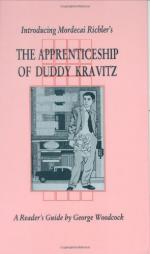
One of Canada's most accomplished writers, Mordecai Richler (1931-2001) produced screenplays, novels, children's literature, and essays. At the time of his death, he was acknowledged as Canada's leadi...
Read more
"I ... feel forever rooted in Montreal's St. Urbain Street," Mordecai Richler stated in an essay, "Why I Write," collected in Notes on An Endangered Species and Others (1974): "That was my time, my pl...
Read more

In the following essay, Brenner compares Richler's dualistic representation of the Jewish response to the Holocaust in his fiction and nonfiction with the works of A. M. Klein, Irving Layton, L...
Read more
In the following review, Fulford evaluates the controversy resulting from Oh Canada! Oh Quebec!: Requiem for a Divided Country, calling the book “disorganized and rambling.”
There are...
Read more
In the following review, Marin commends Richler's wit and cynicism in Oh Canada! Oh Quebec!: Requiem for a Divided Country.
I met my first Québecois language Nazi at a French immersio...
Read more
In the following favorable review, Waller provides a critical reading of the controversial subject matter of Oh Canada! Oh Quebec!: Requiem for a Divided Country, focusing on Richler's charges ...
Read more
In the following review, Delany contends that Oh Canada! Oh Quebec!: Requiem for a Divided Country presents several important insights but notes that “the case for Quebec nationalism needs to b...
Read more
In the following review, Linklater compliments Oh Canada! Oh Quebec!: Requiem for a Divided Country as an “impassioned” critique of Quebec's history and politics.
Perched on to...
Read more
In the following review, Cooper argues that Oh Canada! Oh Quebec! is a useful study of Quebec nationalism and recent Canadian politics, commenting that Richler's criticisms are the “only...
Read more
In the following essay, Craniford surveys the critical reaction to Solomon Gursky Was Here and investigates Richler's inspirations for the Gursky family. Craniford notes that the “most c...
Read more
In the following review, Rieff commends Richler's complex and poignant characterizations in This Year in Jerusalem but faults the work for its excessive political commentary and cursory travel ...
Read more
In the following review, Kelly criticizes the incoherent and disjointed structure of This Year in Jerusalem, labelling the book as “an exercise in self-justification.”
It was only whe...
Read more
In the following review, Alexander offers a negative assessment of Richler's “lazy” intellectual tone in This Year in Jerusalem.
Mordecai Richler first came to prominence by vi...
Read more
In the following review, Wheatcroft compares This Year in Jerusalem with Glenn Frankel's Beyond the Promised Land, calling them both “complementary and absorbing” books.
Just 1...
Read more
In the following review, Ravvin contrasts the portrayals of Jerusalem in This Year in Jerusalem and Bronwyn Drainie's My Jerusalem, commenting that Drainie's work is the more journalisti...
Read more
In the following review, Enright discusses Richler's characterization in Barney's Version and compliments the novel's lean narrative pace.
[In Barney's Version] Terry Mc...
Read more
In the following review, King offers a mixed assessment of Barney's Version, arguing that “for all its defects, this unruly book about a thoroughly unruly life contains not a page withou...
Read more
In the following positive review, Bemrose regards Richler's “bitter, ironic sense of mortality” as the central theme of Barney's Version.
Across the land, Mordecai Richl...
Read more
In the following review, Schechner praises Richler for creating “a delectable, side-splitting comedy of humiliation” in Barney's Version.
At his wedding—his secondȁ...
Read more
In the following review, McSweeney offers a stylistic and thematic examination of Barney's Version.
If old age is a shipwreck, as Charles de Gaulle claimed, then Barney Panofsky, the sixty-s...
Read more
In the following review, Lichtenstein discusses Richler's body of work and asserts that only the final section of Barney's Version lives up to the legacy of the author's oeuvre.
...
Read more
In the following review of Barney's Version, Steyn lauds Richler's caustic wit and vivid depiction of Montreal.
The first time I met Mordecai Richler was through his son Noah, a BBC p...
Read more
In the following review, Edwards explores the role of memory and truth in Barney's Version.
“I dislike most people I have ever met,” says the leading character of the latest of...
Read more
In the following review, Dellandrea regards Barney's Version as an unreliable memoir, praising Richler's examination of the “authority of autobiography and the reliability of acad...
Read more
In the following interview, Richler discusses Canadian politics and culture, the differences between Toronto and Montreal, and the main thematic concerns of Barney's Version.
[Gillam]: Barne...
Read more
In the following review, Brzezinski offers a laudatory assessment of Barney's Version, noting Richler's “savage wit and precisely delivered irony.”
Known in this country...
Read more
In the following review, Gorjup contends that Barney's Version is “Richler's most remarkable accomplishment to date, the work of a great master who has come to understand the pitf...
Read more
In the following essay, Robbeson analyzes the function of various textual strategies in St. Urbain's Horseman, contending that each strategy provokes a specific moral judgment.
The theme of ...
Read more
In the following essay, Wilson-Smith offers a brief memorial overview of Richler's life and career.
Say this, among many nice things, about Mordecai Richler: he knew how to have things both ...
Read more
In the following essay, Aubin recounts his relationship with Richler and offers some reminiscences of Richler's life and career.
Two different Mordecai Richlers passed away last week. CBC TV...
Read more
In the following essay, Steyn characterizes Richler as a politically incorrect writer, placing him within the context of Canadian and Jewish authors.
Mordecai Richler died on July 3, and within min...
Read more
In the following review, Bethune debates the quality of Richler's first novel, The Acrobats, concluding that the work is “pretty good on its own merits and full of promise for the future...
Read more
Critical Essay by G. David Sheps
In their themes and motifs, Mordecai Richler's novels return regularly to a constant set of preoccupations. Despite this consistency, however, his career as a ...
Read more
Critical Essay by F. M. Birbalsingh
[Canadianism and Jewishness] jointly form the main theme of [Richler's] fiction and the chief concern of all his writing. His novels deal, in general, with ...
Read more
Critical Essay by Margot Northey
Mordecai Richler's novel, Cocksure, illustrates [a] satiric double focus on grotesque fantasy and morality. In attempting analysis, one can usefully distinguis...
Read more
Critical Essay by James Wolcott
Of course, Joshua's [racist] outbursts can be explained away as the spasms of a mind twisted with jealous rage, but they're still coarse, particularly in...
Read more
Critical Essay by Thomas R. Edwards
In a volume of his essays, Mordecai Richler once quoted with relish a question he was asked after lecturing to a Jewish audience in his native Canada: "Why ...
Read more
Elizabeth Hay, a former radio journalist who long hoped to write a novel about her "golden summer" working in northern Canada in the 1970s, won the lucrative Scotiabank Giller Prize for her novel "...
Read more