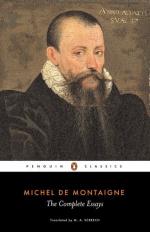
Montaigne, Michel Eyquem De(1533–1592)
Michel Eyquem De Montaigne, French essayist and skeptical philosopher, was born near Bordeaux. His father was an important merchant, and his mother belong...
Read more
The French author Michel Eyquem de Montaigne (1533-1592) created a new literary genre, the essay, in which he used self-portrayal as a mirror of humanity in general.Michel Eyquem de Montaigne was born...
Read more

In the following essay, Hampton discusses Montaigne's representation of the positions of both the Spanish and the indigenous population in his essay on the Spanish conquest of America.
Who h...
Read more
In the following essay, Brody subjects Montaigne's work to a philological analysis, praising the writer for his brilliance and his highly original style.
A philosopher is, after all, only on...
Read more
In the essay below, Losse compares Montaigne's essays on natives in the New World with the accounts provided by his source material, maintaining that the changes Montaigne made were motivated b...
Read more
In the following essay, O'Brien discusses Montaigne's detailed accounts of his food preferences and dietary habits in “De l'experience.”
At one point in his last ...
Read more
In the essay which follows, Heitsch explores Montaigne's use of writing about the death of his friend Étienne de La Boétie as part of the mourning process.
He had deceived deat...
Read more
In the following essay, Russell examines the rhetorical structures used in “De Democritus et Heraclitus” and compares the author's critique of judgment in that essay with similar ...
Read more
In the following essay, Jordan discusses Montaigne's rejection of both divine and natural law and the implications of that rejection for the possibility of social and political change.
An an...
Read more
In this essay, MacPhail examines Montaigne's writings on Sparta, maintaining that he used the comparison between ancient and modern cultures as a way of defining the values of his own time.
...
Read more
In this essay, MacPhail discusses Montaigne's views on political power through an examination of his writings on friendship.
La plus part des offices de la vraye amitié sont envers le...
Read more
In the essay below, Cottrell maintains that Montaigne codes his own authorial voice as female even as he participates in the misogynist discourse of the late medieval and early Renaissance periods.
...
Read more
In the following essay, Posner explores Montaigne's version of the ideal nobleman during a period when the political, social, and military power of the nobility was eroding.
One of the more ...
Read more
In the following essay, Glidden examines Montaigne's self-representation in the essay “Of Physiognomy.”
On the opening page of his penultimate essay, “Of physiognomy,...
Read more
In the essay that follows, Abecassis discusses Montaigne's contradictory views on the split between private life and public obligations, maintaining that his beliefs have much in common with th...
Read more
In the essay below, Morrison explains Montaigne's rejection of torture as part of the execution process and his limited acceptance of torture as a means of interrogation.
Many scholars have ...
Read more