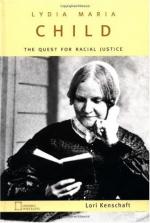
Child, Lydia Maria
CHILD, LYDIA MARIA. Lydia Maria Child (1802–1880) was a prolific author and a founder of the American abolitionist movement. Child wrote two books on religion: The Progress o...
Read more
The popularity and moral force of the American author Lydia Maria Francis Child (1802-1880) contributed to the impact radical abolitionists exerted on the antislavery debate that preceded the Civil Wa...
Read more

Lydia Maria Child (11 February 1802-20 October 1880), abolitionist and popular author, was born into a large family at Medford, Massachusetts. At twelve her mother died and she was sent to live with h...
Read more
For half a century, from 1824, when Lydia Maria Child's daring novel of interracial marriage, Hobomok, A Tale of Early Times, greeted a shocked public, to the turbulent Reconstruction era, which found...
Read more
Lydia Maria Child ranks among the most influential of nineteenth-century American women writers. She was renowned in her day as a tireless crusader for truth and justice and a champion of excluded gro...
Read more
In the following unsigned review of several of Child's books, the reviewer proclaims Child a leading American woman author, offers an overview of her works, and recaps in detail several of the ...
Read more
With The First Woman in the Republic, Karcher published the first extensive analytical biography of Child. In the following chapter from this work, Karcher documents the cultural position of Child...
Read more
In the following introduction to an 1883 edition of Child's letters, Whittier recalls both Child's professional achievements and her personal life, stressing in particular the marked res...
Read more
In the essay below, Higginson discusses Child's broad cultural influence, tempering a general synopsis of her life and works with his personal recollections of her.
To those of us who were b...
Read more
In the following excerpt, Beach provides an overview of Child's life and career.
In the second quarter of the nineteenth century, few names in American literature were more conspicuous than ...
Read more
In the biographical sketch below, Thorp delineates the "dichotomy of mind" that prompted Child to alternate between apparently apolitical works and her highly political antislavery tract...
Read more
In the essay below, Jeffrey examines the consonance between Child's nontraditional married and professional life and her relatively conservative opinion about women's social roles.
Hi...
Read more
In the following excerpt, Conrad argues that Child's writings on women 's history did not champion prototypical feminist causes but did create "a usable past" in which read...
Read more
In the essay that follows, which was originally published in 1987, Crapol examines Child's life and writings—especially her abolitionist An Appeal in Favor of That Class of Americans Cal...
Read more
In the following essay, Mills focuses on Hobomok, exploring the tensions in the novel over race relations and colonialism in America.
When Lydia Maria Child produced her first novel Hobomok in 1824...
Read more