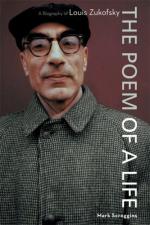
If the twentieth century still harbors a major but undiscovered poet, that poet is surely Louis Zukofsky. Not that he has been entirely unrecognized; indeed, early he earned the praise of an older gen...
Read more
Louis Zukofsky, who died in 1978 at the age of seventy-four largely unknown to the majority of critics and readers of American poetry, was one of the century's most fascinating and accomplished poets....
Read more

An American poet, Niedecker focused on the distillation of images and thoughts into concise expression, composing verse known for its stark, vivid imagery, subtle rhythms, and spare language. Although...
Read more
Kenner is the foremost American critic and chronicler of literary Modernism. He is best known for The Pound Era (1971), a massive study of the Modernist movement, and for his influential works on T. S...
Read more
An American educator and critic, Ahearn is the author of Zukofsky's "A": An Introduction (1983). In the following essay, he explicates the origins of the collage method evident in...
Read more
In the following essay, Tomas explicates "Poem beginning 'The'" as a statement by Zukofsky on his situation as a Jew in modern, secular Western society.
Critics coming to t...
Read more
In the following essay, Comens asserts that Zukofsky's poetry heralds postmodernism through the negation of the absolute.
Despite the acknowledged importance of World War I for the beginning of...
Read more
Davidson is an American poet, educator, and the author of The San Francisco Renaissance and Postmodern Poetics (1983). In the following essay, he assesses the signif icance of "Mantis," ...
Read more
Rexroth was one of the pioneers in the revival of jazz and poetry in the San Francisco area during the 1940s and 1950s. In his criticism he has examined such varied topics as Greek mythology, the work...
Read more
Levertov is a leading post-World War II American poet. Her early verse is often described as neo-Romantic, while her later writing reflects the influence of the objectivist poetry of William Carlos Wi...
Read more
Creeley was one of the originators of the "Black Mountain" school of poetry, along with Charles Olson, Robert Duncan, and Denise Levertov. These poets developed the theory of "pro...
Read more
One of the foremost contemporary American poets, Rich also writes criticism from a feminist perspective. In the following review of Found Objects, she evaluates Zukofsky's verse in terms of the...
Read more
Davie is a highly regarded English poet, critic, educator, and translator. During the 1950s he was associated with the Movement, a group of poets who emphasized restrained language, traditional syntax...
Read more
Carruth is a well-respected and prolific American poet whose verse is frequently autobiographical, varied in mood and form, and noted for its unadorned and precise language. In the following essay, he...
Read more
Symons has been highly praised for his contributions to the genres of biography and detective fiction. His popular biographies of Charles Dickens, Thomas Carlyle, and his brother A. J. A. Symons are c...
Read more
Dembo is an American educator and critic who is the author of Conceptions of Reality in Modern American Poetry (1966), as well as book-length studies on the poets Hart Crane and Ezra Pound. In the fol...
Read more
Critical Essay by Burton Raffel
As Zukofsky notes in his preface [to Catullus], it is the sound of the Latin which has come to interest him—not however as Latin sound, but as a challenge, a kin...
Read more
Critical Essay by Thomas A. Duddy
[The beginning of Zukofsky's A is] richly assertive of the poem's "subject": aurality and its relation to measure. Aurality, where words s...
Read more
Critical Essay by Kenneth Cox
A bare and unpretentious way of speaking, brevity of phrase and concentration on the matter nearest to hand: such features of a language of survival are those [Louis Zuko...
Read more
Critical Essay by Philip R. Yannella
Autobiography is as good a place as any for new readers of Zukofsky to begin. Its warning is direct, a caution sign to those who would do other than read the words...
Read more
Critical Essay by Joseph Cary
In its wisdom [Zukofsky's] publisher is pushing Hugh Kenner's judgment that "A" is "the most hermetic poem in English, which they will ...
Read more
Critical Essay by Robert Creeley
Louis Zukofsky's life work is "A"—not the, mind you, but a, for as he said, "a case can be made out for the poet giving some of his ...
Read more
Critical Essay by William Harmon
[Zukofsky is] the classic eiron described in Northrop Frye's Anatomy of Criticism: self-deprecating, seldom vulnerable, artful, given to understatement, modest ...
Read more