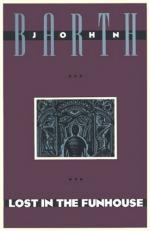
Search "Lost in the Funhouse"
|

|
Lost in the Funhouse by John Barth | |
|
About 304 pages (91,133 words) in 14 products |
|


| Name: |
John (Simmons) Barth | | Variant Name: |
John (Simmons) Barth, John Simmons Barth | | Birth Date: |
May 27, 1930 | | Place of Birth: |
Cambridge, Maryland, United States | | Nationality: |
American | | Gender: |
Male |
summary from source:

Biography of John (Simmons) Barth
9707 words, approx. 32.4 pages
 In a writing career that spans five decades, John Barth has established himself as the premier writer of the postmodern novel in America. Perhaps more than any other contemporary writer, Barth has managed to combine consistently cutting-edge formal exper...
summary from source:

Biography of John (Simmons) Barth
6178 words, approx. 20.6 pages
 John Barth has taken what he considers the moribund genre of the traditional novel and has revived it with a series of imaginative and inventive "fictions." Barth writes, "If I were a painter, I would attempt to be as contemporary as Frank Stella, and st...


Encyclopedia and Summary Information
summary from source:

Lost in the Funhouse Information
101 words, approx. 1 pages
 Lost in the Funhouse is a collection of loosely connected short stories that was originally published by John Barth in 1968. These postmodern stories examine the art of fiction writing, among other things, and seem to undermine the conventional and...


summary from source:
 The New York Observer
Radical Perspectives: Grotjahn\'d5s Singular Focus
11/5/2006: 804 words, approx. 3 pages Mark Grotjahn’s large abstract drawings are so meticulously crafted and striking in effect that, looking at them, I wonder why they don’t excite me more. The pieces are all handsome and, in their own way, masterful. I feel a twinge of guilt for not loving...


Literary Criticism
summary from source:

E. P. Walkiewicz
9,719 words, approx. 32 pages
 In the following excerpt, Walkiewicz maintains that the Möbius strip "Frame-Tale," which opens Lost in the Funhouse, serves as an analogy for the entire collection, which cycles back to its beginning in the final story, "Anonymiad."
summary from source:

Critical Essay by Deborah A. Woolley
7,337 words, approx. 25 pages
 In the excerpt below, Woolley argues that self-consciousness in Lost in the Funhouse presents an affirmative interpretation of narrative reflexivity.
summary from source:

Critical Essay by David Morrell
7,191 words, approx. 24 pages
 Morrell is a Canadian educator, nonfiction writer and novelist. Highly acclaimed as a science fiction and fantasy, action, and western writer, he is perhaps best known to popular audiences as the author of the books on which the "Rambo" films starring Sylvester Stallone were based. In the essay below, Morrell discusses those stories in Lost in the Funhouse originally written for tape or live performance. He maintains that although the nonprint media stimulated Barth's interest in oral ...


|
Lost in the Funhouse by John Barth | |
|
About 304 pages (91,133 words) in 14 products |
|
|