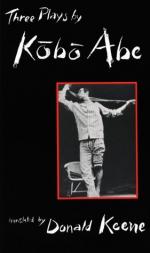
An important figure in contemporary Japanese literature, Kobo Abe (1924-1993) attracted an international audience for novels in which he explored the nihilism and loss of identity experienced by many ...
Read more
For almost forty years until his death in 1993, Abe Kb occupied a central position among avant-garde artists in Japan. Active as a novelist, a writer of film scenarios, a dramatist, and a director of ...
Read more

Critical Essay by The New Republic
Kobo Abe delights in the excessive and the perverse. With its surrealistic setting, its claustrophobic atmosphere, and its increasingly distressing scenes of sexual ...
Read more
Critical Essay by Irving Malin
Kobo Abe refuses to write a conventional novel. He gives us a series of "notebooks" (and epilogue); within the "notebooks" are charts, banks ...
Read more
Critical Essay by Hisaaki Yamanouchi
[Abé is] concerned with the solitude of men and women alienated from contemporary society and suffering from a loss of identity…. [Abé has del...
Read more
Critical Essay by William F. Van Wert
While [Kobo Abe's] figurative language remains essentially Japanese ("His left shoulder made a sound like the splitting of chopsticks"), his ...
Read more
Critical Essay by Anthony Thwaite
If one could imagine a Tom Stoppard "Jumpers" written by Lewis Carroll and Kafka, translated with a minimal sense of topography to a modern Japanese set...
Read more
In the following unfavorable review, Garis derides The Ark Sakura as lacking in coherence and meaning.
International high style at its most stupefyingly relentless is the achievement of Kobo Abe...
Read more
In the following essay, Dissanayake lists the reasons for the success of the cinematic adaptation of Abé's novel The Woman in the Dunes.
The change in the sand corresponded to a change i...
Read more
In the following essay, Lamont-Brown reflects on Abé's life and work.
Kobo Abe was born in Tokyo on March 7, 1924. He was taken by his family to Mukden when he was barely a year old and ...
Read more
In the following introduction, Keene traces the development of Abé's career as a dramatist and underscores the problems with translating the author's work.
Kōbō Abe ...
Read more
In the following review, Iwamoto views the dramas collected in Three Plays as influenced by the Theater of the Absurd.
Known primarily as a novelist, especially in the West, Kobo Abe also wrote plays ...
Read more
In the following laudatory review of Three Plays, Dallas perceives “this witty, lyrical, eminently theatrical collection a welcome change from the confessional realism that pervades most contem...
Read more
In the following review, Iwamoto offers a mixed assessment of Kangaroo Notebook.
Kobo Abe's last novel before his death in 1993, Kangaroo Notebook, originally published in Japanese in 1991, ref...
Read more
In the following essay, Goebel determines the influence of Franz Kafka on Abe's fiction.
Kafka's influence upon Western authors has enjoyed thorough, if by no means exhaustive, critical ...
Read more
In the following essay, Woodhouse offers a favorable assessment of Beyond the Curve.
This collection of stories [Beyond the Curve] is a significant offering from the well-established author best known...
Read more
In the following essay, Mitsutani applauds the broad range of Abe's stories in Beyond the Curve, maintaining that it gives readers “the opportunity for a fresh perspective on one of the ...
Read more
In the following essay, the reviewer provides a positive assessment of Beyond the Curve.
“This is the story of how Common became a dendrocacalia.” So runs the opening line of a short sto...
Read more
In the following mixed review of Beyond the Curve, Loose contends that although Abe “was first recognized for his short stories, this collection suggests that Abe's genius, which is for ...
Read more
In the following review of Beyond the Curve, Lewis addresses the theme of identity in Abe's short stories.
Beyond the Curve is the first collection of Abe's stories to appear in English....
Read more
In the following essay, Lamont-Brown traces Abe's literary development.
Kobo Abe was born in Tokyo on March 7, 1924. He was taken by his family to Mukden when he was barely a year old and thus ...
Read more
In the following excerpt, Iles offers a thematic and stylistic analysis of Abe's short fiction.
However fantastic the stories that Abe writes may become in the course of their development, they...
Read more
In the following unfavorable review, Garis derides The Ark Sakura as lacking in coherence and meaning.
International high style at its most stupefyingly relentless is the achievement of Kobo Abe...
Read more
In the following essay, Lamont-Brown reflects on Abé's life and work.
Kobo Abe was born in Tokyo on March 7, 1924. He was taken by his family to Mukden when he was barely a year old and ...
Read more
In the following introduction, Keene traces the development of Abé's career as a dramatist and underscores the problems with translating the author's work.
Kōbō Abe ...
Read more
In the following laudatory review of Three Plays, Dallas perceives “this witty, lyrical, eminently theatrical collection a welcome change from the confessional realism that pervades most contem...
Read more