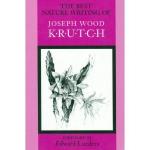
Cats seem to go on the principle that it never does any harm to ask for what they want. Logic is the art of going wrong with confidence. Custom has furnished the only basis which ethics have ever had. What man knows is everywhere at war with what he...
The life of Joseph Wood Krutch is a study in transformation. In the 1920s he was a spokesman for the cynical modernists, who felt that all values had been lost. As part of the New York intellectual circle, he had observed the alienation of many of his...
In his autobiography, More Lives than One (1962), Joseph Wood Krutch modestly recounts his "lives" as a well-known drama critic and associate editor for The Nation, a distinguished professor of dramatic literature at Columbia University, an influential...
The career of Joseph Wood Krutch is remarkable for its variety of achievement. In his early years he became highly visible as a New York drama critic writing for the Nation. In the last decades of his life he gained a new reputation as a naturalist. In...
Through much of his career, Krutch was a teacher of criticism at Columbia University and a drama critic for The Nation. But then respiratory problems led him to early retirement in the desert near Tucson, Arizona. He loved the desert and there turned...
Joseph Wood Krutch (pronounced krootch) (November 25, 1893 – May 22, 1970) was an American writer, critic, and naturalist. Born in Knoxville, Tennessee, he initially studied at the University of Tennessee and received a masters degree and Ph.D....
Ramona June Grey is associate professor in the Department of Political Science at the University of Montana. Theodore L. Putterman is professor of government emeritus at California State University, Sacramento. Although it is now hard to fathom, the reaction of many Western intellectuals...
With the wit that spices everything he writes, Joseph Wood Krutch says in The Twelve Seasons that "the most serious charge that can be brought against New England is not Puritanism but February." Riding out winter a few hundred miles from Mr. Krutch's Connecticut...
The Modern Temper admirably summed up the philosophy of defeatism of the muddled and sadly disillusioned post-war generation. Obviously, the intellectual atmosphere which Mr. Krutch described was the one held in part or as a whole by many of his contemporaries. He gives coherent and reasoned utterance to what many of them felt in a more or less nebulous, uncertain manner. The book, nevertheless, is primarily an effort at self-understanding. It is a personal confession as well as a study of "the moder...
In his attempt to apply psychoanalysis to the career of Edgar Allan Poe for purposes of literary criticism [Edgar Allan Poe: A Study in Genius], Joseph Wood Krutch exhibited a commendable degree of competence for a layman. He seems to have had at his command a fairly good, though incomplete, outline of psychoanalysis as it was constituted circa 1926 and a serviceable understanding of the nature of unconscious conflict as well as certain of its overt manifestations. The psychoanalytic concepts which he uses ...
In Krutch's autobiography [More Lives Than One], there is a strong sense of crisis, insight and redirection at two points in his career; the result in both instances was a book that seemed to write itself, rapidly, out of a fullness of conviction and intensity of feeling. The first was The Modern Temper; and to the extent that it entailed a deliberate embracing of human values sanctioned by art, history and tradition, it may better be termed a reversion than a conversion. Apparently it saved him from...