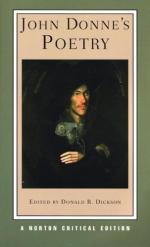
Biography EssayJohn Donne's standing as a great English poet, and one of the greatest of all writers of English prose, is now assured. However, it has been confirmed only in the present century. The h...
Read more
John Donne (1572-1631), English metaphysical poet, Anglican divine, and pulpit orator, is ranked with Milton as one of the greatest English poets. He is also a supreme artist in sermons and devotional...
Read more
John Donne 's standing as a great English poet, and one of the greatest writers of English prose, is now assured. However, it has been confirmed only in the present century. The history of Donne's rep...
Read more
John Donne is now recognized as one of the great originals in the history of English poetry and as an equally accomplished master of English prose. The twentieth century has restored him, in fact, to ...
Read more
In the following essay, originally published in 1978, Aers and Kress examine Donne's representation of self in several verse epistles from Letters to Severall Personages. The epistles studied a...
Read more
In the following essay, originally published in 1986, Marotti examines the conflicts revealed in Donne's poetry and letters as he seeks employment and advancement in the court. Marotti finds th...
Read more
In the following essay, Klause examines how Donne uses the concept of miracles and alchemy—the science of changing matter into gold—in his elaborate, sometimes satirical metaphysical con...
Read more
In the following essay, Cain examines Donne's Satyres in historical context to shed light on Donne's political and religious coming of age.
Despite his involvement with such figures a...
Read more
In the following essay, Halewood provides a detailed reading of Donne's poem, “Goodfriday, 1613. Riding Westward” and suggests that the poem does not achieve closure, but remains ...
Read more
In the following essay, Shifflett provides a historically grounded reading of Donne's poem “Communitie” from Songs and Sonnets, suggesting that Donne explicitly rejected the Calvi...
Read more
In the following essay, Beaston examines the tension between modern readers' expectations and Donne's intent in the Holy Sonnets, arguing that the Sonnets dramatize the medieval concept ...
Read more
In the following essay, Beliles provides an introduction to several feminist responses to Donne's Songs and Sonnets and Elegies, especially “Confined Love,” “Breake of Day&...
Read more
In the following essay, DiPasquale explores the theme of atheism in Donne's poem, “Farewell to Love,” from Songs and Sonnets.
Donne's “Farewell to Love” is...
Read more
In the following essay, Gorton discusses Donne’s sense of place, use of space, and spatial imagery in “The Sunne Rising,” “Breake of Day,” “A Valediction: For...
Read more
In the following essay, Young examines Donne's complex and ironic treatment of love in his poetry, focusing on “The Bracelet,” “Loves Growth,” “The Sunne Risi...
Read more
In the following essay, Raman analyzes s Donne's complex use of money, gender, and colonialist discourse in three erotic poems—“Loves Progress,” “Going to Bed,ȁ...
Read more
In the following essay, first published in 1990, Guibbory focuses his discussion of Donne's love poetry on the poet's often grotesque or negative images of the female body.
For modern...
Read more
In the following essay, Mintz discusses gender ambiguity in Donne's poetry.
Donne's ambivalence about self-other relations is well known to readers of Songs and Sonets. Poised at the ...
Read more
In the following essay, Schoenfeldt considers the theme of sacrifice as developed by post-Reformation religious poets, including Donne, suggesting that seventeenth-century writers imagined sacrifice a...
Read more
In the following essay, Sabine discusses the importance of Donne's wife to his love poetry.
“In the last hour of his last day, as [Donne's] body melted away and vapored into sp...
Read more
In the following essay, Gorton employs contemporary theories of cosmology and physics as a context for understanding Donne's poetry.
Donne's writing shows he was fascinated by new dis...
Read more
In the following excerpt, Meakin discusses Donne's poem about the lesbian poet Sappho as example of how Donne was able to transcend seventeenth-century conceptions of sex and gender.
Donne Wr...
Read more
In the following essay, Fish argues that in his poetry Donne exercises the power of language to dominate and control.
‘my Feigned Page’
For a very long time I was unable to teach Donn...
Read more
In the following excerpt, DiPasquale explores the spiritual anxiety that she perceives in Donne's religious poetry, using La Corona, “I am a little world,” and “Goodfriday,...
Read more
In the following essay, Trevor examines Donne's lifelong melancholy, or depression, as an integral part of his religious beliefs.
Donne is in a sense a psychologist.
—T. S. Eliot
...
Read more
In the following essay, Everett reflects on the history of Donne scholarship, contending that overemphasis on Donne as a public, active man has been misguided.
It's a quiet time just now in ...
Read more
In the following essay, Erne focuses on the poem “Show me deare Christ” as evidence of Donne's feelings about Catholicism.
The life of John Donne is more fully documented than ...
Read more
In the following essay, originally published in 1978, Aers and Kress examine Donne's representation of self in several verse epistles from Letters to Severall Personages. The epistles studied a...
Read more
In the following essay, Gorton discusses Donne’s sense of place, use of space, and spatial imagery in “The Sunne Rising,” “Breake of Day,” “A Valediction: For...
Read more
In the following essay, Young examines Donne's complex and ironic treatment of love in his poetry, focusing on “The Bracelet,” “Loves Growth,” “The Sunne Risi...
Read more
In the following essay, Raman analyzes s Donne's complex use of money, gender, and colonialist discourse in three erotic poems—“Loves Progress,” “Going to Bed,ȁ...
Read more
In the following essay, originally published in 1986, Marotti examines the conflicts revealed in Donne's poetry and letters as he seeks employment and advancement in the court. Marotti finds th...
Read more
In the following essay, Klause examines how Donne uses the concept of miracles and alchemy—the science of changing matter into gold—in his elaborate, sometimes satirical metaphysical con...
Read more
In the following essay, Cain examines Donne's Satyres in historical context to shed light on Donne's political and religious coming of age.
Despite his involvement with such figures a...
Read more
In the following essay, Halewood provides a detailed reading of Donne's poem, “Goodfriday, 1613. Riding Westward” and suggests that the poem does not achieve closure, but remains ...
Read more
In the following essay, Shifflett provides a historically grounded reading of Donne's poem “Communitie” from Songs and Sonnets, suggesting that Donne explicitly rejected the Calvi...
Read more
In the following essay, Beaston examines the tension between modern readers' expectations and Donne's intent in the Holy Sonnets, arguing that the Sonnets dramatize the medieval concept ...
Read more
In the following essay, Beliles provides an introduction to several feminist responses to Donne's Songs and Sonnets and Elegies, especially “Confined Love,” “Breake of Day&...
Read more
In the following essay, DiPasquale explores the theme of atheism in Donne's poem, “Farewell to Love,” from Songs and Sonnets.
Donne's “Farewell to Love” is...
Read more
Metaphysical poetry demonstrates the various techniques employed to present powerful comparisons by which the reader is able to construct meaning. During the Renaissance period, the revolutionary disc...
Read more
Since the publication of his `Songs and Sonets' in 1663, the intellectual wittiness of John Donne's love poetry has caused much speculation about the views of the poet himself. Donne took the traditio...
Read more
Metaphysical poetry is about big issues for example, love, death, and God explored through more trivial things such as chatting up a lover and involves using metaphors to describe these issues. Metap...
Read more
Donne and Hopkins are both poets who have written works which contain love, yet at a glance it is apparent that their poems have quite a different approach to love. Hopkins' poems reserve their love f...
Read more
John Donne lived a life filled with love, pain, and above all; his words. Donne was one of the first to use his words to express feelings toward life, love, and questions. Donne was also a priest, al...
Read more
Poetry of the seventeenth century is among some of the best ever written, however, there is more uncertainty when dealing with particular subjects. The topics, for the most part, are more serious and ...
Read more
There are many literary devices at the disposal of writers that are used to emphasize ideas. In his sonnet "Death, be not proud", John Donne chooses to use personification. He personifies death in o...
Read more
"The Broken Heart" by poet John Donne reveals the speaker's experiences and his consequent attitude towards a personified love, through his sophisticated appliances of language, imagery and form. The...
Read more
John Donne is known for, among many things, his captivating sermons. In Donne's "Holy Sonnet XIV," his piety is met by his poetic ability. As the sonnet follows the speaker's pleas to God for guidance...
Read more
John Donne is known as one of the best metaphysical poet. He uses metaphoric conceit in lots of his writings. Metaphoric conceit is comparing two incredibly unlike things to one another. In John Donne...
Read more
John Donne wrote a total of nineteen sonnets he titled "The Holy Sonnets." When it came to their form, Donne very loosely followed the Petrachan style for all nineteen. In the first eight lines--the o...
Read more
Division of the Body and Soul
John Donne's "The Funeral" and "Holy Sonnet 3" are undeniably similar in their discussions of the separation of the body and soul. Each poem deals directly with the ide...
Read more

A love letter from Napoleon to his mistress Josephine sold for $557,000, more than five times its estimate, at a London auction that attracted spirited bidding for several rare items.The letter is ...
Read more
History hovers nearby at the Lyric Opera of Chicago, where John Adams' ambitious but uneven work about the creation of the atom bomb is being staged just a few miles from the site of the world's fi...
Read more
The worst role any performer can be saddled with is that of Greatest Actor of his Generation. It may look easy to play from the outside-it is, after all, the role of a lifetime-but in reality it re...
Read more
Opera, the most multilayered art form, loves war for its multiplicity of passions. Opera also fears war—or at least the direct depiction of it onstage. Most opera composers have sensibly real...
Read more