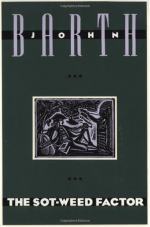
John Barth has taken what he considers the moribund genre of the traditional novel and has revived it with a series of imaginative and inventive "fictions." Barth writes, "If I were a painter, I would...
Read more
In a writing career that spans five decades, John Barth has established himself as the premier writer of the postmodern novel in America. Perhaps more than any other contemporary writer, Barth has man...
Read more

Critical Essay by John Hawkes
[Barth's] awareness of the right word and manipulations of "voice" are brilliant and sometimes devastating. Barth's wit—his word-play,...
Read more
Critical Essay by James F. Walter
The theme of interior disorder and illness caused by a division between human faculties which naturally complement each other in the act of knowing is, of course, a ...
Read more
Critical Essay by Robert Martin Adams
The sequence in [Lost in the Funhouse] leads us from the meditations of a sperm through the boyhood adventures of Ambrose to the mythical life history of an anon...
Read more
Critical Essay by Beverly Gross
It is striking … to see how much Barth's fiction has been moving toward the fulfillment of an idea—the idea being the repudiation of narrative art...
Read more
Critical Essay by Josephine Hendin
John Barth has seen art as the world "elsewhere," the better world where nothing disappears. Letters is his billet doux to literature and his plea to ...
Read more
Critical Essay by Linda A. Westervelt
Toward the beginning of his confession, the narrator of Dostoevsky's Notes from Underground writes, "I am firmly convinced not only that a great de...
Read more
Critical Essay by Joe Weixlmann and Sher Weixlmann
[Barth's aesthetic] embodies a conscious attempt to go beyond Joyce—by going backwards. Like the protagonist of his "Perseid,...
Read more
Critical Essay by Tony Tanner
Much of John Barth's fiction arises out of his scrupulous, exacting, sometimes excruciating, consideration of his own position as a Novelist writing Now. The stat...
Read more
Critical Essay by Geoffrey Wolff
[John Barth's] first novel since Giles Goat-Boy (1966) is, as publishers like to say, an event. Letters … is a big event, almost half a million words, 8...
Read more
Critical Essay by Philip Stevick
In a novel [Letters] that takes many risks, the identity of the correspondents is the biggest risk of all. They are all figures from Barth's previous fiction...
Read more
Critical Essay by Frank Mcconnell
[In Letters, the] subplots, counterplots, and crossplots … exfoliate maddeningly and impinge even more maddeningly upon one another. Its language ranges from ...
Read more
Critical Essay by Benjamin Demott
[The author of Letters manages] to keep a sober promise he makes early on, namely that "the several narratives will become one." He brings it off by fr...
Read more
Critical Essay by Charles Trueheart
Whether or not we are ever so rewarded, most of us believe we deserve a sabbatical, a time outside the scheme of our lives to rest and ruminate, to reckon how far ...
Read more
Critical Essay by James Wolcott
After the slow-grinding, interlocking minutiae of Letters, John Barth may have thought that his readers deserved a breather, and he's given them one: Sabbatical...
Read more
Critical Essay by Michael Wood
"We'll have to stick to the channel," John Barth wrote in his first novel, "The Floating Opera," and let the creeks and coves go by.&...
Read more
Critical Essay by Lorna Sage
With Sabbatical John Barth confirms that he has joined the ranks of the Old Poops. A useful category this, invented by Kurt Vonnegut for purposes of self-description. OPs...
Read more
Critical Essay by Charlotte Renner
Asked by the editors of the New York Times Book Review … to explain how he became a writer, John Barth gave a surprising answer. "It is my fate and eq...
Read more
Critical Essay by Robert Taubman
'There was a story that began—' begins Sabbatical, and the story is then interrupted for two nights and a day by a storm at sea, itself interrupt...
Read more
Critical Essay by Doug Bolling
In the no man's land of contemporary fiction, Barth has always been a willing occupier of the trenches, a writer concerned both to advance and defend, and this p...
Read more
In the following essay, Bradbury discusses the fiction of John Barth, finding that the author uses self-reflexive techniques to comment on American culture.
It is a commonplace of postmodernist fic...
Read more
American car shoppers are a fickle bunch.They're worried about gas prices and are loath to buy the largest SUVs. But they haven't embraced hybrids fully either.At the same time, U.S. automakers are...
Read more