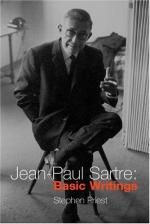
Jean-Paul Charles Aymard Sartre ( 21 June 1905 – 15 April 1980 ), normally known simply as Jean-Paul Sartre , was a French existentialist philosopher, dramatist and screenwriter, novelist, and critic. He had an enduring personal relationship with...
The French philosopher and man of letters Jean Paul Sartre (1905-1980) ranks as the most versatile writer and as the dominant influence in three decades of French intellectual life. Jean Paul Sartre was born in Paris on June 21, 1905. His father, a...
The name Jean-Paul Sartre is recognized by millions around the world. By the time of his death in 1980 he was a public figure throughout Europe and something of a French and even worldwide intellectual property. His volumes have been translated into...
More than any other cultural figure of his generation, Jean-Paul Sartre set the tone of intellectual, philosophical, and literary activity both within postwar France and throughout Europe and the United States. Throughout his long writing career,...
SARTRE, JEAN-PAUL (1905–1980), French philosopher and man of letters, is generally regarded as the chief exponent of the atheistic branch of existentialism. Soon after World War II, Sartre wrote in Existentialism and Humanism (London, 1948):...
Jean-Paul Charles Aymard Sartre (June 21, 1905 – April 15, 1980), normally known simply as Jean-Paul Sartre (pronounced [ʒɑ̃ pol saʁtʁə]), was a French existentialist philosopher and pioneer, dramatist and screenwriter, novelist and critic....
Jean-Paul Sartre. By Andrew Leak. (London: Reaktion Books, 2006. Pp. vii, 167. $16.95.) Writing a short biographical introduction to Sartre is no easy feat, and it would be difficult to top this author's effort. After all, Sartre was one of the most prolific...
Monarch Notes 01-01-1963 Introduction Sartre has probably exercised a greater impact upon the intellectual life of Europe since the Second World War than any other man of letters. He has made a vogue and battle cry out of an abstruse philosophical doctrine; his works...
Selected editorial excerpts from the U.S. press: AN OVERDUE MEMORIAL (The Wall Street Journal, New York) Considering the enormity of what it commemorates, the Memorial to the Victims of Communism, dedicated by President Bush yesterday, is striking for its modest proportions:...
Oct 15 (Reuters) - Following are some of the major events to have occurred on October 22 since 1900: 1906 - Paul Cezanne, French Post-Impressionist painter, died. Among his best known works are "Card Players" and "Mont Sainte-Victoire with Large Pine Trees". 1910 -...
Throughout the essays of Situations 1 one finds a recurrent preoccupation with the problems of language and silence, with the artist's perception of the insufficiencies of language, the perception that language disintegrates the wholeness of the artist's silent intuition. It is precisely those writers who vainly attempt to use language to express silence and a world that precedes words who fascinate Sartre—Parain, Bataille, Blanchot, Camus, Ponge, Faulkner. (p. 19) Sartre's preoc...
Sartre's originality, among contemporary critics of style, lies in his treatment of literary style as an objective rather than a subjective phenomenon. As against those for whom the work of art is the privileged occasion of contact with some deeper force, with the unconscious, with the personality, with Being, or with language, Sartre takes his place among the rhetoricians. The work of art is a construct designed to produce a certain effect; the style of the work of art is the instrument with which a...
In the following essay about Sartre's short story "Intimacy, " Morris examines the character Lulu, noting that in "Existentialist terms, Lulu refuses her choice; she remains 'astride' of a paradox in Baudelairian fashion. " Morris concludes by asserting that "Existentialism is for heroes."
A discussion of Sartre's existentialism philosphy that places the highest value and human freedom and decision-making. Failing to assume total responsibility for one's life causes existential anguish and is living an inauthentic life through pretending that we don't control our destiny.