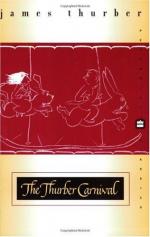
Thurber, James (1894-1961)
Ohio-born satirical writer James Thurber was most noted for his ability to illustrate, through the use of humor, the frailties of human beings in a world seemingly dominated...
Read more
Biography EssayIn a general survey of American humor, James Thurber comes after the traditional horsesense humorists and before the black humorists of the postatomic era. His most famous and most endu...
Read more
James Grove Thurber (1894-1961) was an American writer and artist. One of the most popular humorists of his time, Thurber celebrated in stories and in cartoons the comic frustrations of eccentric and ...
Read more
Called "one of the world's greatest humorists" by Alistair Cooke in the Atlantic, James Thurber was one of the mainstays of the New Yorker magazine, where his short stories, essays, and numerous carto...
Read more
France does not figure prominently as a subject in James Thurber's works. Yet his three longest European sojourns--from November 1918 to March 1920, from May 1925 to May 1926, and from May 1937 to Aug...
Read more
In a general survey of American humor, James Thurber comes after the traditional horse-sense humorists and before the black humorists of the postatomic era. His most famous and most enduring work deve...
Read more
The name of James Thurber is immediately recognized by the majority of Americans as the author of hundreds of humorous essays and the artist of innumerable cartoons featured in the New Yorker during t...
Read more
Next to Mark Twain, James Thurber is the most critically acclaimed humorist in American literary history. Like Twain he first established his reputation as a journalist. By the time he died, he was re...
Read more
In the following essay, Triesch examines the ways in which Thurber changed the traditional form of the fable.
Speaking of the Human Habit of Ascribing Human Weaknesses to animals, James Thurber says t...
Read more
In the following essay, May suggests that Thurber's short story “You Could Look It Up” is an Americanized version of the story of Christ.
A basic characteristic of James Thurber...
Read more
In the following essay, Arnold discusses Thurber's use of animals in his short fiction.
Those critics who have had the temerity to discuss Thurber's animals have often taken the directio...
Read more
In this essay, Blythe and Sweet analyze the sexual symbolism in “The Secret Life of Walter Mitty.”
Several critics have focused on the relationship between Walter Mitty's daydream...
Read more
In the following essay, Secor determines how the character of Walter Mitty reflects the image of Joseph Conrad's creation, Lord Jim.
James Thurber first encountered Joseph Conrad in a college c...
Read more
In the following essay, Long surveys both the best known stories of Thurber and some of the lesser known.
Thurber's tales of the “little man” culminate in “Walter Mitty,...
Read more
In this essay, Cheatham explores the function of sin, death, and judgment in the fantasies of Thurber's character Walter Mitty.
Serious matters, we now know, bubble and boil beneath the cleverl...
Read more
In the following essay, Kaufman notes that below the surface of Thurber's “The Secret Life of Walter Mitty” lies an increasing preoccupation with fantasy life and rejection of rea...
Read more
Critical Essay by Julian Moynihan
In a tribute to Mary Thurber written after her death in 1955 and reprinted in Alarms and Diversions Thurber testified to the life-long occupation of his mind by a sen...
Read more
Critical Essay by Louis Hasley
Beyond question the foremost humorist of the twentieth century, James Thurber was a divided man. With minor exceptions he did not explore the century's large soci...
Read more
Critical Essay by Kenneth Hurren
The temptation to tangle with an analysis of the late James Thurber's gay and anguished humour is generally irresistible to reviewers confronted with such excer...
Read more
The following positive review considers Thurber's Credos and Curios in relation to the author's whole body of work.
Reviewing a book by James Thurber is something like describing the Taj...
Read more
This rapid overview of many of Thurber's most famous works aims to dispute Thurber's critical reputation as the foremost American humorist of his time.
While he was still alive, James Th...
Read more
This brief review finds most of the works included in Collecting Himself not worth a new anthology but nonetheless appreciates a few of Thurber's more insightful essays.
I somehow assumed that ...
Read more
In contrast to unenthusiastic responses to Thurber's Collecting Himself, this review finds the collection a "luminous delight."
Trying to explain the mechanics of humour can be a ...
Read more
In this review, Joyce, a writer of children's books, welcomes the republication of three of Thurber's books for young people.
I had forgotten that James Thurber had written any children&...
Read more
In the following essay, Kaufman disputes the consensus that Walter Mitty is an everyman to be sympathized with. Instead, he proposes that the story is a critique of Mitty's inability to cope wi...
Read more
The following review finds the previously uncollected works in People Have More Fun Than Anybody equal to any of Thurber's more celebrated and familiar writing and cartoons.
It's possibl...
Read more
In the following mixed assessment, Seligman finds that some of Thurber's work retains a peculiar charm but that most of it is overwrought and dated, the product of a talent that never achieved ...
Read more
In the following review the critic deems that Thurber's posthumously published essays and sketches in Credos and Curios are a representative summary of Thurber's career.
My introduction ...
Read more
In the following brief review, the critic laments that Thurber's Credos and Curios is likely his last work.
When a writer has entertained us so well for so many years as James Thurber did, it i...
Read more
This essay views Thurber's baseball short story "You Could Look It Up" as an "ironic, modernized retelling" of a biblical tale.
A basic characteristic of James Thurb...
Read more
In this essay, Gehring identifies Thurber's work for the New Yorker in the 1920s as one of the first instances of a new twentieth-century literary figure, the comic antihero.
The comic anti-her...
Read more
This review of Selected Letters of James Thurber warmly appreciates the substance of the volume but comments unfavorably on the selection criteria for which letters are included.
James Thurber deftly ...
Read more
This brief review faults the editors of this volume of letters for their selection criteria, calling the compilation disappointing.
Thurber was an inveterate letter writer from college days until his ...
Read more
In this brief essay, Underwood offers a previously overloooked explanation for the events of Thurber's classic story.
Critics of James Thurber's "The Catbird Seat" invariab...
Read more
In this essay, Arner discusses the first ten years of Thurber's writing career and his humor's relation to the Depression era.
The first ten years of James Thurber's career coinci...
Read more
Critical Essay by Kenneth Burke
That skillful literary man, St. Augustine, has warned that one should never smite an opponent in bad grammar. Applying a loose interpretation, we could translate his wi...
Read more
Critical Essay by Wilfrid Sheed
Thurber was a marvelous comic writer, but alone among such he was able to sketch the phantasmagoric goo from which his funny ideas came. If Henry James or Dostoevsky ha...
Read more
Critical Essay by Brian Attebery
[James Thurber's] work is often said to be in the line of Twain, Henry James, or T. S. Eliot, and, indeed, he shares traits with all three. In view of his liter...
Read more
Critical Essay by Jonathan Yardley
James Thurber was often an irascible and difficult man, but there is little of that side of his personality in these Selected Letters. Here we find him for the most ...
Read more
Critical Essay by William Zinsser
Afflicted by bad eyesight and eventual blindness, James Thurber had good reason to bemoan the advancing darkness and the racing years, as, in ["Selected Letter...
Read more
Critical Essay by Nora Sayre
Encounters—with unfriendly food, or machinery, or objects that took on a life of their own—were essential to [James Thurber's] vision of human existen...
Read more
Critical Essay by Clancy Sigal
[James Thurber] was one of the funniest men alive, if you at all tuned in to his doggerel cartoons, with their barking seals and daffily aggressive women swooping on glo...
Read more
Critical Essay by Alan Coren
[The] wife who wants to bring out a volume of her deceased husband's correspondence has not one, but two, reputations to protect, if not, indeed, enhance. But in th...
Read more
The Life and the Hard Times of James Thurber
The most Intriguing characteristics of James Thurber are his style and evocation of humor. In almost every surface that was touched by his ink we are able...
Read more

Question 1 of 10:She was to become one
America
's best-known critics, but how did
Dorothy
first make a living?A fashion model
A pianist
A nannyA secretaryQuestion 2 of 10:The first of many trage...
Read more
Today is Wednesday, Feb. 14, the 45th day of 2007. There are 320 days left in the year. This is Valentine's Day.Today's Highlight in History:On Feb. 14, 1929, the "St. Valentine's Day Massacre" too...
Read more
The trend seems as plain as the nose on your child's face, or an arrow through your head. There's Madonna, Billy Crystal and Jamie Lee Curtis. And Jerry Seinfeld. And John Lithgow. And Katie Couric...
Read more
When President Bush invited lawmakers for a picnic, an approaching storm threatened to derail the event. His spokesman, Tony Snow, suggested that Democratic leaders in Congress secretly wanted it t...
Read more
Half full, half empty. No matter how you spin it, the Iraq report won't help President Bush make his stay-the-course case to a skeptical public and Congress.The president's approval rating is 33 pe...
Read more
WASHINGTON (Reuters) - For the first time since a
young and charismatic John F. Kennedy reached the U.S. political
summit nearly half a century ago, a sitting member of Congress may
be elected pre...
Read more
In his 89 years, Arthur M. Schlesinger was a Pulitzer Prize-winning historian, a Kennedy insider, and an influential thinker who helped define mainstream liberalism during the Cold War."(He had) en...
Read more