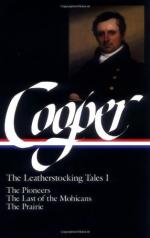
Cooper, James Fenimore
(b. September 15, 1789; d. September 14, 1851) American writer known for early U.S. war novels.
James Fenimore Cooper was part of the generation of writers who created the fir...
Read more
The Spy: First American War Novel
When James Fenimore Cooper decided to write The Spy (1821), a narrative of manners set in the America of the Revolutionary War, he was certainly conscious of the fact...
Read more
Cooper, James Fenimore
Born September 15, 1789
Burlington, New Jersey
Died September 14, 1851
Cooperstown, New York
Writer
James Fenimore Cooper introduced the themes of the frontier, white/Indian con...
Read more
Biography EssayOne hundred and fifty years ago Cooper was one of the world's most widely read novelists and one of the most highly acclaimed. During his lifetime a number of well-publicized quarrels w...
Read more

Novelist and social critic James Fenimore Cooper (1789-1851) was the first major American writer to deal imaginatively with American life, notably in his five "Leather-Stocking Tales." He was also a c...
Read more
James Fenimore Cooper was a pioneer of American literature. He was not only the first of his countrymen to make a living solely from the pen, but he also legitimized American themes, such as the openi...
Read more
One hundred and fifty years ago Cooper was one of the world's most widely read novelists and one of the most highly acclaimed. During his lifetime a number of well-publicized quarrels with his country...
Read more
James Fenimore Cooper sailed for Europe with his family on 1 June 1826 for a projected five-year visit. He left New York with the multiple aims of securing favorable European publication agreements fo...
Read more
Throughout much of the nineteenth century James Fenimore Cooper was one of the most widely read novelists in the world and one of the most highly acclaimed. During his lifetime a series of well-public...
Read more
In the following introduction to The Spy, Cooper discusses the basis of the novel and the state of the union since the Revolutionary War.
The author has often been asked if there were any foundatio...
Read more
In the following essay, Adams contends that Cooper was ambivalent toward the law in America because he "was impelled to believe—emotionally and intellectually—in the law's ...
Read more
In the excerpt below, from the text of a lecture delivered in 1852 at a Public Memorial Meeting in honor of Cooper, Bryant surveys Cooper's career and assesses its significance.
It is now so...
Read more
In the following excerpt, Lounsbury assesses the positive and negative characteristics of Cooper's writing.
More than sixty years have gone by since Cooper began to write; more than thirty s...
Read more
In the following essay, originally composed in 1895, Twain criticizes Cooper for his inflexible style and verbosity.
Young Gentlemen: In studying Cooper you still find it profitable to study him in...
Read more
In the following essay, Grattan considers Cooper to be an overrated writer who is remembered today mostly for his personality rather than his writings.
Among all the figures in American literature ...
Read more
In the following essay, Brooks discusses the influence of the sea on Cooper's early fiction.
While Irving was exploring England, another New Yorker, six years younger, who had served for a w...
Read more
In the following essay, Grossman discusses Cooper's political views and the influence of European values on his writings.
Cooper's literary career, beginning haphazardly without consc...
Read more
In the following essay, McWilliams contends that Cooper failed to employ the epic and romantic imagery that his contemporaries used to describe American Indians.
Americans who first conceived of he...
Read more
In the following excerpt, Kirk discusses Cooper's political views, especially how his aristocratic sympathies shaped his views on democracy.
In Democracies there is a besetting disposition ...
Read more
Twin baby grand pianos stand in the living room of a white clapboard farmhouse high on the Taconic Ridge on the border of New York and Massachusetts. Here the poet Edna St. Vincent M...
Read more
NORWICH, Conn. _ The Mohegans were wiped out long ago in the novel "The Last of the Mohicans," but today the real American Indian tribe is flush with casino cash and using it to restore its proud p...
Read more
When Louis-Joseph de Montcalm departed the southern shore of this Adirondack lake in 1757, he left behind the smoldering ruins of a British fort, mutilated bodies and the seeds for an American lite...
Read more
Washington smarties will tell you that only 15 House seats are ever truly in play every two years, thanks to gerrymandering. This is the world, comfortable and eternal, that all politicians want (e...
Read more
Washington smarties will tell you that only 15 House seats are ever truly in play every two years, thanks to gerrymandering. This is the world, comfortable and eternal, that all politicians want (e...
Read more
A well regulated militia being necessary to the security of a free State, the right of the People to keep and bear arms, shall not be infringed.”
—Second Amendment to the U.S. Const...
Read more