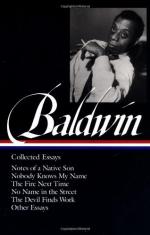
Biography EssayJames Baldwin's eminence as a man of letters is now well established; indeed, his books, essays, and numerous other pieces attest to the truth of Benjamin DeMott's statement that "this ...
Read more
The author James Arthur Baldwin (1924-1987) achieved international recognition for his bold expressions of African American life in the United States.James Baldwin was born in Harlem, New York City, o...
Read more
A self-proclaimed disturber of the peace and subversive outsider whose modest goal was to change the world, James Baldwin is considered one of the most important American writers since World War II. A...
Read more
James Baldwin was a novelist, playwright and essayist, but to many Americans he was known as a spokesman for blacks who grew up during the civil rights movement of the 1960s and 1970s. Baldwin rejecte...
Read more
As novelist, essayist, dramatist and social critic, James Baldwin's books and numerous other pieces attest not only to a sustained prolificacy but also to a consistent perspicacity. Alternately praise...
Read more
James Baldwin's eminence as a man of letters is now well established; indeed, his books, essays, and other pieces attest to the truth of Benjamin DeMott's statement that "this author retains a place i...
Read more
James Baldwin emerged in the 1960s as one of America's most gifted writers and one of black America's most articulate spokesmen. Although he is primarily a novelist, Baldwin has also published essays,...
Read more
In the preface to his 1968 publication of The Amen Corner (produced 1955), James Baldwin comments, in typically forthright fashion, that at the time of writing the play--in the early beginnings of his...
Read more
When he died on 1 December 1987, James Baldwin was remembered as a prophet who addressed the causes and results of racial conflict. He spent his entire literary career writing essays, speeches, storie...
Read more
Critical Essay by Charles Newman
James Baldwin has made a reputation by exploiting social paradoxes, so it should not be surprising to trace his literary antecedents to neither Richard Wright nor Har...
Read more
Critical Essay by Keneth Kinnamon
A decade ago James Baldwin, more than any other author, seemed to liberal white Americans to personify as well as to articulate the outrage and anguish of black Amer...
Read more
Critical Essay by Donald C. Murray
In the world of "Sonny's Blues," the short story by James Baldwin, the author deals with man's need to find his identity in a hostile so...
Read more
Critical Essay by Richard Gilman
Swollen (655 pages), meandering, awkwardly colloquial, and pretentiously elevated by turns, [Just Above My Head] agitatedly contains four or five major themes that ne...
Read more
Critical Essay by Paul Levy
In many of his earlier novels James Baldwin showed that he … was a distinguished craftsman. But in Just Above My Head, though he reverts to the fruitful matter of h...
Read more
Critical Essay by Pearl K. Bell
In his famous essay, "Everybody's Protest Novel," published in Partisan Review in 1949, when he was only twenty-four, Baldwin announced his determ...
Read more
Critical Essay by Paul Bailey
No one today excels James Baldwin in the writing of invective. His art is nourished and sustained by an unquenchable rage. He is, essentially, a prophet, with a prophet&...
Read more
Critical Essay by James Rawley
Baldwin is so experienced an essayist, and Hall Montana so convenient an observer, that Hall's rhetorical social commentary takes an unwanted precedence over the...
Read more
Critical Essay by Timothy S. Seibles
Just Above My Head is a large work which concerns itself with many things and treats each of them with great reverence. There are no ready-made formulas for drama...
Read more
Critical Essay by Colin Macinnes
I envy whoever writes of James Baldwin a century from now. That his work will then be discussed I have no doubt, since of all writers in English of our era his style ...
Read more
Critical Essay by David Levin
Baldwin has come to represent for "white" Americans the eloquent, indignant prophet of an oppressed people, a voice speaking … in an all but despera...
Read more
Critical Essay by Howard Taubman
Mr. Baldwin is a preacher and a rhapsodist. "Blues for Mister Charlie" is an angry sermon and a pain-wracked lament. It draws together the humiliation, ...
Read more
Critical Essay by Philip Roth
[The direction Blues for Mr. Charlie] takes is an expression of the will of one of the characters, Richard's father, who searches for the meaning of [his son...
Read more
Critical Essay by Robert Brustein
Nothing Personal pretends to be a ruthless indictment of contemporary America, but the people likely to buy this extravagant volume are the subscribers to fashion ma...
Read more
Critical Essay by Daniel Stern
Going to Meet the Man, Baldwin's first collection of short stories, is closer in spirit, tone, and achievement to his best critical work than it is to his ...
Read more
Critical Essay by Stephen Donadio
The stories in [Going to Meet the Man] add nothing to Mr. Baldwin's stature, nor do they diminish it by much. Five have appeared in print before; the other th...
Read more
Critical Essay by C.w.e. Bigsby
The continuing battle which Baldwin has waged with the spirit of Richard Wright, a battle which started in 1949 with the publication of his essay, 'Everybody...
Read more
Critical Essay by John Thompson
Baldwin's language from his first writings has been distinguished. Precise, well-ordered, very sophisticated, it could describe extreme experiences with chill c...
Read more
Critical Essay by Mario Puzo
["Tell Me How Long the Train's Been Gone"] is a simpleminded, one-dimensional novel with mostly cardboard characters, a polemical rather than narrati...
Read more
Critical Essay by Richard Gilman
Composed mostly in flashback, [Tell Me How Long the Train's Been Gone] follows Proudhammer through a bitter Harlem childhood, the birth of ambition toward the ...
Read more
Critical Essay by Brian Lee
The particular social condition Baldwin diagnoses in his essays is the same one that makes the creation of a fictional world virtually impossible for a Negro novelist. His...
Read more
Critical Essay by Walter Meserve
The fact that [Baldwin] equated playwriting with improving a troubled world [as he did in an observation made in high school] explains his theory of drama quite clear...
Read more
Critical Essay by Anthony Bailey
[One has] the feeling that Malcolm X's life and death do not furnish the best vehicle by which even an immensely talented writer can express in cinematic terms...
Read more
Critical Essay by Bruce Cook
James Baldwin's screenplay adaptation of [The Autobiography of Malcolm X, written with Alex Haley] now published as One Day When I Was Lost, is no substitute for t...
Read more
Critical Essay by John Simon
A "protest play," unfortunately, always has a hard time of it artistically, and even more so if, like Baldwin, the playwright doth protest too much. And not...
Read more
Critical Essay by Edmund White
Of all the well-known novelists of the day, James Baldwin is among the warmest, the most companionable, the least ironic. So many contemporary writers seem incapable of...
Read more
Critical Essay by John Romano
It isn't hard to see why James Baldwin in particular has chosen to shape his sixth novel along the lines of a saga in the contemporary mode. His fiction has often...
Read more
Critical Essay by Stanley Crouch
It is Baldwin's sentimental and poorly argued attempt to present homosexuality as some form of superior erotic enlightenment that continually slackens the powe...
Read more
Critical Essay by Margo Jefferson
[Despite Baldwin's] absorption in culture's complexities and conundrums, despite his indictments of racism, his deepest impulses are religious, mytholo...
Read more
Critical Essay by Richard Gilman
[Just Above My Head is] a melancholy piece of creation. Swollen …, meandering, awkwardly colloquial, and pretentiously elevated by turns, the book agitatedly c...
Read more
Critical Essay by Whitney Balliet
The novelistic walls of "Just Above My Head" bulge and leak. But the form Baldwin chooses to write in no longer matters. His great and peculiar power i...
Read more
Critical Essay by Darryl Pinckney
Moralistic fervor, a high literary seriousness, the authority of the survivor, of the witness—these qualities made Baldwin unique. In his best work, he is dra...
Read more
Critical Essay by Irving Howe
To transcend the sterile categories of "Negro-ness," whether those enforced by the white world or those erected defensively by Negroes, became Baldwin...
Read more
Critical Essay by Donald Malcolm
Mr. Baldwin [in "Nobody Knows My Name"] proves to be a steady and exact observer of himself and of others. He also qualifies eminently as a person for w...
Read more
Critical Essay by James Finn
[Nobody Knows My Name] is confirmation that James Baldwin is one of America's finest writers. The essays are uneven; some are slight and dated already because of t...
Read more
In the following essay, Shin and Judson analyze the change in Baldwin's presentation of homosexuality between Giovanni's Room and Just Above My Head.
It has become commonplace to sugg...
Read more
In the following interview, Baldwin discusses his relationships, his writing, other writers, and America.
[Baldwin]: It all comes back now.
[Troupe]: When did you first meet Miles?
Oh, a long...
Read more
In the following essay, O'Neale "explores the complexities of Baldwin's concepts of fatherhood and how they impinge on his search—for a sympathetic Father/God—an ody...
Read more
Chinua Achebe is a novelist whose works include Things Fall Apart and Anthills of the Savannah. In the following essay, he asserts the value of James Baldwin's legacy.
The many and varied tr...
Read more
In the following essay, Gates traces the course of Baldwin's thought and importance throughout his career.
"I am not in paradise," James Baldwin assured readers of the Black Sc...
Read more
In the following essay, Rohy analyzes how the questions of origin and identity in Baldwin's Giovanni's Room relate to the concepts of passing and nostalgia.
"America is my coun...
Read more
In the following review, Als presents an overview of Baldwin's life and career.
Twenty-two years ago, when I was fourteen, I was given James Baldwin's second collection of essays, Nob...
Read more
According to James Baldwin, if people were to "guard" and "keep" themselves from society, they are trying to portray an "identity" of which they only assume themselves to be. This can be true in many...
Read more
America: love it or leave it" was a popular slogan in the 1960s. Plastered on signs and bumper stickers, the phrase was a response to the people, most of them young college students, who loudly and an...
Read more

Question 1 of 10:The first African slaves were brought to the
USA
in 1501. When was the importation of slaves finally banned?150816081708
1808
Question 2 of 10:Slaves were promised freedom if the...
Read more
Today is Monday, Dec. 18, the 352nd day of 2006. There are 13 days left in the year.Today's Highlight in History:On Dec. 18, 1944, in a pair of rulings, the U.S. Supreme Court upheld the wartime re...
Read more
How does Black LGBT/SGL culture relate to hip hop?Well, consider the literature.Black LGBT/SGL literature is underground hip hop. We are telling our truths and we have an audience. We are not anoma...
Read more
Hillary Rodham Clinton and her campaign tried to mend ties to black voters Thursday when a key supporter apologized to her chief rival, Barack Obama, for comments that hinted at Obama's drug use as...
Read more
Norman Mailer was at Bobby Kennedy’s wake in 1968 when he lit a woman’s hair on fire with a candle. It was an accident, but that didn’t count for much when the woman’s hair...
Read more
My Life So Far, by Jane Fonda. Random House, 600 pages, $26.95.If ever a novelist was born to review a 600-page autobiography by Jane Fonda, I'm it.
Under any other circumstance, I would hold to t...
Read more