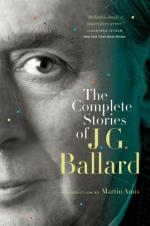
J. G. Ballard is "perhaps the most important figure to emerge from the British New Wave of science-fiction writers, whose works brought a new degree of literary sophistication and critical respectabil...
Read more
J.G. Ballard is more than just a science fiction or futurist fantasy merchant; he is one of the most significant of those British novelists who have established themselves since 1960.Ballard is an amb...
Read more
J. G. Ballard is one of the most significant of those British novelists who have established themselves since 1960. Although he established his literary reputation as a science-fiction writer, he has ...
Read more
J. G. Ballard is perhaps the most important figure to emerge from the British New Wave of science-fiction writers, whose works brought a new degree of literary sophistication and critical respectabili...
Read more

Critical Essay by Michael Wood
There was a time, some ten or fifteen years ago, when the notion of "inner space," usually associated with the writings of J. G. Ballard, threatened to cha...
Read more
Critical Essay by Malcolm Bradbury
[More and more J. G. Ballard] looks like a leading figure in a very rich and developing field. His earlier work was usually cast as science fiction, but he has long ...
Read more
Critical Essay by David Pringle
"The Violent Noon" [Ballard's first published story] is a story about terrorism and military reprisals, set in Malaya during the Emergency. Althoug...
Read more
In the following review, Priest offers praise for The Day of Creation.
One of the familiar smaller pleasures of a J. G. Ballard novel is the way in which the chapters are named, a surreal blend of fan...
Read more
In the following essay, Brigg examines Ballard's preoccupation with time in “The Voices of Time,” The Crystal World, Hello America, and “News from the Sun.” Brigg co...
Read more
In the following review of Iain Sinclair's Crash: David Cronenberg's Post-Mortem on J. G. Ballard's “Trajectory of Fate,” Gray discusses Ballard's literary si...
Read more
In the following interview, Ballard discusses the negative impact of technology, violence, and mass culture in Western society; comments on science fiction, literary realism, and his own writing; and ...
Read more
In the following essay, Wagar discerns underlying elements of idealism and a longing for psychic transformation and transcendence in Ballard's fiction. According to Wagar, Ballard's work...
Read more
In the following essay, Foster, an associate professor of English at Southern Methodist University, contends that Ballard's presentation of extreme perversity and violence—particularly a...
Read more
In the following essay, Brigg analyzes Ballard's expressive and intensely symbolic writing style in his short stories.
The planes of their lives interlocked at oblique angles, fragments of pers...
Read more
In the following essay, Stephenson analyzes Ballard's thematic employment of illusion.
A dominant theme in Ballard's short fiction of the period 1966 to 1989 is that of illusion: the mis...
Read more
In the following two-part essay, Schuyler attempts to amend David Pringle's pioneering study of Jungian psychological symbols used commonly by Ballard.
Just as the present holds perils that you...
Read more
In the following essay, Brigg perceives Ballard's treatment of time and reality as entities apprehended subjectively by the individual.
… instead of treating time like a sort of glorifie...
Read more
In the following essay, Luckhurst discusses both the modernist and postmodernist characteristics of Ballard's work.
How is one to approach this object, this text or texts? The fifteen sections ...
Read more
In the following essay, Luckhurst explores stylistic and thematic aspects of Ballard's writing.
This book [‘The Angle Between Two Walls’: The Fiction of J. G. Ballard] has been co...
Read more
In the following essay, Brigg surveys the “antecedents” or influences and stylistic forms of Ballard's early short fiction.
From 1956 to 1969, Ballard published over eighty short ...
Read more
In the following essay, Brigg discusses “the obsessive quality” of Ballard's later short stories.
Ballard's recent short fiction consists of twenty-five stories and fragmen...
Read more
In the following essay, Carr emphasizes the role of the body and the notion of inner space, among other themes, in Ballard's work.
Out there cruising in the endless suburb is a man who could ne...
Read more
In the following essay, Finkelstein compares the ethos which animates the science fiction works of J. G. Ballard and Robert Smithson to that which inspires modern and postmodern art.
The present [essa...
Read more
In the following essay, Stephenson delineates how Ballard consistently subverts basic assumptions about the nature of reality and identity in his fiction, and provides an overview of Ballard's ...
Read more
In the following essay, Stephenson scrutinizes the metaphysical themes of Ballard's early short stories.
J. G. Ballard's first published story, “The Violent Noon,”1 appeare...
Read more