Ivan Petrovich Pavlov
1849-1936
Russian psychologist and physiologist who is best known for his theory of conditioned and unconditioned reflexes, which he developed on the basis of experiments with do...
Read more
Ivan Petrovich Pavlov
1849-1936
Russian Physiologist
Ivan Petrovich Pavlov was born in Ryazan, Russia. After attending a local theological seminary, Pavlov traveled to the University of St. Petersburg...
Read more
Pavlov, Ivan Petrovich
1849–1936
RUSSIAN PHYSIOLOGIST, PSYCHOLOGY RESEARCHER
ST. PETERSBURG UNIVERSITY, 1875; IMPERIAL MEDICAL ACADEMY (A.K.A. MEDICAL-SURGICAL ACADEMY), MD, 1879
Brief Overview...
Read more
Pavlov, Ivan (1849-1936)
The Russian physiologist Ivan Petrovich Pavlov is best known as the discoverer of the conditioned reflex. The life and work of this Nobel laureate is encapsulated in his motto...
Read more
Pavlov, Ivan Petrovich(1849–1936)
Ivan Petrovich Pavlov, the Russian physiologist and originator of conditioned-reflex method and theory, was born the eldest son of a priest in Riazan'. ...
Read more
The Russian physiologist Ivan Petrovich Pavlov (1849-1936) pioneered in the study of circulation, digestion, and conditioned reflexes. He believed that he clearly established the physiological nature ...
Read more
Ivan Pavlov is best known for his studies on the digestive systems which consequently led to the discovery of conditioned reflexes making it possible to study a purely physical reaction to an outside ...
Read more
Ivan Petrovich Pavlov's research on mammalian digestion earned him the Nobel Prize and his research regarding conditioned reflexes brought him international recognition. The colloquial expression "Pav...
Read more



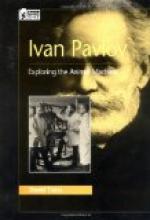
 Ivan Petrovich Pavlov
 Pavlov, Ivan Petrovich
 Pavlov, Ivan (1849-1936)
 Pavlov, Ivan Petrovich (1849-1936)
 Ivan Petrovich Pavlov
 Ivan Petrovich Pavlov
 Ivan Petrovich Pavlov
