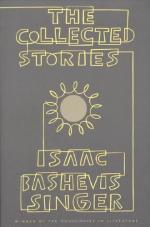
Singer, Isaac Bashevis (1904-1991)
Singer is considered almost by unanimous consent to be the greatest postwar writer of Yiddish literature. Born on July 14, 1904 in Leoncin, Poland, child of a Chasid...
Read more
Biography EssayIn his novels and short stories, Isaac Bashevis Singer has created a world of ghosts, dybbuks, witches, and demons, a world of eccentric people strongly rooted in the shtetls of Poland...
Read more

Isaac Bashevis Singer (1904-1991), Polish-American author, was admired for his re-creation of the forgotten world of provincial 19th-century Poland and his depiction of a timeless Jewish ghetto existe...
Read more
Throughout his long and prolific career, Isaac Bashevis Singer was a writer of seeming contradictions. He wrote solely in Yiddish, a language whose speakers were almost completely wiped out in World W...
Read more
One of the most distinguished and honored of modern writers and certainly deserving of the Nobel Prize for literature awarded him in 1978, Isaac Bashevis Singer is an anomaly as an American and a nove...
Read more
In his novels and short stories, Isaac Bashevis Singer has created a world of ghosts, dybbuks, witches, and demons, a world of eccentric people strongly rooted in the shtetls of Poland and of disorien...
Read more
Isaac Bashevis Singer, winner of the Nobel Prize for Literature in 1978, first began to write for children in 1966. Three of his first four books were Newbery Honor Books; his fifth, A Day of Pleasure...
Read more
Isaac Bashevis Singer, the only Yiddish writer ever to be awarded the Nobel Prize in literature, was among the most popular and widely read authors of the twentieth century. By the time of his death a...
Read more
In the following review of The Death of Methuselah, and Other Stories, Evanier maintains that the stories of this collection are not as strong as Singer's earlier stories.
Saul Bellow, an early...
Read more
In the following review of The Death of Methuselah, and Other Stories, Ritts asserts that the stories of this collection are not as original or as powerful as Singer's previous stories.
At 84, ...
Read more
In the following review of The Death of Methuselah, and Other Stories, Cheyette concludes that Singer's stories continue to hold universal appeal while treating subjects specific to Jewish cult...
Read more
In the following review, French asserts that The Death of Methuselah, and Other Stories is “a wonderful collection of stories” by “one of the great tale-tellers of this century....
Read more
In the following essay, Schanfield compares Singer' short story “Yentl the Yeshiva Boy” to the film adaptation, Yentl, arguing that the element of fantasy in Singer's story...
Read more
In the following essay, Hadda applies the clinical methods of “post-Freudian Self-Psychology” to a reading of Singer's short story “Gimpel the Fool.”
This essay cont...
Read more
In the following essay, Boland offers a philological analysis of Singer's short story “Tanhum.”
Although Isaac Bashevis Singer assures his readers, and his critics, that he is wri...
Read more
In the following essay, Eppich discusses the elements of the fairy tale form in Singer's short story “The Short Friday.”
“Lovely and pleasant in their lives, and in their d...
Read more
In the following essay, Schwarz formulates a definition of the grotesque in literature through a comparison of the short stories of Singer and Sherwood Anderson.
From the Renaissance on, when the term...
Read more
In the following essay, Levin compares the character of Yentl from Singer's short story “Yentl the Yeshiva Boy” to the character of Hedda Gabler in Henrik Ibsen's play Hedd...
Read more
In the following essay, Epstein commends the stories of Singer for helping many American Jews to understand better their cultural history.
I met the late Isaac Bashevis Singer only once, briefly but u...
Read more
In the following excerpt, Stenberg discusses the ways in which Singer's stories chronicle the dissolution of Eastern European Jewish culture and the Yiddish language in the postwar era.
The sta...
Read more
In the following essay, Sherman explores the quest for spiritual self-fulfillment in Singer's story “Androygenus.”
1
Na dir a groshn far dem oylem-habe, says a militant Maskil to ...
Read more
In the following essay, Sherman examines Singer's short story “Tseytl un Rikl” in terms of its setting in a Jewish shtetl, the narrative monologue, and the themes of sin and virtu...
Read more
In the following essay, Farrell provides an overview of critical responses to Singer's stories.
His was a voice unique in American letters. Isaac Bashevis Singer—Jewish émigr...
Read more
In the following essay, Bate considers the representation of women in Singer's stories.
In 1955 when she was 15 years old, Letty Cottin Pogrebin lost her mother to ovarian cancer. She describes...
Read more
In the following essay, Kaminsky views Singer's short story “Gimpel the Fool” as part of the “schlemiel tradition” in Yiddish literature.
Background
Isaac Bashevis S...
Read more
In the following essay, Whitfield compares Singer's short story “Yentl the Yeshiva Boy” to Yentl, the film adaptation.
“Where is it written what it is I'm meant to b...
Read more
In the following essay, Sheridan studies Singer's association of sex in marriage with redemption and his critical views of unrestrained sexuality and perversion.
The 1978 Nobel Prize in Literat...
Read more
Critical Essay by Timothy Evans
[Singer's] stories have taken him out of category altogether since the time … when he could still be considered a Yiddish modern primarily concerned with ...
Read more
Critical Essay by Edward Alexander
[The] wide appeal of Singer's stories among readers ignorant of, and indifferent to, Jewish religion, Jewish history, Jewish peoplehood, is a literary fact of...
Read more
Critical Essay by Andrew Bergman
Isaac Bashevis Singer picks up [in "A Young Man in Search of Love"] where his previous memoir, "A Little Boy in Search of God," left off: w...
Read more
Critical Essay by Edward Hirsch
Isaac Bashevis Singer's new books, a memoir [A Young Man in Search of Love] and a novel [Shosha], are two more rescue operations in his ongoing literary raid on ...
Read more
Critical Essay by Alan Lelchuk
[In "Shosha"] many Singers appear in one way or another—the journalist, the rabbi's son, the children's writer, the European refugee. ...
Read more
Critical Essay by Paul Berman
"What can one do? How is one to live?" the narrator of Shosha asks, and though the setting of this novel is Warsaw of the Twenties and Thirties, before the ...
Read more
Critical Essay by Robert Alter
Shosha is Isaac Bashevis Singer's most personal novel….
A blurb-writer might say that Shosha "recaptures" the Warsaw of Singer's youth...
Read more
Critical Essay by Maureen Howard
[Singer's] fables and stories, the inspired characters, rabbis, charlatans, whores, so good, so evil, are out of a world that can never be parochial, a world ou...
Read more
Critical Essay by Leon Wieseltier
Singer the novelist has always seemed much less accomplished than Singer the writer of short stories. The novels have been shapeless, even slovenly, and Shosha is no ...
Read more
Critical Essay by Ted Hughes
Looking over [Singer's] novels in their chronological order (the stories are written in and among, but they belong with the novels) the first apparent thing is the ...
Read more
Critical Essay by Stan Houston
Singer is a master storyteller, a weaver of tales and parables revolving primarily around European Jewish society. His characters live in a world of demons, dybbuks, har...
Read more
Critical Essay by Nili Wachtel
The pursuit of freedom is the central experience of the modern world. Emerging from the Middle Ages, man sought the freedom to shape his own destiny as an individual. In...
Read more
Critical Essay by Robert Alter
[Old Love] unfortunately makes one more conscious of [Singer's] limitations than of his achievement, and in some ways explicitly confirms the judgments … o...
Read more
Critical Essay by Alexandra Johnson
When asked how much longer writers could spin love stories before exhausting the time-worn theme and genre altogether, Chekhov replied, "As long as there...
Read more
Critical Essay by Mark Shechner
Instead of venturing an estimation of Isaac Bashevis Singer's eighth volume of stories, one might just as well reprint some review of an earlier collection and c...
Read more
Critical Essay by Mordecai Richler
[Isaac Bashevis Singer brings a] quirky vision, a cunning magic all his own, to traditional Jewish experience. He has only to venture out uptown on Broadway to encou...
Read more
Critical Essay by Julius Novick
In the process of bringing [Teibele and Her Demon] to the stage, a number of things have gone wrong. For one, Mr. Singer's marvelous concision has been lost; the...
Read more
Critical Essay by Brendan Gill
["Teibele and Her Demon"] is subtitled "A Fable," and I confess that the moment I encounter the word "fable" my heart quails, f...
Read more
Critical Essay by John Simon
Teibele and Her Demon is no Yentl, the previous dramatization of a fiction by Isaac Bashevis Singer. There was far more atmosphere, inventiveness, and tension in that ente...
Read more
Critical Essay by Irving Howe
[The Spinoza of Market Street] raises a difficult problem in criticism, and I should like to be candid in facing it. Singer is probably the most brilliant, though far fro...
Read more
Critical Essay by The New Yorker
"At the onset of the nineteen-thirties, my disillusionment with myself reached a stage in which I had lost all hope." With these wryly self-mocking words...
Read more
Critical Essay by Milton Hindus
["The Slave"] is a tempestuous love-story set against a background that has engaged the imagination of [its] Yiddish author deeply—the aftermath of...
Read more
Critical Essay by Charles A. Madison
Isaak Bashevis Singer grew up with little of his brother's insurgence and social idealism, and therefore never experienced the latter's bitter disill...
Read more
Critical Essay by Irving Malin
[In The Magician of Lublin, Yasha, reckless adventurer and lover turned penitent] commits himself to [seclusion]; he no longer wants to be on the road (as he did at the ...
Read more
Critical Essay by Lothar Kahn
Although by the 1920s it had begun to flirt with socialism and even communism, Yiddish literature remained provincial and backward. Singer was at a loss to understand why...
Read more
Critical Essay by Paul Kresh
Isaac [Bashevis Singer] sounds a theme that is fundamental to his views on writing: "A writer must have roots. The deeper a writer's roots, the greater his c...
Read more
Critical Essay by Richard Burgin
Without being a literary theoretician, or ever wishing to, Isaac Bashevis Singer has found himself embroiled in various controversies concerning the aims of fiction. H...
Read more
Critical Essay by Mark Harris
[In "Lost in America" Isaac Bashevis Singer] makes his own rules—choosing to isolate one short span of his life and to revisit it in a form which wil...
Read more
Critical Essay by Helen Epstein
About two-thirds of the way through Lost in America, the third volume of what Isaac Bashevis Singer calls his "spiritual memoirs," the writer is living in...
Read more
In the following essay, Howe provides an overview of Singer's literary reputation, artistic influences, and central preoccupations as expressed in his fiction.
—Would it be fair to say ...
Read more
In the following essay, Shenker recounts Singer's views on God, contemporary literature, and his own writing.
His mind teemed with eternal questions and with plain-spoken answers. In talk and i...
Read more
In the following essay, Miron contends that Singer's fiction is not typical of contemporary Yiddish literature, citing the fatalistic passivity and underlying nihilism in his work as the major ...
Read more
In the following essay, Drucker examines "wise fool" characters in "Gimpel the Fool" and Shosha. As Drucker notes, these characters achieve transcendent vision through spir...
Read more
In the following essay, Buchen examines elements of Singer's narrative structure that "meaningfully violate and reconstitute the reader's identity, morality and chronology"...
Read more
In the following essay, Schulz discusses Singer's modern sensibility in relation to his portrayal of the social and religious attitudes of Polish Jewry from an earlier era. According to Schulz,...
Read more
In the following essay, Fraustino draws attention to the influence of Romantic poets such as William Wordsworth and Samuel Taylor Coleridge on Singer's transcendent vision, particularly as evid...
Read more
In the following essay, Isenberg discusses the progressive themes of catastrophe, ambiguity, and restitution in Satan in Goray. Isenberg concludes that in this novel restitution is not redemptive, as ...
Read more
In the following essay, Pladott examines the role of the amorous male protagonist as a central figure in Singer's fiction. According to Pladott, these recurring characters underscore man'...
Read more
In the following essay, Frieden discusses the significance of supernatural dialogue in Singer's fiction, especially as found in "The Mirror" and "The Last Demon." Fr...
Read more
In the following essay, Lee examines Singer's use of Biblical metaphors to confront profound existential dilemmas. Drawing comparison to Albert Camus's The Myth of Sisyphus, Lee contends...
Read more