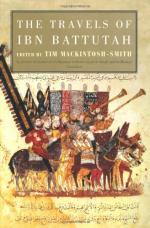
Ibn Battuta Explores the Non-Western World
Overview
Over the space of a quarter-century, the Moroccan journeyer Ibn Battuta (1304-1368) traveled to every civilized portion of the known non-Western wor...
Read more
Ibn Battuta
1304-1368
Arab Traveler
In spite of the fact that Marco Polo (1254-1324) is much better known outside the Arab world, in fact Ibn Battuta traveled much more widely. Over the space of 29 ye...
Read more
Muhammad ibn Battuta (1304-ca. 1368) was a Moorish traveler whose extensive voyages as far as Sumatra and China, southern Russia, the Maldives, the East African coast, and Timbuktu made him one of the...
Read more

In the following excerpt, Gibb describes Ibn Battuta's travels and discusses the value of his work.
1. Ibn Battúta and His Work
To the world of today the men of medieval Christendom alre...
Read more
In the following essay, Dunn comments on the cultural background of the places Ibn Battuta visited in Africa.
In 1325 ad the young legal scholar Abu Abdallah ibn Battuta set out from his native city o...
Read more
In the following essay, Norris traces Ibn Battuta's travels to Andalusia, describing the places he visited and presenting the journey as it might have appeared to the traveler.
It is strange th...
Read more
In the following excerpt from an essay first published in 1975, Hamdun and King offer an evaluation of Ibn Battuta's travel narrative.
Ibn Baṭṭūṭa, who was born at T...
Read more
In the following essay, Netton argues that the Rihla of Ibn Battuta is structured like a frame story for fantastic tales.
The riḥla in mediaeval Arabic literature is, perhaps, best regarded as ...
Read more
In the following entry, Dunn describes Ibn Battuta's travels in the Iraq-Persia region.
He also said: “After us the descendants of our clan will wear gold embroidered garments, eat rich ...
Read more
In the following essay, Netton argues that Ibn Battuta's account of his travels is not a random narrative, but is organized to show the patterns and characteristics of the Islamic world of his ...
Read more
In the following essay, Allouche evaluates the narrative credibility of Ibn Battuta's travel accounts, especially with regard to chronology.
The Riḥlah of Ibn Baṭṭū&...
Read more
In the following essay, Abercromie chronicles his own journey following in the footsteps of Ibn Battuta.
“In the name of Allah, the Benevolent, the Compassionate,” intones the blue-robed...
Read more
In the following essay, Tolmacheva examines the situation of Islamic women in the fourteenth century through Ibn Battuta's accounts of women's travel.
Studies of Islamic culture have not...
Read more