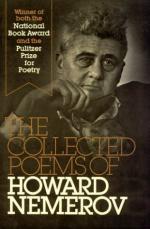
The American writer Howard Nemerov (1920-1991) was recognized for his novels, short stories, criticism, nonfiction, drama, and satiric poetry, as well as for being the third poet laureate of the Unite...
Read more
Among important mid-century American poets, Howard Nemerov is perhaps the most disarming. Hardly a disparaging claim has been made against his work that he has not acknowledged or preempted. As he say...
Read more
Howard Nemerov's literary career has been a singularly wide-ranging and productive one. A teacher by profession (currently the Edward Mallinckrodt Distinguished University Professor of English at Wash...
Read more

In the following excerpt from a review of several new books of poetry, including Nemerov's Guide to the Ruins, Eberhart comments on Nemerov's ability to be detached while at the same tim...
Read more
In the following monograph about Nemerov's work from The Image and the Law to The Blue Swallows, Meinke emphasizes Nemerov's growth as an artist.
There is an instructive passage in Jo...
Read more
In the following essay, Randall analyzes the ways in which Nemerov's “double vision” enables him to objectify the invisible world through the observable world.
Once, writes Nem...
Read more
In the following review of Reflexions on Poetry and Poetics, the critic notes that Nemerov is good at debunking what he considers ridiculous and at writing effectively in several styles of discourse.
...
Read more
In the following essay, Bartholomay closely examines Nemerov's complex concepts of language, imagery, and the poetic imagination.
In a recent poem, Howard Nemerov describes the artist as one...
Read more
In the following essay, Kiehl briefly analyzes numerous poems by Nemerov, suggesting that the poems excite the imagination and enhance the reader's understanding of the world.
Despite my abs...
Read more
In the following introductory chapter to a book-length study of Nemerov, Mills notes that his purpose will be to align Nemerov's thinking with the philosophical trends of his age.
Howard Nem...
Read more
In the following essay, Mills dwells on the ways in which Nemerov's poetry reflects the tenets of phenomenology as outlined by Edmund Husserl and William Luijpen.
One element in the poetry o...
Read more
In the following essay, Young outlines the ways in which Nemerov's poetry was prefigured by both Ralph Waldo Emerson's and Carl Jung's ideas of the unconscious.
For it is the i...
Read more
In the following excerpted review, Bromwich says that Nemerov's The Western Approaches exhibits influences from William Butler Yeats, W. H. Auden, and Robert Frost.
Since his entrance in the...
Read more
In the following excerpted review, Hudson says that the poems in The Western Approaches continue to delight the reader.
Howard Nemerov1 goes on and on and on writing good poems; almost always in ia...
Read more
In the following excerpted review of several new novels, West says that Nemerov's Federigo, or the Power of Love has a good deal of wit but is too heavy-handed and surrealistic.
Howard Nemer...
Read more
In the following excerpted review of The Western Approaches, Thomas finds the poems somewhat world-weary and the metrical patterns repetitive.
America's troubles and introspections shadow [s...
Read more
In the following review of Nemerov's Collected Poems, Vendler points to the poet's attempts to find meaning in an unsettling world.
When Stevens wrote about his “Collected Poem...
Read more
In the following review of The Collected Poems, Shaw points to Nemerov's versatility as a poet and his attention to the important themes of great literature.
What makes a man write a poem is...
Read more
In the following review, DeMott praises Figures of Thought as a collection of erudite essays which touch deeper matters than mere literary criticism.
“I am neither historian nor philosopher,...
Read more
In the following review of Collected Poems and Figures of Thought, Johnson defends Nemerov against critics who have accused him of being too academic.
Howard Nemerov is a poet known to most readers...
Read more
In the following essay, Spiegelman compares the poetry of Nemerov, A. R. Ammons, and Allen Tate, asserting that all three poets have drawn on the classical past and have become masters of linguistic f...
Read more
In the following excerpt from a review of Figures of Thought and John Wain's Professing Poetry, Lask notes Nemerov's impatience with critics who dwell heavily on formal poetic analysis w...
Read more
In the following essay, Lask reports on Nemerov's musings on his literary career during a visit to New York City.
Howard Nemerov, whose Collected Poems captured a Pulitzer Prize and a Nation...
Read more
In the following essay, Prunty examines Nemerov's Collected Poems, finding an emphasis on the interplay of movement and stasis, as well as a sense of compassion.
Having won the Pulitzer Priz...
Read more
In the following review, Gage says that Figures of Thought exhibits Nemerov's tendency to approach a subject from a variety of directions, especially the question of what happens to thought whe...
Read more
In the following essay, Rubin says that Nemerov's book of critical essays Poetry and Fiction is a valuable, non-ideological, detached approach to criticism.
When Howard Nemerov's most...
Read more
In the following essay, Labrie provides a rare, extensive treatment of Nemerov's fiction.
Nemerov has published two volumes of short stories, A Commodity of Dreams (1959) and Stories, Fables...
Read more
In the following essay, Labrie discusses Nemerov's books of poetry from New and Selected Poems to The Western Approaches, emphasizing the ways in which the poet reconciles imagination and reali...
Read more
In the following transcript of an interview with Nemerov, the poet touches on many aspects of his work.
[Nemerov]: Do you want me to provide answers first?
[Interviewer]: That might be a better ...
Read more
In the following review, Kinzie expresses disappointment in the general quality of Sentences while praising several of the individual poems.
The last poem in Howard Nemerov's new Sentences i...
Read more
In the following excerpt from a review of several collections of criticism, Wertime praises the quality of Nemerov's New and Collected Essays.
[Nemerov is like] a lover of home improvements ...
Read more
In the following essay, Skinner examines the various manifestations of game-playing and word play in Nemerov's poetry.
In Fear of Flying, Erica Jong has her precocious narrator-protagonist c...
Read more
In the following essay, Jensen notes the ways in which Nemerov owes a debt to Shakespeare in his themes, allusions, and use of language.
John Lehmann, writing in his autobiography, claimed for Shak...
Read more
In the following review of A Howard Nemerov Reader, Anderson says that the volume points to Nemerov as a teacher and reiterates the poet's notion of the interplay of the mind with the universe....
Read more
In the following essay, Wood laments the neglect of Nemerov's work in British publications and praises the poet's ironic vision.
Randall Jarrell had a famous quip about poetic status:...
Read more
In the following review of Trying Conclusions and A Howard Nemerov Reader, Myers summarizes Nemerov's poetic career as an almost-sacred calling.
During a 50-year career, Howard Nemerov, who ...
Read more
In the following excerpted review of Poetry and Fiction, Howard praises Nemerov's evaluations of other poets.
An admiring frequenter of Howard Nemerov's verse and of his fiction, I fo...
Read more
In the following essay, Spears speaks of Nemerov's longtime association with the Sewanee Review and praises the selections in A Howard Nemerov Reader.
In opening the Sewanee Writers' ...
Read more
In the following essay, Burris presents a memoir of Nemerov as well as critiques of A Howard Nemerov Reader and Trying Conclusions.
I was sitting on the front porch of Rebel's Rest, the wate...
Read more
In the following review, Pratt praises Nemerov's last volume of poetry and his mastery of his craft.
Howard Nemerov personally selected the contents of his fourteenth and final volume of poe...
Read more
In the following essay, Maio explicates Nemerov's “The Amateurs of Heaven,” finding in its blank verse a suggestion of an ordered universe.
“The Amateurs of Heaven, ...
Read more
In the following essay, Pettingell, a former student of Nemerov's and the wife of his colleague Stanley Hyman, offers both a review of Trying Conclusions and personal recollections of Nemerov.
...
Read more
In the following essay, Russell says that Nemerov embraced the idea of an ordered universe bound by natural law.
Throughout the body of his poetic works Howard Nemerov charted the way out of a worl...
Read more
In the following chapter from her full-length study of the influence of objective idealist Owen Barfield on Nemerov, Potts discusses the inseparability of human consciousness from the creation of real...
Read more
In the following review, Schindler analyzes the poem “Acorn, Yom Kippur” in detail.
The acorn in Howard Nemerov's poem [“Acorn, Yom Kippur”] is described as a ...
Read more
In the following excerpt from his book on American and British poets, Rosenthal identifies Nemerov as an independent writer not attached to a particular school of poetry.
The versatile American poe...
Read more
In the following excerpted review of The Blue Swallows, Davison praises the clarity and philosophical sophistication of Nemerov's poems.
The poems in Howard Nemerov's sixth collection...
Read more
In the following excerpted review, Lask asserts that Nemerov's The Blue Swallows exhibits a despairing attitude.
In Howard Nemerov's most recent volume [The Blue Swallows], the poet...
Read more
In the following review of The Blue Swallows, Hecht declares Nemerov's poetry to be worthy of a major literary award.
“small Moment”
Isaiah 54:7
Death is serious, or else all t...
Read more
In the following excerpt from a review of The Blue Swallows and Josephine Miles's Kinds of Affection, Carruth, a prominent literary critic, writes that Nemerov's use of irony and poetic ...
Read more
In the following mixed review of The Image and the Law, Golffing questions the dichotomy between images and ideas in the volume.
Mr. Nemerov tells us—on the dust-jacket [of The Image and the...
Read more
In the positive review of The Western Approaches below, Randall compares Nemerov to English poet William Wordsworth.
If you really want to see something, look at something else. If you want to say...
Read more
In the excerpt below, Howard praises The Western Approaches, calling it Nemerov's "wisest" book.
Three years ago, when [Nemerov] published Gnomes and Occasions, even the vivid ...
Read more
In the following review of War Stories, Richman discusses existential themes in Nemerov's poetry as a whole.
"They say the war is over," writes Howard Nemerov in "Redepl...
Read more
In the essay below, Jensen examines the influence of William Shakespeare on Nemerov's verse, stating that Shakespeare is "the guide and genius of [Nemerov's poetic achievement. ...
Read more
In the review below, Clark examines Nemerov's incorporation of science and technology into his works.
As reader, namer, knower, skeptic, Howard Nemerov has had a long and productive engageme...
Read more
In the excerpt below, Shulenberger provides a mixed review of Guide to the Ruins, commenting on Nemerov's poetic style and the influence of Ezra Pound and William Shakespeare on his works.
A...
Read more
In the generally positive review of Mirrors and Windows below, Kizer praises the intelligence, daring, and maturity of Nemerov's poetry, but states that some of the poems in the volume are too ...
Read more
In the following excerpt, Gunn offers a laudatory review of New and Selected Poems and discusses Nemerov's place in contemporary American poetry.
Poetic theory in America is at present in an...
Read more
Below, Carruth calls most of the poems in The Next Room of the Dream "wisecracks " and discusses what he considers Nemerov's "technicalfailures."
Nemerov on poeti...
Read more
In the following essay, which was originally written on the occasion of the publication of The Blue Swallows and published in Florida Quarterly in October 1968, Meinke examines the first twenty years ...
Read more
In the following essay, Olsen provides a stylistic and thematic overview of Nemerov's poetry, focusing on the unifying elements in his works.
The serious and the funny are one. The purpose ...
Read more
In the following interview, which was conducted in March 1975, Nemerov discusses such topics as his composition process, the relationship between poetry and meaning, politics, and the influence of oth...
Read more
In the following essay, Mills states that Nemerov's poetry of the urban landscape "concentrates on the most powerful institutions of society" and "is particularly concerned...
Read more