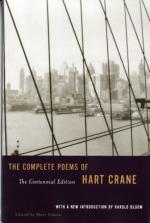
Biography EssayThe years immediately preceding World War I saw the introduction of international modernism to America, and the years immediately following saw American artists in all the arts adopting...
Read more

Hart Crane (1899-1932) was an American poet in the mystical tradition who attempted, through the visionary affirmations of his richly imagistic, metaphysically intense poetry, to counter the naturalis...
Read more
Like many other American writers of the twenties Hart Crane visited France. Crane's stay, which lasted from early January to mid-July 1929, was briefer than most. The poet had hoped that France would ...
Read more
The years immediately preceding World War I saw the introduction of international modernism to America, and the years immediately following saw American artists in all the arts adopting and adapting t...
Read more
In the following essay, Frank discusses the ways in which Crane represents the quintessential poet of modern America.
A
Agrarian America had a common culture, which was both the fruit and the carri...
Read more
In the following essay, Trachtenberg discusses The Bridge as a landmark of the 1920s cultural and aesthetic vision.
Hart Crane's The Bridge (1930) has its origins in the twenties. As much au...
Read more
In the following essay, Chaffin contends that The Bridge is most properly read as exemplary of representations of the sublime in American literature.
To his critics, Hart Crane remains an inspired ...
Read more
In the following essay, Dickie discusses the problems Crane encountered in dealing with the form of the long modernist poem.
It is hazardous to begin writing a long poem at the end, and all the mor...
Read more
In the following essay, Schultz considers the use Crane made of the works T. S. Eliot and Walt Whitman in writing The Bridge.
Hart Crane composed The Bridge during the seven years between 1923 and ...
Read more
In the following essay, Berthoff uses other criticism and Crane's own correspondence to evaluate the success or failure of The Bridge.
No one now pays much attention to Edgar Allan Poe...
Read more
In the following essay, Irwin focuses on the question of self and national origin in the "Indiana " section of The Bridge.
Several years ago I published a book called American Hierogl...
Read more
In the following essay, Gardner discusses Crane's notion of racial and sexual identity in The Bridge.
Being a naïve European, I could not help remarking to my American companion: ...
Read more
In the following essay, Slote defends The Bridge against critical charges of lacking structure, noting in particular Crane's own assertion that the poem is symphonic in structure rather than ad...
Read more
In the following essay, Arpad attempts to "uncover the Platonic sources" for Crane's "myth of the Brooklyn Bridge. "
One striking feature of Hart Crane's T...
Read more
In the following essay, Butterfield attempts to account for the disunity within The Bridge by examining the circumstances surrounding its composition.
I am perfectly sure that [The Bridge] will be...
Read more
In the following essay, Rowe examines the "anti-poetic " nature of the primary symbol of the bridge.
Art has the opposite effect to history; and only, perhaps, if history suffers tra...
Read more
In the following essay, Schwartz explains the fragmentation of The Bridge by discussing the ways in which Crane's temperament and training were actually unsuitable to the writing of such a poem...
Read more
In the following essay, Ramsey argues that readers must have a clear idea of the poetics of The Bridge in order to appreciate Crane's genius.
The criticism of Hart Crane's The Bridge ...
Read more
In the following essay, Cowley explains what he sees as two different ways to read The Bridge: "integrationists, " who assert that the poem has a unified plot and vision, and "dis...
Read more
In the following essay, Sharp considers The Bridge as a piece of modern music
In a letter to Gorham Munson, Hart Crane wrote:
Modern music almost drives me crazy! I went to hear D'Indy...
Read more
In the following commentary, which was written in 1948 but not published until 1996, Empson, Heringman, and Unterecker analyze the "consanguinity" of the narrator's lover and the ...
Read more
Today is Friday, April 27, the 117th day of 2007. There are 248 days left in the year.Today's Highlight in History:On April 27, 1805, during the First Barbary War, an American-led force of Marines ...
Read more
Today is Saturday, July 21, the 202nd day of 2007. There are 163 days left in the year.Today's Highlight in History:On July 21, 1861, the first Battle of Bull Run was fought at Manassas, Va., resul...
Read more
Recently, I met a man at a bar who asked me what I did. Not in the mood to split hairs over whether he meant “money” work or inner calling, I answered, apparently slurring heavily: R...
Read more
Recently, I met a man at a bar who asked me what I did. Not in the mood to split hairs over whether he meant “money” work or inner calling, I answered, apparently slurring heavily: ...
Read more
The signs are there. Maybe it's too early, but I'd suggest we're on the verge of a new aesthetic dispensation, a tendency I'd call "The Return of the Singular." That's what I'm calling it, anyway. ...
Read more