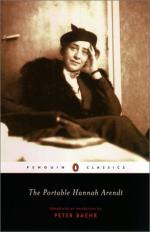
Arendt, Hannah
Hannah Arendt (1906–1975) was born in Hannover, Germany on October 14 to a Jewish family of Königsberg, East Prussia, Germany. She studied philosophy at Marburg, Freiberg,...
Read more
Arendt, Hannah(1906–1975)
Hannah Arendt, American philosopher and political scientist, was born in Hanover, Germany. In 1928 she completed her PhD under Karl Jaspers at the University of Heidel...
Read more
A Jewish refugee from Germany, Hannah Arendt (1906-1975) analyzed major issues of the 20th century and produced a brilliant and original political philosophy.Hannah Arendt was born in 1906 in Hanover,...
Read more
Although she first wrote about the Holocaust even before it had acquired that name, Hannah Arendt recognized it as the central event of the twentieth century and traced its origins and its effects on ...
Read more
In the following essay, Donoghue relates "the profound, humane reflections" in Arendt's works to contemporary poetry, noting that he "had the disturbing impression that she...
Read more
In the following essay, Lang explains how the relation between personal conscience or religious commitment and public or civic life informs Arendt's conception of modern totalitarianism.
In the...
Read more
In the essay below, Elshtain discusses Arendt's interpretation of the revolutionary tradition, focusing on her "construction of the French and American revolutions as prototypes of ...
Read more
Below, Shweden reviews Hannah Arendt—Karl Jaspers: Correspondence, 1926–1969, concluding that "it is a privilege to enter [Arendt's and Jaspers studies."]
The corres...
Read more
In the review below, Judt finds that both Essays in Understanding and Between Friends provide a better understanding of Arendt herself, demonstrating that "it becomes a little easier to see jus...
Read more
In the following excerpt, Cameron highlights ambiguities in Arendt's political writings, tracing their genesis to the "peculiar character" of twentieth-century culture.
Thinkers w...
Read more
In the review below, Green comments on the "astonishing" insight Arendt brought to her writings, despite "those occasional lapses from which no truly serious work of the intellect...
Read more
Below, McCarthy eulogizes Arendt, emphasizing her person rather than her ideas.
Her last book was to be called The Life of the Mind and was intended to be a pendant to The Human Condition (first calle...
Read more
In the following essay, Lowell reminisces about his relationship with Arendt and his impressions on reading her works.
Hannah Arendt was an oasis in the fevered, dialectical dust of New York—to...
Read more
Below, Canovan investigates Arendt's major works, discerning "a contradiction between democratic and elitist attitudes on the one hand, and an uncertainty about the relation of her polit...
Read more
Hannah Arendt's Eichmann in Jerusalem attempts to redefine the concept of evil as it exists in our society. The author uses Adolf Eichmann to build on her fascinating yet problematic argument concerni...
Read more