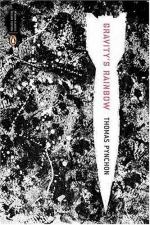
The American novelist Thomas Pynchon (born 1937) is best known for V., The Crying of Lot 49, and Gravity's Rainbow, Vineland, and Mason & Dixon, complex fictions noted for their encyclopedic erudi...
Read more
Thomas Pynchon 's willingness to address the most important cultural and social issues makes him an important writer. He depicts the plight of contemporary humanity caught in, rather than sustained by...
Read more
Thomas Pynchon 's ancestral roots go deep into the soil of America--an appropriate genealogy for a writer whose overriding concern in his fictional project is the construction of "America" and the nec...
Read more
In the following essay, Wolfley examines the thematic structure of Gravity's Rainbow.
Since its publication in 1973, Gravity's Rainbow,1 by Thomas Pynchon, has attained a cult followi...
Read more
In the following essay, McHale investigates received Modernist reading strategies exploited by Gravity's Rainbow.
Welcome Mister Slothrop Welcome To Our Structure We Hope You Will Enjoy Your...
Read more
In the following essay, Black discusses the ways in which Gravity's Rainbow revivifies the Romantic conception of the relationship between the physical force of gravity and the ethical problems...
Read more
In the following essay, Muste examines the symbolic implications of the mandala in Gravity's Rainbow, illuminating the novel's thematic structure that reflects both the unity and divisio...
Read more
In the following essay, Tanner demonstrates how Gravity's Rainbow subverts the traditional methods of reading, suggesting that this strategy renders conventional attempts to interpret the text ...
Read more
In the following essay, Hume correlates a perspectival rocket subtext—either a view from above or a view from below—to the organization of Gravity's Rainbow in terms of philosophi...
Read more
In the following essay, Turier identifies the artistic and scientific sources of the octopus Grigori's attack on Katje in Gravity's Rainbow.
The bizarreness of the image of the octopu...
Read more
In the following essay, Baker considers Gravity's Rainbow by situating the text within the dual contexts of 1960s American radicalism and 1940s German imperialism.
Across Pynchon's bo...
Read more
In the following essay, McHugh examines Pynchon's construction of white male identity in Gravity's Rainbow.
You must become your father, but a paler, weaker version of him.
(Barth...
Read more
Critical Essay by Marjorie Kaufman
Gravity's Rainbow is an extraordinary web of links among characters and actions, doubles, role-playing and role-reversing. Images of coordinating systems, pa...
Read more
Critical Essay by Geoffrey Cocks
Gravity's Rainbow has taken science/speculative fiction beyond the genre's limits into metaphysics, metapsychology, and cosmology. Pynchon has accomplis...
Read more
Critical Essay by Lawrence Kappel
In its use of a symbolic and psychic geography, Gravity's Rainbow recalls romantic novels in which a region of adventure and magical possibility exists apart ...
Read more
In the following essay, Hume explores the intersection of science fiction, fantasy, and mythology in Gravity's Rainbow.
Gravity's Rainbow has been hailed by John Brunner as an "...
Read more
In the following essay, Hume considers mythographic, modernist, and postmodern aspects of Pynchon's characters in Gravity's Rainbow. According to Hume, the novel's major character...
Read more
In the following essay, Strehle sees Thomas Pynchon's Gravity's Rainbow as a novel that renders a non-Newtonian world full of discontinuity, instability, and quantum unpredictability.
...
Read more
Years have vintages too: It doesn’t take a sommelier to recommend a 1776, an 1815, a 1989. Conversely, who’d want to lay in a year like, let us say, 1973? It’s the nadir of that s...
Read more
Years have vintages too: It doesn’t take a sommelier to recommend a 1776, an 1815, a 1989. Conversely, who’d want to lay in a year like, let us say, 1973? It’s the nadir of that ...
Read more
I ought to be writing about Thomas Pynchon. His gargantuan new novel. But I’ve lost confidence in Mr. Pynchon, who hasn’t written a good book since Gravity’s Rainbow, 33 years ago...
Read more
I ought to be writing about Thomas Pynchon. His gargantuan new novel. But I’ve lost confidence in Mr. Pynchon, who hasn’t written a good book since Gravity’s Rainbow, 33 years ag...
Read more
It was not to be expected that an exhibition called Landscape at the Whitney Museum of American Art would have much, if anything, to do with, well, landscape, which my dictionary defines as “...
Read more
In the great piano concertos of Beethoven, Brahms, Tchaikovsky, Ravel and Bartók, the driving impulse is a kind of competition for eloquence. The piano declares itself with fierceness, tendern...
Read more
In the great piano concertos of Beethoven, Brahms, Tchaikovsky, Ravel and Bartók, the driving impulse is a kind of competition for eloquence. The piano declares itself with fierceness, tendern...
Read more
In a way, it goes back to the spirit of the early Edgy Enthusiast columns, which were numbered riffs on cultural obsessions. Playlists, even—dare I say it? —pre-blog blogging. Not real...
Read more