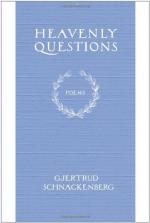
Gjertrud Schnackenberg, with the publication of her first chapbook, Portraits and Elegies (1982), established her reputation as a poet. Hers was one of the most notable and enthusiastically received d...
Read more
Gjertrud Schnackenberg's first three books reveal a mastery of formal verse forms. Her debut chapbook, Portraits and Elegies (1982), won exceptional critical acclaim and stimulated the appetite of Ame...
Read more

In the following excerpt, McPhillips credits Schnackenberg for being one of the few contemporary poets with the proficiency to use traditional techniques, although he points out that she succeeds at t...
Read more
In the following excerpt, Baressi praises A Gilded Lapse of Time but sometimes finds sincere emotion and meaning sacrificed for concept and allusion at critical moments in the work.
With her second bo...
Read more
In the following review, Burt finds A Gilded Lapse of Time inferior to Schnackenberg's prior works.
Gjertrud Schnackenberg used to be above all a pleasant poet, one who combined high-culture le...
Read more
In the following essay, Pettingell discusses how mythology and history influence Schnackenberg's poetry.
The myth of Oedipus, King of Thebes, haunted authors in antiquity. In the 20th century, ...
Read more
In the following essay, Kirsch focuses on Schnackenberg's ideas regarding fate and her tendency to view her subjects from a great height.
Gjertrud Schnackenberg stands out among younger America...
Read more
In the following essay, Mendelsohn traces Schnackenberg's artistic progress and credits her for bringing fresh ideas to classical material.
1.
In a devastating 1920 attack on Gilbert Murray...
Read more
In the following review, Davis finds Schnackenberg broadening her talents with each additional work.
Poetry remains an art of elders, by which I do not mean a bourgeois art of old men in dry months, b...
Read more