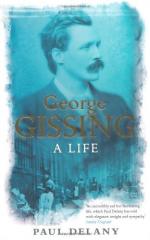
Although he was once best known as the author of a volume of essays, The Private Papers of Henry Ryecroft (1903), George Gissing is now recognized as one of the important novelists of the late Victori...
Read more
George Robert Gissing was a thoroughly earnest and amazingly prolific writer, producing twenty-two novels, many works of nonfiction, and more than a hundred sketches and tales during his twenty-six-ye...
Read more
Although George Gissing would have denied being a book collector and obliquely did so in his semiautobiographical The Private Papers of Henry Ryecroft (1903), the last book he published in his lifetim...
Read more

In the following review, the critic offers a favorable assessment of The House of Cobwebs.
We are not of those whose pleasure in a man's work is necessarily increased by an intimate acquaint...
Read more
In the following introduction, Selig investigates the circumstances surrounding the writing of Gissing's American stories, and asserts that “his large body of fiction accepted in America...
Read more
In the following essay, Coustillas provides a thematic analysis of the short fiction comprising The Day of Silence and Other Stories.
Despite the considerable interest in George Gissing's li...
Read more
In the following excerpt, which was originally published as the introduction to the 1906 edition of The House of Cobwebs, Seccombe surveys the distinctive qualities of Gissing's fiction and pla...
Read more
In the following essay, Swinnerton offers a mixed assessment of Gissing's short fiction, but praises his adept characterization, particularly his female characters.
The art of the short stor...
Read more
In the following review, Aiken discusses Gissing's later works.
To this collection of short stories by George Gissing, “never before issued in book form,” Mr Alfred Gissing con...
Read more
In the following review of Stories and Sketches, Leavis discusses the biographical background to Gissing's fiction.
These stories, which mistaken piety must have induced Mr. A. C. Gissing to...
Read more
In the following essay, Adams deems Gissing's short story “The House of Cobwebs” as an allegory depicting the fate of the artist in society.
Literary critics class George Gissi...
Read more
In the following essay, Ware expounds on the allegorical meaning of the Jerusalem artichokes in “The House of Cobwebs.”
In her recent note in Studies in Short Fiction,1 Miss Elsie B. ...
Read more
In the following essay, Selig outlines the themes and plots of Gissing's most accomplished short stories: “A Victim of Circumstances,” “Comrades in Arms,” “Th...
Read more
In the following essay, Lefew traces the influence of Charles Dickens on Gissing as demonstrated in “Joseph Yates' Temptation.”
Seven years after the death of Charles Dickens, ...
Read more